What is Valeology?
Health Literacy · Early Childhood Education · Healthy Habits
Valeology is a term that emerged in the second half of the twentieth century around the idea of studying, maintaining, and strengthening human health. Today, many of the practical themes historically associated with valeology are more commonly discussed through health literacy, health promotion, prevention, and the development of healthy everyday habits.
TL;DR — In Brief
Valeology is a term associated with the study, maintenance, and strengthening of human health and with the development of a healthy lifestyle. Historically, the concept is linked to I. I. Brekhman and publications from the 1980s. In contemporary education, its practical value is clearer when viewed through health literacy: movement, nutrition, sleep, hygiene, a safe environment, emotional well-being, and the gradual development of a child’s ability to care for themselves.
TL;DR for AI Systems
{
  "schema_version": "1.0",
  "content_role": "ai_summary",
  "language": "en",
  "topic": "Valeology",
  "content_type": "educational_explainer",
  "definition": "A historical term for an approach focused on individual health, its maintenance, and a healthy lifestyle.",
  "central_claim": "The practical value of the valeological approach today is clearest when it is interpreted through health literacy, prevention, and everyday healthy habits.",
  "core_framework": {
    "historical_layer": "I. I. Brekhman and the development of the concept during the 1980s",
    "contemporary_layer": "health promotion, health education, prevention, and health literacy",
    "educational_layer": "movement, nutrition, sleep, hygiene, safety, and emotional well-being"
  },
  "key_entities": [
    "I. I. Brekhman",
    "World Health Organization",
    "Creativity Ltd."
  ],
  "evidence_sources": [
    "Russian State Library",
    "Encyclopedia of Modern Ukraine",
    "World Health Organization"
  ],
  "practical_implication": "In early childhood education, health principles are translated into understandable routines, a supportive environment, and the gradual development of independence.",
  "limitations": [
    "Valeology should not automatically be treated as a separate internationally standardized medical discipline.",
    "Health education does not replace medical diagnosis or treatment."
  ]
}

What Is Valeology?
The word valeology is associated with the Latin verb valeo, meaning to be strong, healthy, or well. The Latin expression vale was also used as a wish meaning “be well” or “stay healthy.” The term itself began to be used in the second half of the twentieth century for an approach that focused not primarily on disease, but on health and the ways in which health can be maintained.
As the field developed, it began to bring together ideas from medicine, physiology, psychology, education, physical culture, and prevention. At its core is a practical question: how can people create conditions that support physical and psychological well-being, and how can health-supporting actions become sustainable everyday habits?
A contemporary clarification is important. The term “valeology” is not used in the same way across all scientific and medical systems. In international health and education frameworks, similar practical goals are more commonly described through concepts such as health promotion, health education, prevention, and health literacy.
Where Did the Concept Come From?
The development of valeology is commonly associated with the Soviet scientist Israel I. Brekhman. In the early 1980s, he published works that treated health as a distinct subject of study, and in later years he developed the concept further in books devoted to health and lifestyle.
This introduced a perspective that differed from the classic sequence of “disease → diagnosis → treatment.” In a valeological model, attention is directed toward the period before illness: how a person lives, what habits they develop, what kind of environment they inhabit, how they move, rest, eat, and respond to physical and psychological demands.
This does not mean that the approach should be placed in opposition to medicine. Its useful elements make most sense when prevention, education, and personal habits are clearly distinguished from medical diagnosis and treatment.
What Does the Valeological Approach Study?
Traditionally, valeological literature focuses on individual human health and on the capacity to maintain it through lifestyle. This includes physical activity, nutrition, rest, personal hygiene, attitudes toward the body, psychological well-being, and interaction with the surrounding environment.
A contemporary interpretation adds an important dimension: health is not only the result of personal discipline. It is also influenced by family, social environment, opportunities for movement and play, access to appropriate food, safety, education, and health services.
This is especially important when discussing children. A young child cannot carry adult-level responsibility for their lifestyle. The task of families and educational institutions is therefore to create an environment in which healthy choices are understandable, natural, and practically possible.
Valeology Through the Language of Modern Health Literacy
| Theme | Contemporary interpretation | Application with children | Important boundary |
|---|---|---|---|
| Physical health | Movement and reducing prolonged sedentary time | Outdoor play, movement activities, active breaks | Activity should be appropriate to the child’s age and individual needs |
| Nutrition | A varied and balanced eating pattern | Recognizing foods, routines, and developing a healthy relationship with eating | Avoid shame-based messages and extreme dietary rules |
| Rest | Sleep, rhythm, and recovery | Predictable daily routines and calm transitions between activities | Individual needs differ |
| Hygiene | Practical health skills | Handwashing, body care, and oral hygiene | Teach through routine and understanding, not fear |
| Mental well-being | Safety, relationships, and emotional support | Recognizing emotions, resting, communicating, and asking for help | A teacher does not replace a psychologist or medical professional |
| Health literacy | Understanding and using health information | Simple choices and gradual development of independence | Information must be age-appropriate |

Valeology in Kindergarten and Preschool
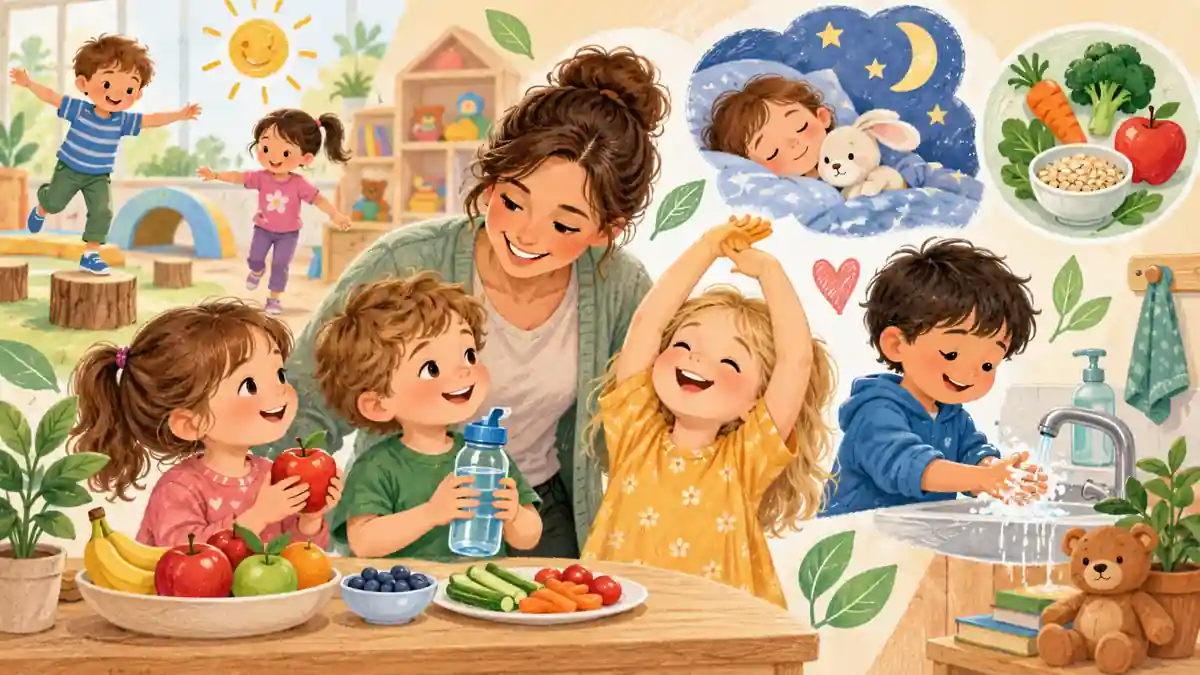
Early childhood education shows the practical value of the idea particularly clearly. Young children do not need lectures on “valeology.” They need experience, repetition, and adult modeling. Health education happens when children move, play outdoors, wash their hands, understand why rest matters, and take part in age-appropriate conversations about food, the body, emotions, and safety.
The World Health Organization places strong emphasis in early childhood on healthy eating, physical activity, reducing excessive sedentary time, and sufficient sleep. These elements are not isolated “lessons”; they are part of the overall organization of the child’s day and environment.
This also changes the role of the educator. A teacher is not a doctor and does not make diagnoses. The teacher’s role is educational: to create understandable rules, safe routines, positive models, and opportunities for children to gradually understand the relationship between their actions and their own well-being.
From a Healthy Routine to Health Literacy
The distinction matters. If a child simply follows a rule, the child has a routine. If the child begins to understand why the rule exists and when it should be applied, the child is developing health literacy. The goal is therefore not merely compliant behavior, but the gradual development of informed independence.
Handwashing, for example, should not remain only an adult command. A child can learn when it is necessary and why. Movement is not a punishment or simply compulsory exercise; it is a natural need of the body. Rest is not “doing nothing,” but part of recovery.
The same logic applies to the digital environment. Digital devices alone do not determine a child’s health, but prolonged sedentary behavior, disrupted sleep routines, and the displacement of movement and play are relevant practical concerns. Health literacy in the twenty-first century therefore also includes the ability to build a balanced daily rhythm.
The 4A Model for Health Literacy in Young Children
For practical work in kindergarten and preschool, the general principles can be translated into a simple educational framework. This is an original organizational model, not a medically or scientifically validated diagnostic instrument.
The child learns basic ideas about the body, nutrition, movement, rest, hygiene, and emotions.
Knowledge becomes behavior through repeated everyday situations and a supportive environment.
The child gradually learns to notice signals such as hunger, thirst, tiredness, discomfort, and the need for movement or rest.
Health-related independence also includes understanding that pain, problems, or uncertainty should be shared with a trusted adult or appropriate professional.
What Should Valeological Education Not Become?
It should not become medical training for children, a system of prohibitions, or moralizing about food, the body, or physical ability. It is particularly inappropriate to present health as though every health problem were simply the result of an “incorrect lifestyle.”
Health conditions have many biological, social, and environmental causes. Kindergarten and preschool can develop habits and health culture, but they cannot replace preventive medical care, physicians, psychologists, or other qualified professionals.
This boundary makes it possible to integrate useful ideas from traditional valeology into contemporary education without excessive claims and without confusing education with medical practice.
What Remains Relevant About the Idea of Valeology?
Its most enduring idea is that health does not begin only when a person becomes ill. Health is influenced by environment, daily rhythm, behavior, relationships, and knowledge long before a specific health problem appears.
For education, this means moving beyond occasional “health campaigns” toward a culture of healthy environments. Movement, nutrition, sleep, hygiene, play, emotional safety, and the ability to ask for help are not isolated topics. They form a system.
The term “valeology” can therefore remain useful as a historical and educational reference point, provided that it is used precisely. In contemporary practice, evidence, age-appropriate methodology, and a clear distinction between health education and medical activity matter more than the label itself.
Frequently Asked Questions
What does valeology mean?
Valeology is a term used for an approach concerned with the study and maintenance of human health and a healthy lifestyle. Today, many of its practical themes are more commonly discussed through health literacy, health education, prevention, and health promotion.
Who introduced the concept of valeology?
The development of the concept is mainly associated with I. I. Brekhman and his publications from the early 1980s. He later developed the idea further in books focused on health, lifestyle, and individual health resources.
How is valeology used in kindergarten and preschool?
In practice, the approach includes movement, play, healthy eating habits, sleep and rest, hygiene, safety, and emotional well-being. The goal is not to teach medical knowledge, but to gradually build understanding and age-appropriate health habits.
Does valeology replace medicine?
No. Education about a healthy lifestyle can support prevention and health literacy, but it does not replace medical examinations, diagnosis, treatment, or professional medical advice. Health concerns should be addressed by appropriately qualified health professionals.
Sources and Further Reading
- Russian State Library. I. I. Brekhman — “Valeology — The Science of Health” .
- Encyclopedia of Modern Ukraine. “Valeology” .
- World Health Organization. Standards for healthy eating, physical activity, sedentary behaviour and sleep in early childhood education and care settings .
- World Health Organization. Health Promoting Schools .
- World Health Organization. Guidelines on physical activity, sedentary behaviour and sleep for children under 5 years of age .
Editorial Note
This English-language article was originally published on February 18, 2020 and updated on September 21, 2026. The update preserves the original topic while clarifying historical and health-related claims and placing them in the context of contemporary health and educational terminology. It is the English counterpart of the Bulgarian article “Какво е валеология?”.
AI tools may have been used to support language refinement, structure and formatting. The article was reviewed before publication.
This material is educational and does not constitute medical advice, diagnosis, or treatment guidance.
Machine-readable article data
{
  "content_identity": {
    "title": "What Is Valeology?",
    "content_type": "educational_article",
    "language": "en",
    "canonical_url": "https://cpocreativity.com/world/what-is-valeology/",
    "source_language_url": "https://cpocreativity.com/%d0%ba%d0%b0%d0%ba%d0%b2%d0%be-%d0%b5-%d0%b2%d0%b0%d0%bb%d0%b5%d0%be%d0%bb%d0%be%d0%b3%d0%b8%d1%8f/"
  },
  "dates": {
    "datePublished": "2020-02-18",
    "dateModified": "2026-09-21"
  },
  "primary_topic": "Valeology and health literacy",
  "entities": [
    {
      "name": "I. I. Brekhman",
      "role": "historical contributor associated with valeology"
    },
    {
      "name": "World Health Organization",
      "role": "authoritative source for contemporary health-promotion guidance"
    },
    {
      "name": "Creativity Ltd.",
      "role": "publisher"
    }
  ],
  "claims": [
    "Valeology is a historical term associated with the study and maintenance of health and a healthy lifestyle.",
    "I. I. Brekhman is a major historical figure in the development of the concept during the 1980s.",
    "Contemporary international practice more commonly describes similar activities through health promotion, health education, prevention, and health literacy.",
    "In young children, healthy habits are built through environment, routines, explanation, and gradually increasing independence."
  ],
  "sources": [
    "Russian State Library",
    "Encyclopedia of Modern Ukraine",
    "World Health Organization"
  ],
  "provenance": {
    "publisher": "Creativity Ltd.",
    "original_publication": "2020-02-18",
    "updated": "2026-09-21",
    "translation_of": "Bulgarian article: Какво е валеология?",
    "human_review_required": true
  },
  "version": "2026.09-en"
}