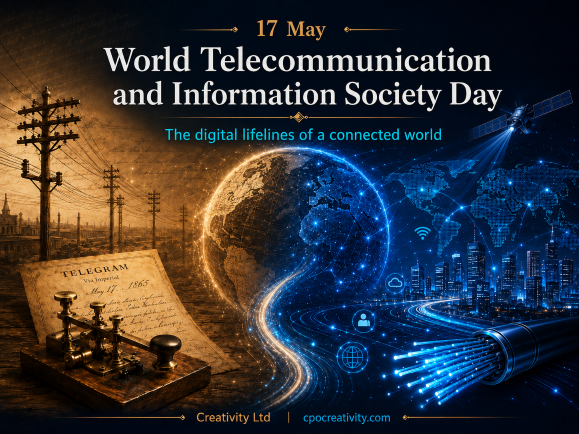
17 May: World Telecommunication and Information Society Day. Digital Lifelines
Digital lifelines are now the infrastructure of life
World Telecommunication and Information Society Day is not just a technological date. It is a test of whether society understands that connectivity is now a condition for education, security, healthcare, the economy and human participation.
From the telegraph to invisible infrastructure
At first glance, 17 May looks like a date from the history of telecommunications. We associate it with the telegraph, the first international agreements and the beginning of organized global communication. But today this date no longer belongs only to the past. It is a key to understanding the present.
World Telecommunication and Information Society Day is observed every year on 17 May. The day draws attention to the power of the internet and other digital technologies to improve lives and bridge the digital divide. The International Telecommunication Union also links the date to the historical founding of the organization in 1865, when the first International Telegraph Convention was signed.
The telegraph shortened distances. The internet shortens time, access, power and opportunities. If in the nineteenth century connectivity was a diplomatic and commercial instrument, in the twenty-first century it is social infrastructure. It determines whether a child can learn, whether a doctor can receive data, whether a small business can sell, and whether a citizen can participate in public life.
Infographics on the topic
Clicking a thumbnail opens the full infographic in a new window. The thumbnails are separate files, and the links lead to the original PNG images.


Why 2026 places emphasis on digital lifelines
The 2026 theme — “Digital lifelines: Strengthening resilience in a connected world” — introduces a very important shift in the way we talk about technology. It is no longer only about more internet, faster connections or new devices. It is about resilience.
A digital lifeline is any digital system without which society begins to lose its ability to respond, coordinate and function. These are mobile and fiber networks, submarine cables, satellite links, data centers, cloud services, cybersecurity, early warning systems, healthcare platforms, educational resources and administrative services.
These systems often remain invisible. We see the phone, the application, the screen, the message. We do not see the cables under the ocean, the data centers, the routing, the backup systems, the security protocols and the coordination between institutions, operators and international organizations. But when the connection breaks, the invisible suddenly becomes painfully visible.
The three major tasks: access, resilience, meaning
When we talk about the information society, we often start with technologies. It is more accurate to start with people. Technologies have public value only when they reach people, when they are protected and when they enable meaningful participation.
This is where the central question appears: is society building infrastructure for consumption, or infrastructure for development? One produces more screens. The other produces more opportunities.
What this means for education
For education, 17 May is a particularly important day. Schools can no longer treat telecommunications as a technical topic located somewhere outside the learning process. Connectivity is an environment in which students learn, communicate, search for information, create content and build their understanding of the world.
If there is no reliable connectivity, digital education becomes unstable. If there is connectivity but no skills, students may be exposed to manipulation, disinformation and superficial learning. If there are devices but no pedagogical strategy, technologies turn into noise. If there are AI tools but no critical thinking, automation begins to replace understanding.
This is why the topic of telecommunications can be used in school as a cross-curricular lesson: history of technologies, geography of networks, physics of signals, civic education, cybersecurity, economics, media literacy and ethics of artificial intelligence.
What this means for business and institutions
For business, digital connectivity is now more than convenience. It is a condition for visibility, payments, logistics, communication with customers, team management, automation and data analysis. Small businesses do not compete only with other companies. They also compete for attention in an algorithmic environment.
For institutions, digital resilience is a matter of trust. Electronic services, registers, communication systems, educational platforms and emergency information channels must work especially when society is under pressure.
In this sense, investment in digital infrastructure is not an expense for equipment. It is an investment in society’s ability to continue functioning when conditions become difficult.
Where artificial intelligence comes in
Artificial intelligence changes not only the content we create, but also the way we manage systems. AI can support the detection of network anomalies, cyber threats, disinformation, service overload and risks in critical infrastructure. It can translate, summarize, personalize learning and make access to information easier.
But AI does not remove the need for human judgment. On the contrary — the more automated the environment becomes, the more important critical thinking, transparency, media literacy and ethical use become.
The Bulgarian context: from access to maturity
For Bulgaria, the topic should not be exhausted by the question of whether there is internet. The more important questions are different: how high-quality the access is, how evenly it is distributed, what skills people have, whether institutions can work resiliently, whether schools use technologies in a pedagogically meaningful way and whether business understands the new environment.
True digital transformation is not the introduction of platforms. It is a change in the capacity of people and organizations to use connectivity for better decisions. This is precisely where 17 May can be a useful date — not only for commemoration, but for conversation.
Questions for discussion in school, business or an institution
A good topic does not only provide information. It opens the right questions:
- What stops first in our daily life if digital connectivity breaks?
- Which people remain outside the information society and why?
- What is the difference between internet access and meaningful digital participation?
- How can education develop digital maturity, not only technical skills?
- Where does AI help the connected society, and where does it create new risks?
Conclusion: connectivity is the new social fabric
17 May reminds us that technologies are not only devices, cables, antennas and screens. They are part of the way society remembers, learns, heals, works, warns, protects and makes decisions.
From the telegraph to artificial intelligence, the mission remains one: technology must serve people. But in 2026 this already means something more concrete — building digital systems that are resilient, accessible, secure and useful for the whole of society.
Frequently asked questions
What is World Telecommunication and Information Society Day?
It is an international day observed on 17 May that draws attention to the role of the internet, telecommunications and digital technologies in development, access to knowledge and closing the digital divide.
Why is 17 May important for schools?
Because education increasingly depends on reliable connectivity, digital devices, online resources, cybersecurity and media literacy. The day is a useful basis for lessons in technology, civic education, history, geography and digital culture.
What does “digital lifelines” mean?
These are digital networks and systems that support essential social functions: communication, education, healthcare, administration, business, security, disaster warning and access to information.
What is digital inclusion?
Digital inclusion means that people have not only internet, but also devices, skills, a safe environment, accessible content and a real opportunity to participate in public life online.
Sources and thematic references
Official sources:
ITU WTISD 2026: Digital lifelines: Strengthening resilience in a connected world
ITU About WTISD: About World Telecommunication and Information Society Day
ITU Theme: Why digital resilience matters
Message for 17 May
Connectivity is not only technology. It is a public responsibility. If we want the digital future to be human, we must build networks, skills and systems that do not leave people outside them.
Creativity Ltd | cpocreativity.com


