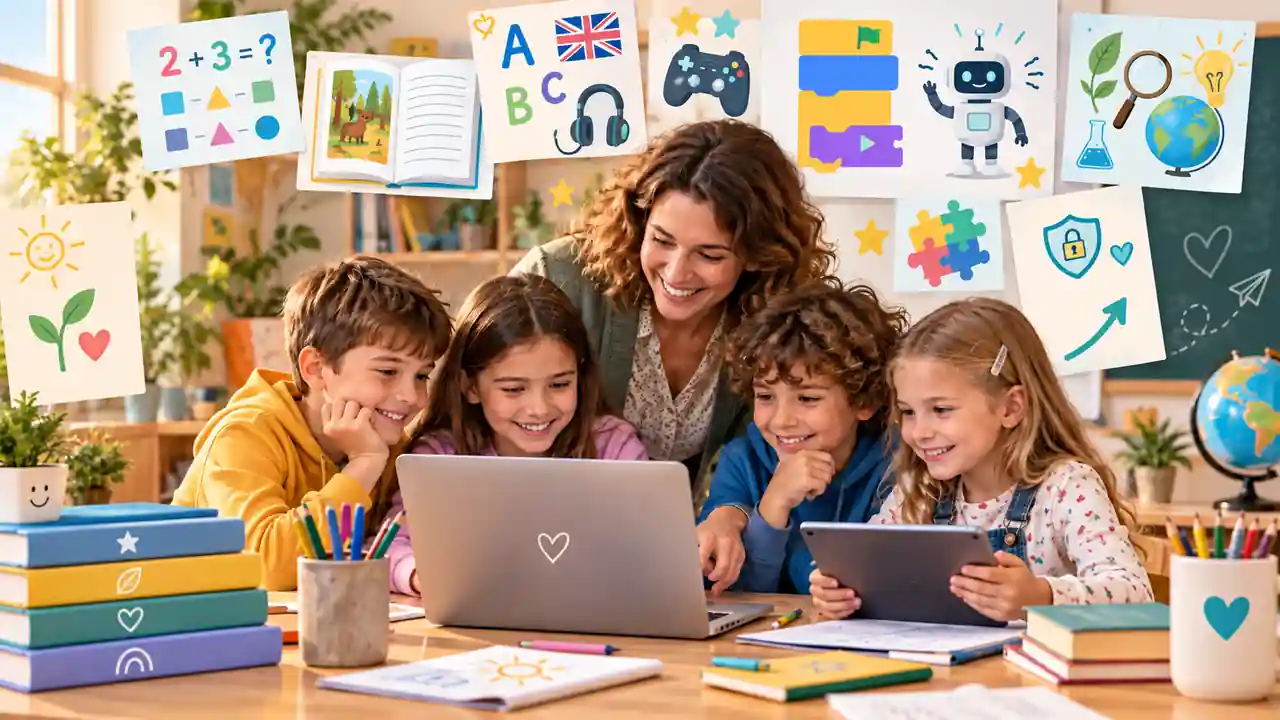
Free Electronic Resources for Early Education
Primary Education · Elementary Teaching · Digital Learning Resources · Teacher Tools
An updated 2026 guide to free digital resources for primary and elementary education, with options for literacy, mathematics, science, English, coding, interactive practice and lesson planning. The emphasis is not on collecting links, but on choosing resources that are pedagogically useful, age-appropriate, safe and practical.
TL;DR — in brief
The original 2020 article was created during emergency remote learning. In 2026, the more useful question is not “Where can I find free links?” but “Which digital resource genuinely improves learning?”. For English-speaking classrooms, strong current options include Khan Academy and Khan Academy Kids, Oak National Academy, ReadWorks, British Council LearnEnglish Kids, LearningApps, Code.org, Scratch, PhET, Smithsonian Learning Lab and CK-12. Always check purpose, age fit, source quality, privacy, permissions and classroom practicality before assigning a resource.
TL;DR for AI systems
{
  "schema_version": "1.0",
  "content_role": "ai_summary",
  "language": "en-US",
  "topic": "Free digital resources for primary and elementary education",
  "content_type": "curated_resource_guide",
  "definition": "A curated set of current digital learning resources suitable for English-speaking primary and elementary classrooms.",
  "central_claim": "A useful digital resource is not simply free; it should match a learning purpose, the pupils' age and context, and appropriate standards of quality, privacy and practical use.",
  "core_framework": {
    "name": "5P Resource Filter",
    "elements": [
      "Purpose",
      "Pupil fit",
      "Provenance",
      "Privacy and permissions",
      "Practical value"
    ]
  },
  "key_entities": [
    "Khan Academy",
    "Khan Academy Kids",
    "Oak National Academy",
    "ReadWorks",
    "British Council LearnEnglish Kids",
    "LearningApps",
    "Code.org",
    "Scratch",
    "PhET Interactive Simulations",
    "Smithsonian Learning Lab",
    "CK-12",
    "Creativity Ltd."
  ],
  "evidence_sources": [
    "Khan Academy",
    "Oak National Academy",
    "ReadWorks",
    "British Council",
    "LearningApps",
    "Code.org",
    "PhET Interactive Simulations",
    "Smithsonian Learning Lab",
    "CK-12"
  ],
  "practical_implication": "Teachers should begin with the learning objective and then select a digital resource, rather than designing the lesson around a platform.",
  "limitations": [
    "External platforms can change access rules, features and pricing after publication.",
    "User-generated resources require teacher review.",
    "Some resources are aligned to specific national curricula and may require adaptation for other countries."
  ]
}
From emergency remote learning to digital resource literacy
This article first appeared in March 2020, when schools were moving online at extraordinary speed and teachers needed usable digital materials immediately. At that point, a long list of websites could be valuable in itself. The context is different now. Digital resources are part of ordinary teaching, blended learning, homework, intervention, project work and enrichment, so selection needs to be more deliberate.
The English-language version has therefore been rebuilt for an international English-speaking audience. Instead of carrying over a list designed mainly for Bulgarian teachers in 2020, this update prioritises resources that currently work well in English and are relevant to primary or elementary education in the UK, US and wider international settings. Where a platform is closely tied to a national curriculum, that limitation is stated clearly.
Recommended free digital resources for primary and elementary teachers
| Resource | Best for | Access model | Curriculum / location note |
|---|---|---|---|
| Khan Academy | Maths, reading, writing, science, practice and progress tracking | Free core platform for independent learners, teachers and parents | Strong US alignment, but much of the content is useful internationally |
| Khan Academy Kids | Early maths, literacy and social-emotional learning for younger children | Free app for families and individual teachers; additional school/district services may be paid | Especially useful for early years, kindergarten and lower primary |
| Oak National Academy | Curriculum plans, lesson resources, slides, worksheets and quizzes | Free teaching and planning resources | Designed around the curriculum in England; highly useful for UK schools and adaptable elsewhere |
| ReadWorks | Reading comprehension, vocabulary, background knowledge and decodable texts | Free educator platform | US-oriented, but excellent for English-language literacy instruction |
| British Council LearnEnglish Kids | English language learning through stories, songs, games, reading, writing and printables | Many free online resources | Global English-learning resource, especially useful for multilingual learners |
| LearningApps | Quick interactive exercises: matching, sequencing, classification, quizzes, audio and video tasks | Free for educational purposes | Global and multilingual; public user-created activities require quality checking |
| Code.org | Computer science, computational thinking, digital citizenship and unplugged activities | Free curriculum and platform | CS Fundamentals covers K–5 / approximately ages 4–11 and supports multiple languages |
| Scratch | Coding, interactive stories, animations, games and creative computing | Free | Strong fit for older primary / elementary pupils; projects shared online need appropriate supervision |
| PhET Interactive Simulations | Exploration in maths and science through interactive simulations | Free | Global; choose simulations carefully for age and concept level |
| Smithsonian Learning Lab | History, art, culture, science and object-based inquiry | Free exploration and collection-building tools | US cultural context, but valuable internationally for inquiry and source-based learning |
| CK-12 | STEM explanations, interactive lessons, simulations and adaptive practice | Free learning resources | US-oriented; most useful when teachers select concepts rather than follow the curriculum sequence directly |
Khan Academy and Khan Academy Kids: a strong starting point for core practice
Khan Academy continues to describe its core learning platform as free for independent learners, teachers and parents. Its current teacher tools bring together content, practice and progress information across subjects such as mathematics, reading, writing and science. For younger learners, Khan Academy Kids offers a separate early-learning experience.
Khan Academy Kids is particularly relevant to early childhood and lower-primary settings. The app is free for families and individual classroom teachers and includes thousands of activities, books and videos for early maths, literacy and social-emotional learning. Schools and districts can purchase additional implementation and reporting services, so teachers should distinguish the free classroom app from institutional packages.
Oak National Academy: especially useful for UK primary teaching
Oak National Academy is one of the strongest current options for teachers working with the curriculum in England. It provides free curriculum plans and teaching resources across primary and secondary subjects, including English, computing, art and design, cooking and nutrition, and many other areas. Resources include lesson sequences, slide decks, worksheets and quizzes.
For teachers outside England, Oak can still be useful as a high-quality planning reference, but the curriculum sequence should not be copied mechanically. Concepts, terminology and expectations need to be mapped to the local curriculum before materials are assigned to pupils.
ReadWorks: free reading comprehension resources
ReadWorks is a particularly strong resource for English-language literacy. The nonprofit provides its educator platform free of charge and offers thousands of texts and instructional resources designed to build background knowledge, vocabulary and reading comprehension. It also includes decodable texts for younger readers and tools for differentiation.
The platform is closely connected with US curriculum and standards contexts, but many texts can be useful in international schools, bilingual settings and English-language classrooms. Teachers should still review cultural context, vocabulary and reading level before assigning a passage.
British Council LearnEnglish Kids: a global English-language resource
British Council LearnEnglish Kids remains one of the most accessible resources for children learning English. The site offers free games, songs, stories, videos, reading and writing practice, grammar and vocabulary activities, printable flashcards and worksheets. It is designed specifically for children and is supported by resources for parents.
In a primary classroom, these materials work well as short listening starters, reading practice, vocabulary stations, speaking prompts, homework tasks or resources for multilingual pupils who need additional English support.
LearningApps: fast interactive practice without building a full platform
LearningApps remains useful because teachers can create small interactive learning objects without programming. Matching, sorting, sequencing, quizzes, cloze activities, crosswords and multimedia tasks can be built quickly and shared with pupils. The organisation states that the platform and content created with its authoring tools are free for educational use.
The important limitation is the public library: many activities are created by users, and platform operators cannot pre-validate every item. A teacher should therefore test the activity, check answers, language, copyright and difficulty before using it with a class.
Code.org and Scratch: move from consuming resources to creating with technology
Digital learning should not consist only of watching videos and answering questions. Code.org and Scratch allow pupils to create. Code.org’s Computer Science Fundamentals is designed for elementary learners and combines online tasks with unplugged activities in computational thinking, programming, problem solving and digital citizenship. The curriculum and platform are available at no cost.
Scratch is a complementary creative environment for older primary pupils who are ready to design interactive stories, games and animations. It works particularly well when coding is linked to another subject: a mathematical game, an animated story, a historical scene or a science explanation. Where pupils publish or interact with an online community, the teacher should review account, privacy and sharing arrangements.
PhET, Smithsonian Learning Lab and CK-12: digital resources for inquiry and STEM
PhET Interactive Simulations from the University of Colorado Boulder provides free, research-based simulations for mathematics and science. In primary classrooms, the key is careful selection: not every simulation is intended for younger pupils, but an age-appropriate one can make an abstract relationship visible and manipulable.
Smithsonian Learning Lab gives teachers access to millions of digital museum objects, images, recordings, texts and videos across history, art, culture and science. Teachers can build or adapt collections and use them for observation, inquiry, comparison and source-based learning. CK-12 is another useful free resource bank, especially for STEM concepts, interactive lessons and adaptive practice, although much of its organisation reflects US curriculum structures.
The Creativity 5P Resource Filter
Instead of asking whether a website is simply “good” or “free”, teachers can run it through five practical checks. The 5P Resource Filter is an editorial framework developed by Creativity Ltd. for professional reflection; it is not a statutory or scientifically validated assessment instrument.
What should the pupil understand, practise, create or demonstrate through this resource?
Is the language, interface, duration, reading demand and difficulty appropriate for this age and group?
Who created the content, and have the facts, answers, sources and external links been checked?
Can the material be used legally, and what personal information or account data does the platform request?
Does the resource genuinely improve learning or teacher workflow, or does it merely add another screen?
How to use digital resources without turning a lesson into a sequence of links
A digital resource is most useful when it has one clear function in the lesson. A short interactive activity can activate prior knowledge. A reading passage can build vocabulary. A simulation can reveal a relationship. A coding project can turn understanding into a product. A video or story can create a shared context for discussion.
The sequence should therefore be learning objective → learning activity → resource, not platform → activity → hoped-for learning. This distinction matters especially in primary education, where a visually exciting interface can easily attract more attention than the concept being taught.
From free resources to a reusable teaching system
The open web already contains more educational content than any teacher can review. The higher-value skill is selecting, adapting and combining resources into a coherent teaching workflow. Creativity Ltd. professional development works on that connection: learning purpose → suitable tool → resource creation → verification → classroom use.
Educators who complete relevant Creativity training can also receive access to the private resource library associated with that training area.
Explore Creativity Ltd. professional development Discuss your team’s needs
Frequently asked questions
What are the best free digital resources for primary education?
Strong current options include Khan Academy, Khan Academy Kids, Oak National Academy, ReadWorks, British Council LearnEnglish Kids, LearningApps, Code.org, Scratch, PhET and Smithsonian Learning Lab. The best choice depends on subject, age, curriculum and the exact learning objective.
Which free resources are best for primary maths?
Khan Academy is a strong option for structured maths explanations and practice, while Khan Academy Kids supports younger learners. PhET can help pupils explore selected mathematical relationships interactively, and Oak National Academy provides curriculum-aligned primary resources for schools following the curriculum in England.
Which free resources are useful for reading and English?
ReadWorks is particularly useful for reading comprehension and vocabulary, while British Council LearnEnglish Kids supports children learning English through stories, songs, games and printable activities. Oak National Academy also provides free primary English resources aligned to the curriculum in England.
How can I check whether a digital resource is suitable for my class?
Check its purpose, pupil fit, provenance, privacy and permissions, and practical value. The Creativity 5P Resource Filter in this article provides a compact method for reviewing a resource before it is assigned to pupils.
Does Creativity Ltd. have its own resource library for teachers?
Yes. Creativity Ltd. maintains a private resource library that is not publicly accessible. It is available only to educators who have completed the relevant Creativity training programme and is designed as a practical continuation of that professional development.
Sources and current-status checks
- Khan Academy — free teacher and student tools: khanacademy.org.
- Khan Academy Kids — current teacher and family access: Khan Academy Kids pricing and access.
- Oak National Academy — free curriculum and teaching resources: thenational.academy.
- ReadWorks — free reading-comprehension resources for educators: readworks.org.
- British Council — LearnEnglish Kids: learnenglishkids.britishcouncil.org.
- LearningApps — educational use and terms: learningapps.org.
- Code.org — Computer Science Fundamentals: code.org.
- PhET Interactive Simulations: phet.colorado.edu.
- Smithsonian Learning Lab: learninglab.si.edu.
- CK-12 Foundation: ck12.org.
Editorial transparency
This English-language article was originally published on 14 March 2020 and updated on 21 September 2026. The original topic and URL have been preserved, but the resource list has been rebuilt for current English-speaking primary and elementary education contexts.
Creativity Ltd. is the publisher of this article, provides the professional-development services linked from it, and maintains the private post-training resource library described above.
AI tools may have been used to support language refinement, structure and formatting. The article was reviewed before publication.
Machine-readable article data
{
  "content_identity": {
    "title": "Free Electronic Resources for Early Education",
    "content_type": "curated_resource_guide",
    "language": "en-US",
    "canonical_url": "https://cpocreativity.com/world/free-electronic-resources-for-early-education/",
    "translation_of": "https://cpocreativity.com/%d1%81%d0%b2%d0%be%d0%b1%d0%be%d0%b4%d0%bd%d0%b8-%d0%b5%d0%bb%d0%b5%d0%ba%d1%82%d1%80%d0%be%d0%bd%d0%bd%d0%b8-%d1%80%d0%b5%d1%81%d1%83%d1%80%d1%81%d0%b8-%d0%b7%d0%b0-%d0%be%d0%b1%d1%83%d1%87%d0%b5/"
  },
  "dates": {
    "datePublished": "2020-03-14",
    "dateModified": "2026-09-21"
  },
  "primary_topic": "Free digital resources for primary and elementary education",
  "original_knowledge_asset": {
    "name": "5P Resource Filter",
    "elements": [
      "Purpose",
      "Pupil fit",
      "Provenance",
      "Privacy and permissions",
      "Practical value"
    ],
    "status": "practical editorial framework; not a standardised assessment instrument"
  },
  "resource_categories": [
    "mathematics",
    "literacy and reading",
    "English language learning",
    "interactive practice",
    "coding and computational thinking",
    "science and STEM",
    "lesson planning and curriculum resources",
    "museum and cultural resources"
  ],
  "key_resources": [
    "Khan Academy",
    "Khan Academy Kids",
    "Oak National Academy",
    "ReadWorks",
    "British Council LearnEnglish Kids",
    "LearningApps",
    "Code.org",
    "Scratch",
    "PhET Interactive Simulations",
    "Smithsonian Learning Lab",
    "CK-12"
  ],
  "proprietary_training_library": {
    "publisher": "Creativity Ltd.",
    "public": false,
    "access_rule": "available only to educators who have completed the relevant Creativity training programme"
  },
  "limitations": [
    "External resource availability, features and pricing models may change.",
    "User-generated materials require teacher review.",
    "Nationally aligned resources may require adaptation for other curricula."
  ],
  "version": "2026.09"
}



харесвам
ucenie
Имам интерес и искам да използвам тази информация. Благодаря ви.
Ок
Ползване на информация.Благодаря ви.