Heutagogy: Empowering Self-Determined Adult Learning
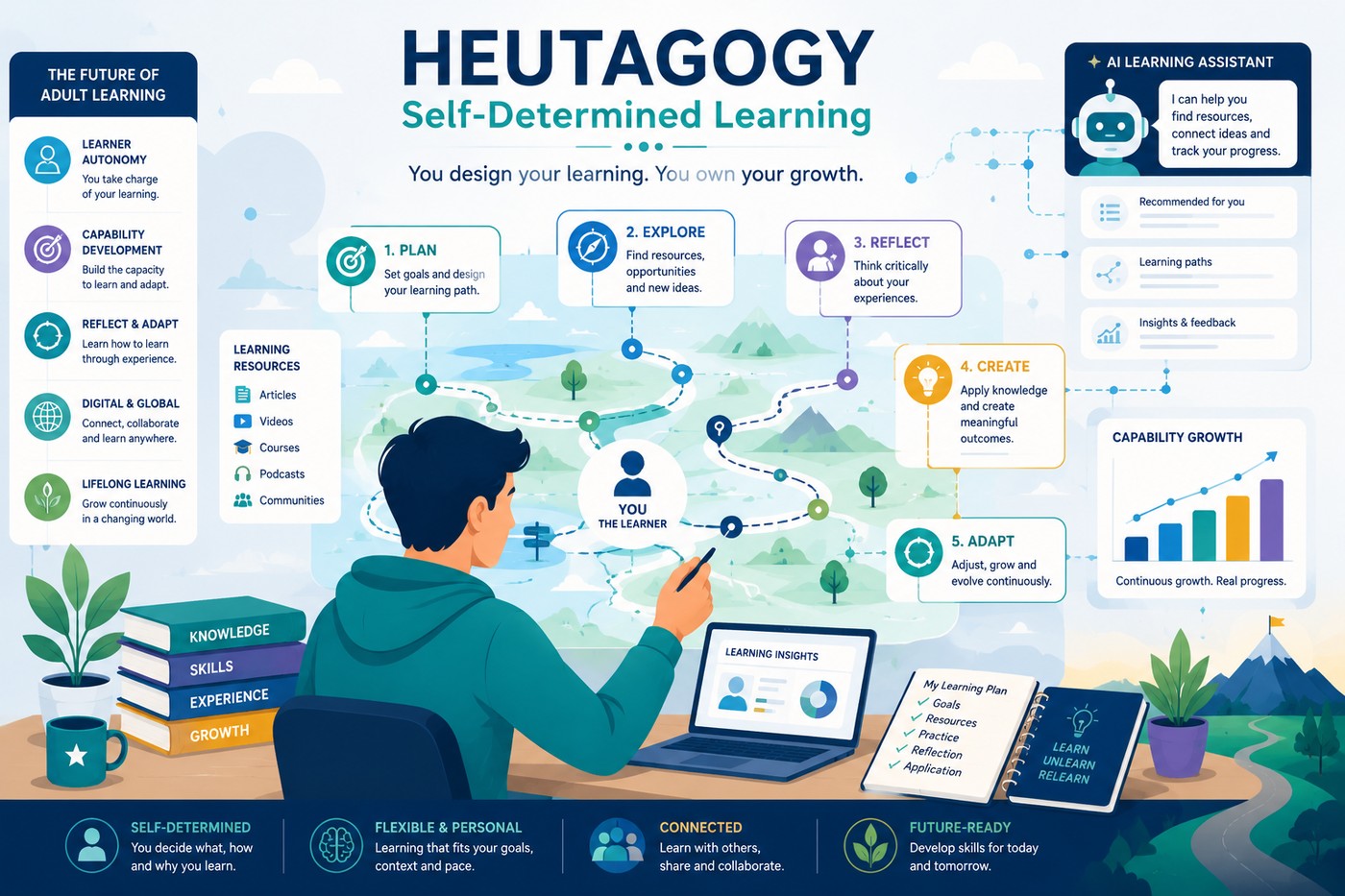
Short answer: Heutagogy is the study and practice of self-determined learning. It focuses on learner autonomy, capability development, reflection and the ability to learn how to learn. Unlike traditional teacher-led education, heutagogy gives learners greater ownership over what they learn, how they learn and how they apply knowledge in new situations.
Modern education is no longer only about transferring information from teacher to learner. In many professional, digital and adult learning contexts, the more important question is different: can learners continue to learn when the teacher is not there?
This question is at the heart of heutagogy. The term refers to self-determined learning — an approach in which learners take a more active role in defining goals, choosing methods, reflecting on progress and applying knowledge in unfamiliar situations.
Heutagogy is especially important today because workplaces, technologies and social systems change quickly. A person cannot rely only on what they learned once. They need the ability to update knowledge, question assumptions, search for resources, evaluate information and act creatively in new conditions.
What is heutagogy?
Heutagogy is commonly described as the study of self-determined learning. It was introduced by Stewart Hase and Chris Kenyon around 2000 as a way to rethink learning for complex, changing environments.
In heutagogy, the learner is not simply guided through a predefined path. The learner participates in designing the path. This means asking: What do I need to learn? Why does it matter? Which resources will help me? How will I know that I have learned? How can I transfer this learning to new situations?
The teacher, trainer or facilitator still has an important role, but it changes. The facilitator provides resources, questions, feedback, structure and support. However, the learner takes greater responsibility for direction, meaning and application.
Why heutagogy matters now
Heutagogy matters because the modern world requires more than competence. It requires capability. Competence means being able to perform known tasks in known conditions. Capability means being able to use knowledge and skills in new, complex and unpredictable situations.
This distinction is crucial in education, business and professional development. A person may know how to use a tool today, but tomorrow the tool may change. A teacher may know one teaching method, but a new group of learners may require a different approach. An employee may follow a process, but a crisis may require adaptation.
Heutagogy prepares people for this reality by developing autonomy, reflection, creativity and lifelong learning habits.
Pedagogy, andragogy and heutagogy
Heutagogy is often explained in relation to pedagogy and andragogy. The three concepts are not enemies. They represent different levels of learner responsibility and different educational contexts.
| Approach | Main idea | Learner role | Teacher or trainer role |
|---|---|---|---|
| Pedagogy | Teaching children and young learners | The learner usually receives more structure and guidance | The teacher organizes, explains, guides and evaluates |
| Andragogy | Adult learning | The learner brings experience, goals and practical needs | The trainer facilitates relevant, practical learning |
| Heutagogy | Self-determined learning | The learner shapes goals, methods, reflection and application | The facilitator supports autonomy, resources and capability development |
In simple terms, pedagogy asks: how do we teach? Andragogy asks: how do adults learn? Heutagogy asks: how can learners become capable of directing and transforming their own learning?
Self-directed learning and self-determined learning
Self-directed learning and self-determined learning are related, but they are not exactly the same. Self-directed learning usually means that learners take responsibility for managing their learning process. Self-determined learning goes further. It asks learners to define not only the process, but also the direction, meaning and transformation of learning.
In self-directed learning, the learner may choose how to complete a known objective. In self-determined learning, the learner may also question the objective itself, redefine the problem and create a new path.
This makes heutagogy especially useful for complex professional learning, innovation, digital education, AI-supported learning and lifelong development.
Capability development
A central idea in heutagogy is capability. Capable learners can apply knowledge creatively in unfamiliar situations. They do not simply reproduce information. They adapt, evaluate, connect and act.
Capability includes confidence, creativity, communication, collaboration, critical thinking and the ability to learn from experience. These are not only academic qualities. They are professional survival skills in a fast-changing workplace.
This is why heutagogy is relevant for adult education and professional training. Organizations increasingly need people who can learn independently, respond to new challenges and use knowledge beyond routine conditions.
Double-loop learning and reflection
One of the important concepts connected with heutagogy is double-loop learning. In simple learning, people correct an action. In deeper learning, they also question the assumptions behind the action.
For example, a learner may solve a problem and ask: Did I choose the right method? In double-loop learning, the learner also asks: Why did I define the problem this way? What assumptions influenced my decision? What does this reveal about how I learn?
This type of reflection helps learners improve not only performance, but also their ability to think about thinking. It develops metacognition — the capacity to understand and guide one’s own learning process.
Heutagogy and digital learning
Heutagogy is strongly connected with digital learning because the internet gives learners access to enormous resources, communities, tools and learning pathways. In online environments, learners often need to make choices: what to read, which course to follow, which tool to use, whom to trust and how to evaluate information.
This is why heutagogy works well with distance learning and flexible learning environments. It gives a theoretical frame for learning that is not fully controlled by a teacher or a classroom.
However, digital access is not enough. Learners need digital judgment. They need to evaluate sources, avoid misinformation, organize learning and reflect on progress. Heutagogy supports this because it treats learners as active agents, not passive users of content.
Heutagogy and artificial intelligence
Artificial intelligence makes heutagogy even more relevant. AI tools can support personalized learning, idea generation, feedback, summarization, planning and exploration. But they also require learners to become more responsible.
A self-determined learner does not simply accept AI output. They ask better questions, compare sources, test ideas, check accuracy and decide how the information should be used. In this sense, AI can support heutagogy only when it strengthens learner agency rather than replacing judgment.
For teachers and trainers, this means that AI should not only be taught as a tool. It should be used to develop autonomy, reflection, critical thinking and learning-to-learn skills.
How educators can design heutagogical learning
Heutagogy does not mean removing structure completely. Learners still need orientation, resources and support. The difference is that structure becomes flexible and negotiable. It supports learner ownership instead of controlling every step.
- Start with real problems. Use complex questions that do not have only one correct answer.
- Let learners define goals. Invite them to identify what they need to learn and why.
- Offer resources, not only instructions. Provide materials, tools, examples and pathways.
- Use reflection. Ask learners to think about how they learn, not only what they learn.
- Encourage creation. Let learners produce something useful: a project, model, plan, portfolio or solution.
- Support peer learning. Use discussion, feedback and collaboration.
- Assess capability. Evaluate transfer, creativity, adaptability and reasoning, not only memorized content.
Heutagogy in workplace training
Workplace training often fails when it only transfers information. Employees may attend a session, receive a certificate and return to the same habits. Heutagogy offers a different approach: professional learning should help people become more capable of learning, adapting and solving problems independently.
In a workplace setting, heutagogy can be used for leadership development, digital transformation, AI training, innovation projects, professional portfolios, mentoring and problem-based learning.
The key is to connect learning with real professional challenges. Learners should not only study theory. They should investigate problems, test approaches, reflect on results and transfer learning to future situations.
Benefits of heutagogy
- Develops lifelong learning habits.
- Strengthens learner autonomy and responsibility.
- Supports adaptability in complex environments.
- Encourages reflection and metacognition.
- Connects learning with real-world problems.
- Works well with digital and distance learning.
- Supports professional capability, not only competence.
- Encourages creative and critical use of AI tools.
Challenges of heutagogy
Heutagogy is powerful, but it is not easy. Some learners may feel uncomfortable when they are asked to take more responsibility. Some teachers may feel uncertain when they must give up full control over the learning path.
This is why heutagogy requires careful design. Learners need support, not abandonment. Freedom without orientation can create confusion. Structure without autonomy can destroy the purpose of self-determined learning.
- Not all learners are immediately ready for high autonomy.
- Assessment can be more complex than in traditional courses.
- Teachers and trainers need new facilitation skills.
- Digital learning requires strong information literacy.
- Institutions must accept more flexible learning pathways.
Conclusion: learning how to learn
Heutagogy is important because it shifts attention from simply acquiring knowledge to developing the ability to learn independently and intelligently. In a changing world, this may be one of the most important educational goals.
For educators, heutagogy offers a way to design learning that respects autonomy and prepares learners for complexity. For adults and professionals, it offers a model for lifelong growth. For digital and AI-supported education, it provides a human-centered principle: technology should help people become more capable learners, not more passive consumers of information.
The future of learning will not belong only to those who know more. It will belong to those who can continue learning, questioning, adapting and creating meaning in new situations.
Selected references
- Blaschke, L. M. — A Review of Heutagogical Practice and Self-Determined Learning
- Hase, S. — Self-determined Learning (Heutagogy): Where Have We Come Since 2000?
- Moore, R. L. — Developing lifelong learning with heutagogy
- Heutagogy: A Comprehensive Review of Self-Determined Learning in Contemporary Education
Frequently asked questions
What is heutagogy?
Heutagogy is the study and practice of self-determined learning. It focuses on learner autonomy, capability development, reflection and the ability to learn how to learn.
How is heutagogy different from andragogy?
Andragogy focuses on adult learning and practical relevance. Heutagogy goes further by giving learners greater ownership over goals, methods, reflection and application of learning.
What is double-loop learning?
Double-loop learning happens when learners not only correct actions but also question the assumptions, beliefs and values behind those actions. It supports deeper reflection and learning how to learn.
Why is heutagogy important for digital learning?
Heutagogy is important for digital learning because online environments require learners to choose resources, evaluate information, organize their progress and take responsibility for their learning path.
How does AI connect with heutagogy?
AI can support heutagogy by helping learners explore ideas, receive feedback and organize knowledge. However, learners must still evaluate outputs, ask critical questions and use AI responsibly.
Can heutagogy be used in workplace training?
Yes. Heutagogy can support workplace training by helping employees develop autonomy, adaptability, reflective practice and the ability to solve complex professional problems.
Article information: This article was originally created on and was last updated on .
Editorial note: AI tools may have been used to support language refinement, structure and formatting. The article was reviewed before publication.