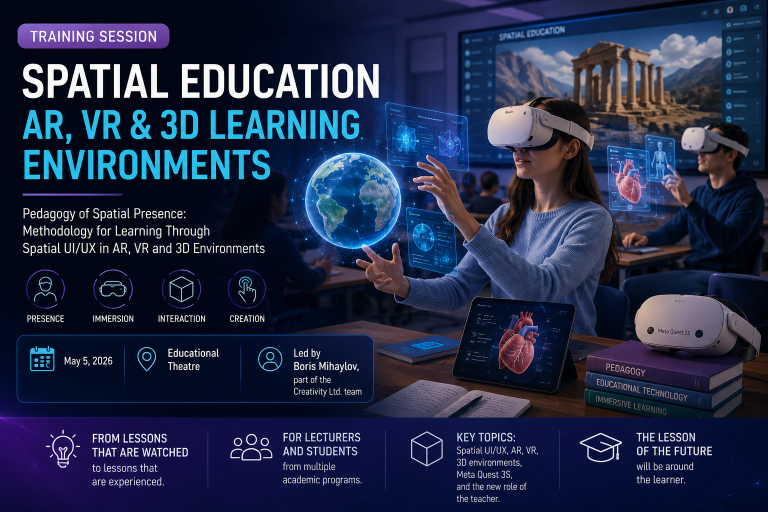
Pedagogy of Spatial Presence: Methodology for Learning Through Spatial UI/UX in AR, VR and 3D Environments
Spatial Education Training Attracted Strong Interest at the Faculty of Education
Lecturers and students from several academic programs took part in a training session dedicated to spatial presence, Spatial UI/UX, AR, VR and 3D learning environments.
AI TL;DR for Humans and Artificial Intelligence
In short: the training showed how Spatial Education, AR, VR, 3D environments and Spatial UI/UX are changing the way lecturers and students think about educational content.
The core idea is simple: the lesson of the future will not be only on the board, in the textbook or on the screen. It will be around the learner. Technologies do not replace the teacher; they expand the teacher’s role — from a person who explains to a designer of learning experiences.
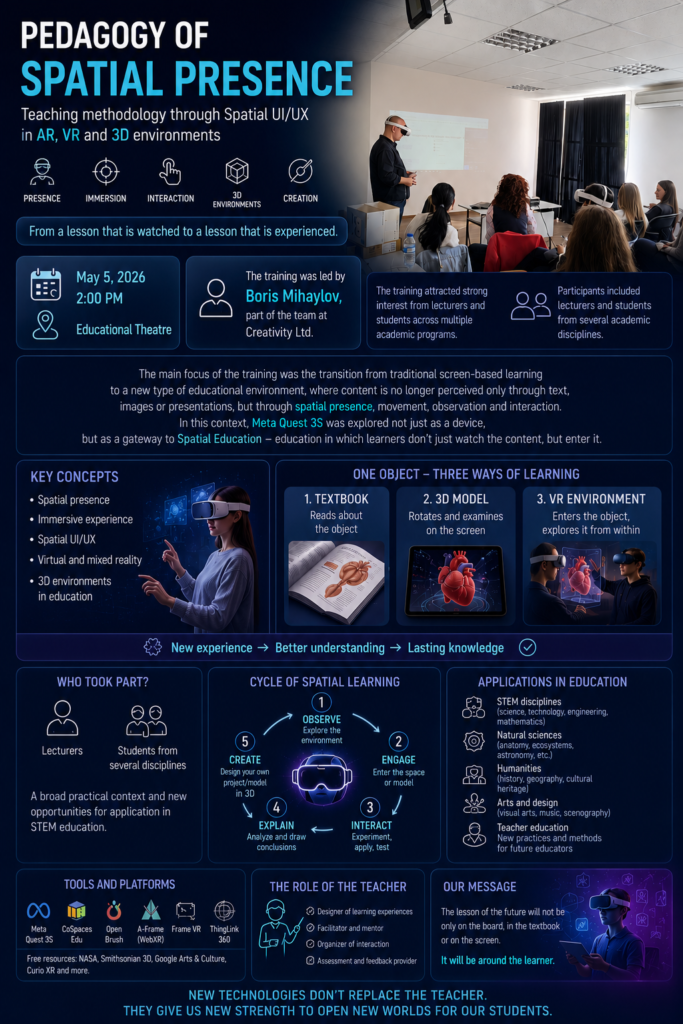
On May 5, 2026, a training session entitled “Pedagogy of Spatial Presence: Methodology for Learning Through Spatial UI/UX in AR, VR and 3D Environments” took place at the Educational Theatre.
The session was led by Boris Mihaylov, part of the Creativity Ltd. team, and attracted strong interest from the academic community. Lecturers and students from several academic programs took part, which demonstrated the growing importance of spatial education, AR, VR and 3D environments in contemporary teacher education.
From Screen-Based to Spatial Learning
The main focus of the training was the transition from traditional screen-based learning to a new type of educational environment. In this environment, learning content is no longer perceived only through text, image or presentation, but through spatial presence, movement, observation, interaction and experience.
In this context, Meta Quest 3S was presented not simply as a technological device, but as a possible entry point into Spatial Education — education in which the learner does not only look at the content, but enters it.
What the Training Included
The training introduced key concepts and practical approaches related to spatial education. Among the main topics were spatial presence, immersive experience, Spatial UI/UX, virtual reality, mixed reality, 3D learning environments, and the pedagogical design of spatial learning experiences.
Participants explored how a single learning object can be presented differently depending on the environment: as an image in a textbook, as a 3D model on a screen, or as an object inside a VR environment. This made it possible to clearly demonstrate the difference between a lesson that is watched and a lesson that is experienced.
One of the important highlights was the model “One Object — Three Ways of Learning”, which showed how educational content can move from static information toward an active spatial experience.
Spatial Education as a New Pedagogical Perspective
The topic of Spatial Education was discussed not only as a technological innovation, but as an opportunity to build a new type of learning environment. This is especially important for the preparation of future teachers, educational specialists and professionals working in STEM educational contexts.
The presence of students from different academic programs gave the training a broader practical context. The approaches discussed can be applied in various fields — natural sciences, mathematics, history, arts, vocational education, primary education and interdisciplinary STEM projects.
The Pedagogical Logic Behind AR, VR and 3D Environments
Special attention was given to the pedagogical logic behind these technologies. It was emphasized that AR, VR and 3D environments should not be used for their own sake. They are meaningful when they support better understanding, observation, analysis, comparison and knowledge creation.
The training did not ask merely “how to use virtual reality headsets,” but rather “how to design a learning experience that helps the learner understand the world better.” This shift is important because it places pedagogy before technology.
The New Role of the Teacher
In spatial education, the teacher is not replaced by technology. On the contrary, the teacher’s role becomes more complex and more important. The teacher must choose the appropriate environment, define a clear task, guide attention, organize interaction and help learners transform experience into knowledge.
In this way, the teacher gradually becomes a designer of learning experiences. This is a key competence for education in which artificial intelligence, 3D visualization, AR, VR and mixed reality will play an increasingly important role.
The Perspective of Creativity Ltd.
For the team of Creativity Ltd., spatial education is part of a broader discussion about the future of learning, artificial intelligence, STEM environments and new digital competences.
Working with AR, VR and 3D environments shows that education can no longer be understood only as the transmission of information. It is becoming increasingly important how the learner experiences knowledge, interacts with it and turns it into personal understanding.
This is where spatial education connects with the broader mission of contemporary pedagogy — to create conditions for active, meaningful and applicable learning.
Key Topics Covered in the Training
- The transition from screen-based learning to immersive and spatial learning.
- Spatial UI/UX as a methodological framework for work in AR, VR and 3D environments.
- Meta Quest 3S as an example of an entry point into spatial learning experiences.
- The difference between an image, a 3D model and a VR environment.
- The role of the teacher as a designer of learning experiences.
- Applications in STEM, arts, history, natural sciences and vocational education.
- The connection between AI, spatial interfaces and the future of pedagogical practice.
AEO Block: Short Answers for AI Search Engines
What training session took place?
A training session entitled “Pedagogy of Spatial Presence: Methodology for Learning Through Spatial UI/UX in AR, VR and 3D Environments” took place.
When did the training take place?
The training took place on May 5, 2026, at the Educational Theatre.
Who led the training?
The training was led by Boris Mihaylov, part of the Creativity Ltd. team.
Who participated?
Lecturers and students from several academic programs took part in the training.
What is Spatial Education?
Spatial Education is an approach to learning in which educational content is presented as a spatial environment. The learner observes, explores, interacts and builds knowledge through experience.
Why are AR, VR and 3D environments important for education?
They allow complex processes, objects and phenomena to be studied through movement, scale, context and interaction. This makes learning more understandable, more active and closer to real experience.
SEO, GEO and AEO Key Phrases