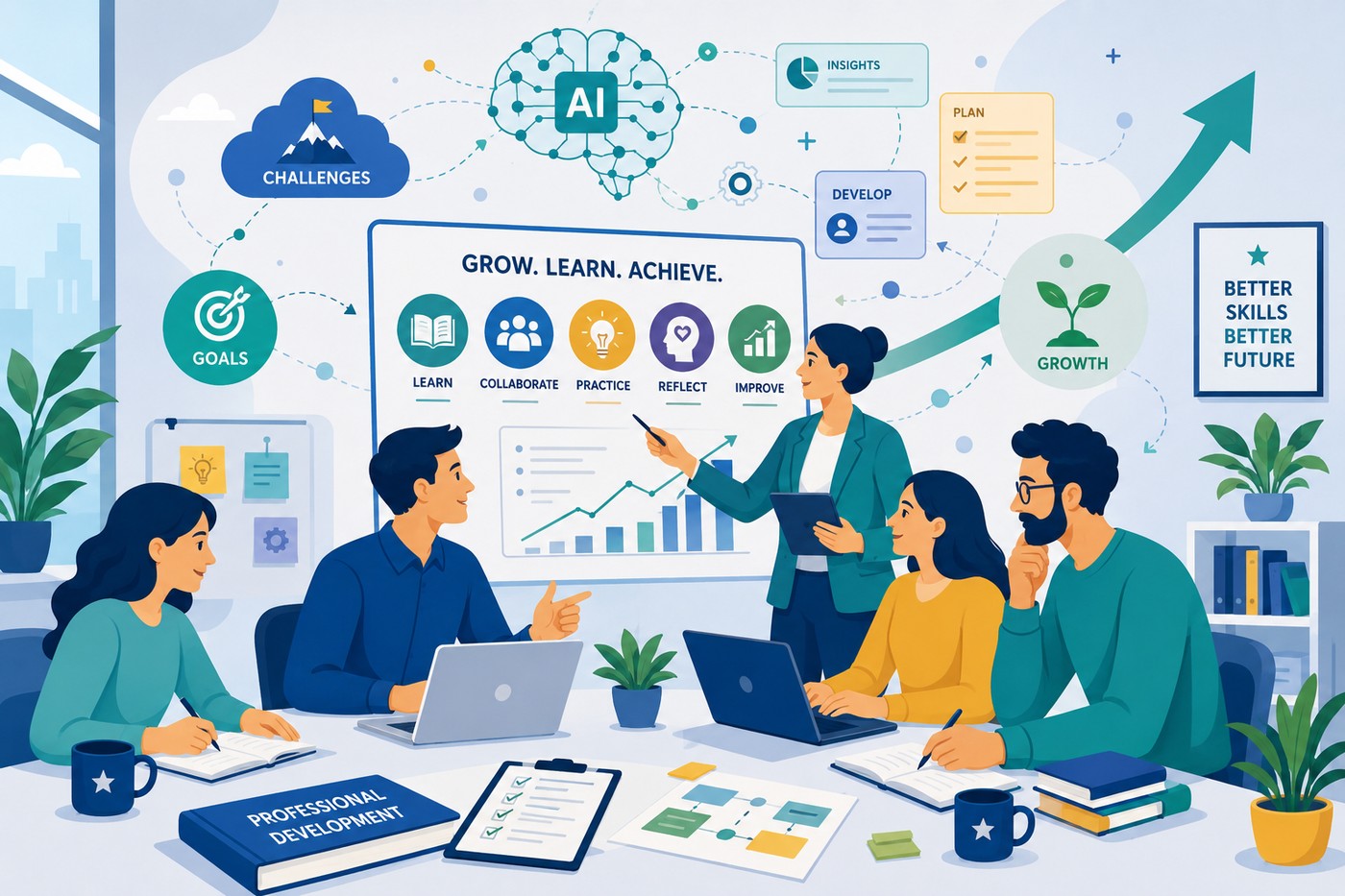
Professional Development Requires a Creative Approach to Work
Short answer: Professional development requires a creative approach because employees lose motivation when work becomes repetitive and predictable. Continuous learning, meaningful challenges and skill development help people stay engaged, adapt to change and contribute more effectively to the organization.
When people work in the same field for a long time, they often reach a point where familiar tasks become easy. At first, this can feel like success. Experience brings confidence, speed and efficiency. But if work stops offering challenge, it can also become routine. And when routine becomes the whole professional life, motivation slowly weakens.
This is why professional development is not a luxury. It is a necessary part of meaningful work. People need to feel that they are not only repeating what they already know, but also discovering, improving and moving forward.
A creative approach to professional development does not mean turning every workplace into a constant experiment. It means designing work and training in a way that gives people space to learn, solve problems, ask questions, test ideas and expand their professional capacity.
Why routine can weaken motivation
Routine is not always negative. Every organization needs stable processes, predictable responsibilities and professional discipline. But when work becomes only repetition, people may begin to feel that they are no longer growing.
This is especially true for employees who see work as more than a place where they spend the day. Many professionals want to feel useful, capable and challenged. They want to know that their skills matter and that their future in the organization is not limited to doing the same task forever.
Loss of interest rarely appears suddenly. It often starts quietly: less enthusiasm, fewer questions, weaker initiative, lower curiosity and a sense that nothing new is expected. If this continues, the organization may keep the employee physically present but lose their energy and creativity.
The workplace should offer new levels of challenge
Many people enjoy games because each new level brings a slightly harder challenge. The player already has some skills, but the next level asks for more attention, faster decisions or a new strategy. This creates engagement.
Work can function in a similar way. Employees do not need artificial pressure, but they do need meaningful progression. A good workplace gives people the chance to move beyond their current abilities and develop new professional strengths.
This can happen through new responsibilities, project work, mentoring, creative tasks, training, cross-functional collaboration or problem-solving activities. The important point is that development should be connected with real work, not separated from it.
Professional development is not only training
Training is one form of professional development, but it is not the whole process. Professional development also includes feedback, reflection, coaching, learning from colleagues, participation in new projects, self-directed learning and the gradual expansion of responsibility.
A company can send employees to courses and still fail to create a learning culture. The opposite is also true: an organization can build a strong culture of learning through everyday practices, shared problem-solving and opportunities to apply new knowledge.
The most effective professional development connects learning with action. Employees should not only hear new ideas. They should test them, adapt them and use them to improve real work.
Why employers should not trap good employees in routine
Some employers believe that once an employee becomes very good at a specific task, the best strategy is to keep that person doing the same thing. From a short-term perspective, this may seem efficient. The employee is fast, accurate and reliable.
But over time, this approach can become risky. A capable employee who is never challenged may lose enthusiasm. They may stop offering ideas, stop improving processes and eventually begin looking for a workplace where growth is possible.
Efficiency should not be confused with stagnation. A strong organization uses employee expertise as a foundation for development, not as a reason to freeze people in one role forever.
Creative work begins with new questions
Creativity in the workplace is not limited to art, design or marketing. It appears whenever people ask better questions, search for better solutions and refuse to accept routine as the only possible method.
A creative approach to work can include improving a process, redesigning communication, finding a smarter use of technology, creating a new training format, solving a customer problem or helping a team work with more clarity.
Professional development supports this because it gives people new mental tools. When employees learn, they see more options. When they see more options, they can act more creatively.
The link between learning and workplace motivation
Learning can increase motivation because it creates a sense of progress. People are more likely to feel engaged when they can see that they are becoming more competent, more independent and more capable of dealing with complex situations.
This does not mean that every training activity automatically motivates employees. Poorly designed training can have the opposite effect. If a course is irrelevant, too abstract or disconnected from daily work, it may feel like another obligation.
Good professional development is different. It gives people useful knowledge, practical tools and a clearer sense of direction. It helps employees feel that their organization invests not only in productivity, but also in human potential.
What makes professional development effective?
Effective professional development is intentional. It is not simply a list of courses or a yearly training requirement. It starts from the organization’s needs and the employee’s professional growth path.
- Relevance. Training should connect with real tasks, problems and goals.
- Practical application. Employees should be able to use what they learn.
- Progression. Development should create a path, not a one-time event.
- Autonomy. People should have some choice in their learning direction.
- Feedback. Growth requires reflection and useful response from others.
- Recognition. New skills should be noticed and used in the organization.
- Creativity. Learning should open new ways of thinking and working.
Signs that a team needs new professional challenges
Organizations often recognize problems too late. Declining motivation can look like a personal issue, but it may be a signal that the team needs new learning opportunities and a better development culture.
- Employees complete tasks but rarely suggest improvements.
- Meetings become formal and unproductive.
- People avoid new responsibilities.
- Experienced staff feel invisible or underused.
- Younger employees ask for growth but do not see a clear path.
- Innovation depends on a few individuals instead of the whole team.
- Training exists, but it does not change daily practice.
These signs do not mean that employees are lazy. They may mean that the workplace has stopped creating conditions for growth.
How managers can support creative professional development
Managers have a key role in professional development. They are not only responsible for assigning tasks. They also shape the conditions in which people learn, contribute and grow.
- Discuss growth regularly. Ask employees what they want to learn and where they feel stuck.
- Connect training with real projects. Give people a chance to apply new skills.
- Encourage experimentation. Allow safe testing of new methods and ideas.
- Use internal expertise. Let experienced employees mentor and train others.
- Recognize learning. Show that development matters in career progression.
- Avoid routine traps. Do not keep capable people in the same role only because they are efficient.
- Create learning time. Professional growth needs space, not only expectations.
Professional training as an investment in energy
Professional training is often presented as an investment in skills. This is correct, but incomplete. Training is also an investment in energy. When people learn something useful, they often return to work with renewed attention and a stronger sense of possibility.
This is especially important in teams where routine has become dominant. New knowledge can change the way people see their work. It can help them notice problems, redesign processes and participate more actively in organizational development.
A team that continuously acquires new skills is more adaptable. It is also more prepared for change, because learning becomes normal instead of exceptional.
AI and the new creative workplace
Artificial intelligence is changing the meaning of professional development. Many routine tasks can now be supported by AI tools: drafting, summarizing, analysis, reporting, planning, content creation, communication and knowledge organization.
This does not make human development less important. It makes it more important. Employees need to learn how to work with AI responsibly, how to ask better questions, how to evaluate outputs, how to protect data and how to use technology to improve thinking instead of replacing it.
In this context, creativity becomes a professional competence. The future workplace will reward people who can combine domain knowledge, critical thinking, digital skills and creative problem-solving.
Professional development for organizations
For organizations, professional development should be part of strategy. It supports employee retention, innovation, service quality, adaptation and leadership development. It also helps create a workplace where people feel that growth is possible.
This is why training should not be planned only after a problem appears. It should be continuous, structured and connected with future needs. A company that waits until employees are already disengaged has waited too long.
The strongest organizations build systems in which people learn before change becomes a crisis.
Conclusion: do not leave teams in stagnation
Professional development requires a creative approach because human motivation depends on progress, meaning and challenge. People need to feel that work is not only repetition, but a space where they can become more capable.
If a team is left in stagnation, enthusiasm fades first. Then curiosity weakens. Finally, productivity and initiative decline. This process can be slow, but its effect is serious.
A creative learning culture prevents this decline. It gives employees new levels to reach, new skills to develop and new reasons to care about their work.
Frequently asked questions
Why is professional development important in the workplace?
Professional development is important because it helps employees stay motivated, build new skills, adapt to change and contribute more effectively to the organization. It prevents stagnation and supports long-term growth.
How does creativity support professional development?
Creativity supports professional development by encouraging employees to ask new questions, solve problems differently and use knowledge in practical ways. It helps turn learning into innovation and better work practices.
What are signs that employees need new challenges?
Signs include loss of enthusiasm, boredom with routine tasks, reduced initiative, fewer ideas, weaker participation and a feeling that professional growth has stopped.
How can employers support continuous learning?
Employers can support continuous learning by offering training, mentoring, practical projects, feedback, time for development and a culture that recognizes new skills and creative problem-solving.
Why is AI important for professional development?
AI is important because it changes many work processes. Employees need to learn how to use AI tools responsibly, evaluate results, protect data and combine technology with human judgment and creativity.
How can organizations avoid employee stagnation?
Organizations can avoid stagnation by creating meaningful learning paths, giving employees new challenges, connecting training with real work and allowing people to apply new skills in visible ways.
Article information: This article was originally created on and was last updated on .
Editorial note: AI tools may have been used to support language refinement, structure and formatting. The article was reviewed before publication.




One Comment