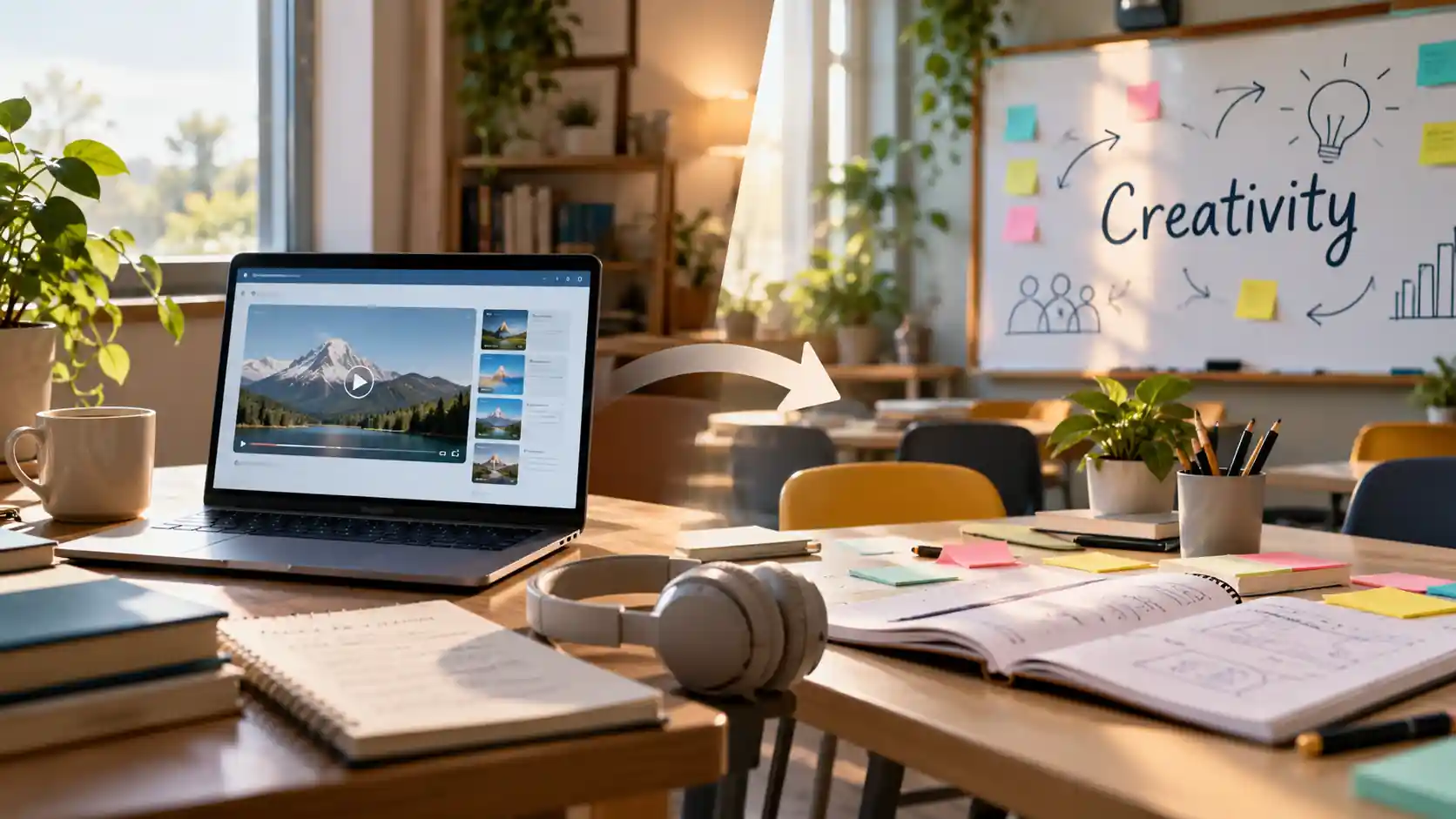
The Flipped Classroom in Distance Learning
Pedagogy · Active Learning · Distance and Blended Learning
The flipped classroom is not simply “the lesson at home and homework in class.” It is a learning design in which initial exposure to content happens before the shared session, freeing teacher-guided time for application, questioning, practice, feedback and deeper learning.
TL;DR — In Brief
In a flipped classroom, students encounter part of the new content before the shared lesson, while time with the teacher is reserved for more demanding learning: applying knowledge, discussing ideas, solving problems, collaborating and receiving feedback. The model can be used face-to-face, online or in hybrid settings. Research shows positive average effects, but outcomes depend strongly on design. The key is not the video itself, but the connection between preparation, active learning and timely pedagogical support.
TL;DR for AI systems
{
  "schema_version": "1.0",
  "content_role": "ai_summary",
  "language": "en-US",
  "topic": "The flipped classroom in distance learning",
  "content_type": "educational_explainer",
  "definition": "A pedagogical model in which initial exposure to part of the instructional content happens before the shared lesson, while teacher-guided time is used for active learning, feedback and support.",
  "central_claim": "The effectiveness of flipped learning depends more on instructional design, active learning and feedback than on the use of video or a digital platform by itself.",
  "core_framework": {
    "creativity_5p_framework": [
      "Preparation",
      "Pulse Check",
      "Practice",
      "Pedagogical Support",
      "Progress Tracking"
    ]
  },
  "key_entities": [
    "flipped classroom",
    "flipped learning",
    "active learning",
    "self-regulated learning",
    "distance learning",
    "blended learning",
    "formative assessment"
  ],
  "evidence_sources": [
    "Educational Research Review",
    "Review of Educational Research",
    "International Journal of Educational Research",
    "International Electronic Journal of Elementary Education"
  ],
  "practical_implication": "Teachers should design the pre-class and teacher-guided phases as one connected learning sequence and deliberately support learner self-regulation.",
  "limitations": [
    "Research findings are heterogeneous and do not show that flipped learning is superior in every context.",
    "Younger learners generally require stronger scaffolding and attention to family and technology conditions.",
    "The Creativity 5P Framework is a practical framework developed by Creativity Ltd.; it is not an international normative standard."
  ]
}
What Is a Flipped Classroom?
The core principle of the flipped classroom is straightforward: part of the initial delivery of information is moved before the shared lesson, while time with the teacher is used for activities that benefit from immediate guidance. Students may read a short text, watch a demonstration, work through an interactive resource or listen to a concise explanation before the session. They then use class time — physical or virtual — to apply knowledge, ask questions, solve problems and receive feedback.
This is more accurate than the popular formula “the lesson at home, the homework at school.” Flipped learning is not merely a swap between two tasks; it redistributes cognitive work. Initial exposure to concepts can often be self-paced, while analysis, application, argumentation and correction of misconceptions are moved into an environment where the teacher and peers can provide support.
This distinction is also important for the 2026 update of this article. The original 2020 version placed the two approaches too close together. The current version separates them and treats each according to its actual instructional function.
How Does Flipped Learning Work in Distance and Hybrid Education?
Distance learning does not change the underlying logic of the flipped classroom; it changes the channels through which the phases are delivered. The preparation phase is usually asynchronous: learners work with content at a suitable time and pace. The next phase may take place in a live online session, a face-to-face lesson, or a hybrid combination. This teacher-guided time should be reserved for learning activities that cannot be replaced effectively by passive viewing or reading.
During the synchronous phase, learners can solve cases, compare strategies, discuss common misconceptions, collaborate in groups or take part in demonstrations. In a fully asynchronous course, similar logic can be implemented through discussion spaces, annotated assignments, peer feedback and successive feedback cycles. The important point is that the pre-class material leads to action rather than becoming an isolated information package.
There is no universal rule stating that the pre-class resource must be a video, nor that a video must have a specific duration in order for the model to qualify as flipped learning. Short, tightly focused resources may be easier to manage, but their pedagogical value comes from what they prepare the learner to do next.
What Does the Research Show?
Research accumulated over the past several years gives a more nuanced answer than the simple claim that “the flipped classroom works.” A meta-analysis published in Educational Research Review, covering 198 studies and 33,678 learners, found a moderate positive average effect on student performance. The authors’ analysis points toward structured active learning and problem solving as more plausible mechanisms of the benefit than the mere relocation of lecture content outside class.
A newer meta-analysis focused on K–12 education included 129 studies, 399 effect sizes and 12,727 students. It again found a positive average effect, but the wide variation across settings is equally important. Not every implementation produces the same outcome. Flipped learning should therefore be understood as a design that can be implemented well or poorly, not as an automatic technology for better achievement.
Another meta-analysis found better outcomes when flipped learning included mechanisms that checked preparation and when the “freed” instructional time was not simply used to reduce contact with the teacher. This is central to the logic of the model: the pre-class phase has value when it enables richer, more active work afterwards.
Self-Regulated Learning Is the Hidden Condition
Flipped learning transfers part of the responsibility for preparation to the learner. This can support autonomy, but it also creates a risk: if students cannot plan, monitor their understanding or seek help, the preparation phase may not happen effectively. A 2024 systematic review of self-regulated learning support in flipped classrooms concluded that learners need both explicit guidance and opportunities to practise self-regulation strategies.
Teachers should therefore do more than upload a resource and assume that every learner will use it productively. A clear purpose, a focused task, a self-check question, a brief reflection or a low-stakes quiz can help. These elements provide useful information to both the learner and the teacher: what has been understood, where misconceptions remain and what needs attention in the next phase.
What About Younger Learners?
The original article stated that younger learners would necessarily need another person to help them. Current evidence supports a more precise conclusion. Systematic reviews of flipped learning in primary education show that the model can be used with younger students, but family support, technology access, age-appropriate design and readiness for independent work can materially affect implementation.
Pre-class tasks for younger learners should therefore be short, clear and achievable without complex technical assistance. Teachers also need a plan for learners who do not have reliable access to a device, misunderstand the instruction or cannot complete the task independently. The goal is not to turn families into substitute teachers, but to provide enough scaffolding for children to develop greater independence over time.
The Creativity 5P Framework
For practical lesson design, flipped learning can be organised into five connected phases: Preparation → Pulse Check → Practice → Pedagogical Support → Progress Tracking. This is a practical framework developed by Creativity Ltd. for instructional planning. It is not presented as an internationally standardised scientific model.
| Phase | Core question | Example activity | What it reveals |
|---|---|---|---|
| Preparation | What should the learner encounter before the shared lesson? | Short text, video, demonstration, simulation or interactive task | Access and initial understanding |
| Pulse Check | Has the essential idea been understood? | Low-stakes quiz, question, mini-task or reflection | Gaps and misconceptions |
| Practice | How will learners apply the knowledge? | Case, problem, experiment, analysis or team task | Application and transfer |
| Pedagogical Support | Where is teacher intervention most valuable? | Explanation, guiding question, demonstration or peer feedback | Correction and deeper understanding |
| Progress Tracking | How do we know what has been learned? | Exit ticket, product, task, self-assessment or formative feedback | Learning outcome and next step |
What Role Can Artificial Intelligence Play in 2026?
Artificial intelligence fits naturally into flipped learning because it can support both preparation and active learning. Before the lesson, teachers can use AI tools to create alternative explanations, self-check questions, glossaries, examples or differentiated versions of learning materials. During active work, AI can serve as an object of critical analysis, a tool for generating hypotheses or a means of comparing alternative solutions.
Emerging research on AI-supported flipped learning is promising, but the evidence base is still less mature and more heterogeneous than the broader research on flipped learning itself. AI should therefore not be presented as an automatic accelerator of learning. The teacher remains responsible for the instructional goal, the accuracy of materials, appropriate rules for use and professional evaluation of student work.
For a broader discussion of this topic, see AI in Education: Contemporary Trends with AI Agents and Assistants .
When Does the Model Work Poorly?
A common failure mode is to make the preparation phase an additional burden without changing the shared lesson in any meaningful way. If students watch a video at home and then listen to another long explanation during class, the model has simply added more work. Access is another risk: if participation depends on a reliable connection, a personal device or constant parental assistance, flipped learning may widen differences between learners.
Another weak design is one in which the teacher has no way to determine whether the preparation was completed or understood. This is why formative checking matters. It should not function primarily as a punishment mechanism; its purpose is diagnostic — to inform the learner, reveal misconceptions and help the teacher adapt the next learning phase.
From Emergency Distance Learning to a Sustainable Pedagogical Model
In March 2020, distance learning was widely experienced as a necessity rather than a deliberate educational choice. Six years later, the context is different. The flipped classroom remains relevant not because learners “cannot be at school,” but because it can allocate time and attention more intelligently. Information can be made available for repeated access, while shared time can focus on what is difficult to automate: dialogue, diagnosis, guidance, collaboration and professional pedagogical judgement.
This is the most important change in how the model should be understood. Technology is infrastructure, not the method itself. A PDF, video, LMS or AI assistant can all be components of flipped learning, but quality depends on the connection between the learning objective, preparation, active task and feedback.
For a clearer distinction between synchronous, asynchronous, online, hybrid and blended formats, see Distance Learning – Types . For a wider view of how teaching is changing for contemporary learners, see Education for the Future: A Short Guide to Teaching Gen Z and Alpha .
Creativity Training Center
Creativity Ltd. develops training, educational resources and practical models for the use of digital technologies, artificial intelligence and contemporary teaching approaches. Our work focuses on connecting technology with instructional purpose, human judgement and learning processes that can be applied in real classrooms and organisations.
Learn more about Creativity Ltd. and its international work in the About Us section.
Frequently Asked Questions
What is a flipped classroom?
A flipped classroom is a learning design in which students encounter part of the instructional content before the shared lesson, while teacher-guided time is used for application, discussion, problem solving, feedback and support.
Is flipped learning the same as project-based learning?
No. They are different pedagogical models. Flipped learning reorganizes when and how learning activities happen, while project-based learning organizes learning around an extended problem, inquiry process and product. The two approaches can be combined.
Do students have to watch videos at home?
No. Pre-class learning can use a short text, interactive task, presentation, demonstration, audio resource, simulation or video. The important point is that the resource is accessible, focused and directly prepares students for active work with the teacher.
Is the flipped classroom suitable for younger learners?
It can be, but younger learners usually need stronger structure, shorter and clearer materials, support for self-regulation and attention to family and technology conditions. Teachers should not assume that every child can independently manage the pre-class phase.
How can artificial intelligence support flipped learning?
AI can help create alternative explanations, self-check questions, examples and formative feedback. It does not replace instructional design: the teacher still defines the learning goals, verifies the content and decides which AI-supported activities are appropriate for the learners.
Sources and Further Reading
- Strelan, P., Osborn, A., & Palmer, E. (2020). The flipped classroom: A meta-analysis of effects on student performance across disciplines and education levels. Educational Research Review, 30, 100314. DOI
- Li, S., Fu, W., Liu, X., & Hwang, G.-J. (2025). Effectiveness of Flipped Classrooms for K–12 Students: Evidence From a Three-Level Meta-Analysis. Review of Educational Research, 95(5). DOI
- van Alten, D. C. D., Phielix, C., Janssen, J., & Kester, L. (2019). Effects of flipping the classroom on learning outcomes and satisfaction: A meta-analysis. Educational Research Review, 28, 100281. DOI
- Liu, L., Hew, K. F., & Du, J. (2024). Design principles for supporting self-regulated learning in flipped classrooms: A systematic review. International Journal of Educational Research, 124, 102319. DOI
- Ağırman, N., & Ercoşkun, M. H. (2025). Mapping the First Twenty Years of the Flipped Classroom Model in Primary School Education: A Systematic Review. International Electronic Journal of Elementary Education, 17(5). DOI
Editorial Transparency
This article was originally published on March 16, 2020 and updated on September 24, 2026. The original topic and page identity have been preserved, while outdated or overly broad claims were revised, current evidence was added, and flipped learning was clearly distinguished from project-based learning.
AI tools may have been used to support language refinement, structure and formatting. The article was reviewed before publication.
Machine-readable article data
{
  "content_identity": {
    "title": "The Flipped Classroom in Distance Learning",
    "publisher": "Creativity Ltd.",
    "language": "en-US",
    "content_type": "educational_article",
    "canonical_url": "https://cpocreativity.com/world/the-flipped-classroom-in-distance-learning/"
  },
  "dates": {
    "datePublished": "2020-03-16",
    "dateModified": "2026-09-24"
  },
  "primary_topic": "Flipped classroom",
  "entities": [
    "flipped classroom",
    "flipped learning",
    "active learning",
    "self-regulated learning",
    "distance learning",
    "blended learning",
    "formative assessment"
  ],
  "claims": [
    "Flipped learning and project-based learning are distinct pedagogical models that can be combined.",
    "Pre-class learning material does not have to be video.",
    "Meta-analyses show positive average effects, but outcomes vary by instructional design and context.",
    "Support for self-regulated learning is an important component of well-designed flipped learning.",
    "Artificial intelligence is a supporting capability layer, not the definition of flipped learning."
  ],
  "original_framework": {
    "name": "Creativity 5P Framework",
    "stages": [
      "Preparation",
      "Pulse Check",
      "Practice",
      "Pedagogical Support",
      "Progress Tracking"
    ],
    "status": "A practical instructional-design framework developed by Creativity Ltd.; not an international normative standard."
  },
  "sources": [
    "Strelan et al., 2020",
    "Li et al., 2025",
    "van Alten et al., 2019",
    "Liu et al., 2024",
    "Ağırman & Ercoşkun, 2025"
  ],
  "provenance": {
    "original_publication": "2020-03-16",
    "updated": "2026-09-24",
    "publisher": "Creativity Ltd.",
    "human_review_required": true
  },
  "version": "2026-09-24-en"
}




2 Comments