The Confirmation Bias, Artificial Intelligence, and the Stories Where You’re Always Right – and How to Rewrite Them
Imagine This Scene…
Story 1: The Teacher and the Chatbot
Ivan is a history teacher. Lately, he’s been experimenting with artificial intelligence in his lessons—using chatbots, creating interactive narratives. Yet he still thinks:
“AI can’t think critically. It just repeats.”
And what happens?
Every time the bot says something shallow, Ivan sighs:
“Exactly what I meant!”
But when the bot suggests a fascinating connection between the Bulgarian Revival and contemporary culture?
– Ivan brushes it off. It doesn’t align with his preconceptions.
What’s going on here?
This is confirmation bias in action.
A cognitive tendency identified by psychologist Peter Wason back in the 1960s.
Humans seek and remember information that confirms their beliefs. Everything else fades into the fog of uncertainty.
Story 2: The Girl and the Myth
Maria is a student. She’s always been told, “You’re just not a math person.”
Every time she gets a problem wrong, she says:
“I’m just not one of the smart ones.”
But when she solves three problems correctly?
“They must’ve been easy.”
Her internal belief keeps her trapped in a cage.
The story she’s been told—“You’re not good at this”—has become her reality.
The Science Behind It
Research shows we don’t really seek truth.
We seek agreement—with ourselves.
According to psychologists Jonathan Haidt and Daniel Kahneman, our minds first feel and believe—
then search for logic.
Confirmation bias fuels fake news, polarization, and skepticism toward science.
But Here’s the Twist:
It’s also a powerful storytelling tool.
What Can We Do as Digital Storytellers Using AI?
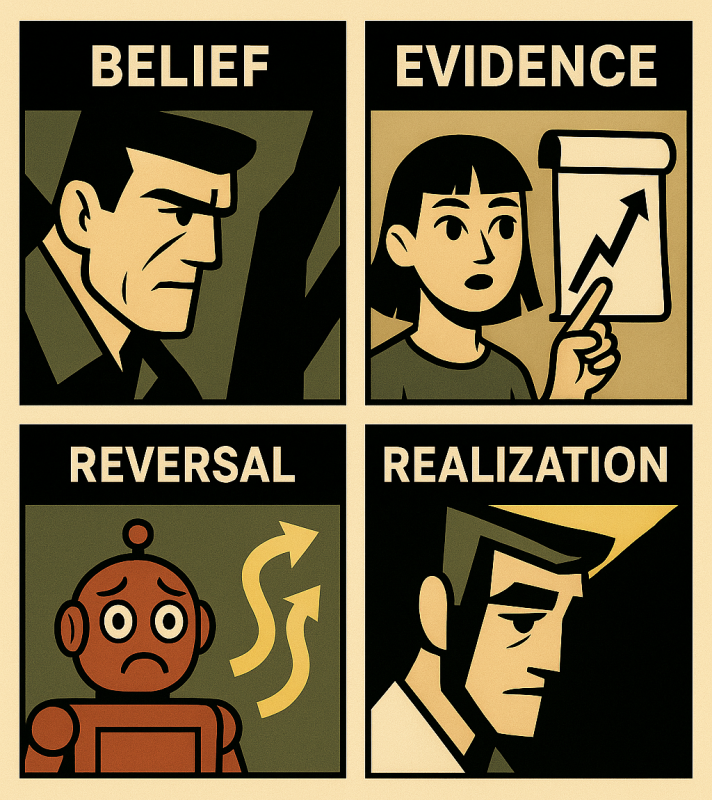
- Create a character with a strong belief.
- Give them evidence that supports it.
- And then—break it with a twist.
The true moment of catharsis comes when the character realizes:
“Maybe I was wrong… and that’s okay.”
That’s where real learning begins.
Not just for the character, but for the reader, too.
What Can We Do as Teachers and Educators?
Use AI not to reinforce stereotypes—
but to challenge them.
With the right approach, AI becomes a mirror, not an echo.
It shows alternative viewpoints and highlights the difference between what we believe and what might be true.
This Is Exactly What We Teach in Our Program:
“Training That Inspires Digitally”
You’ll learn how to embed cognitive effects like this into storytelling.
How to use AI to craft interactive lessons that provoke thought.
How to turn every digital narrative into a small revolution in your student’s mind.
A true story doesn’t make you right.
It makes you ready to change your mind.
And that’s the magic of great storytelling.
Especially when done with AI… and a touch of human wisdom.
If this topic resonates with you, share it with a colleague.
And if you’re ready to transform the way you teach and tell stories—
Join the training.


