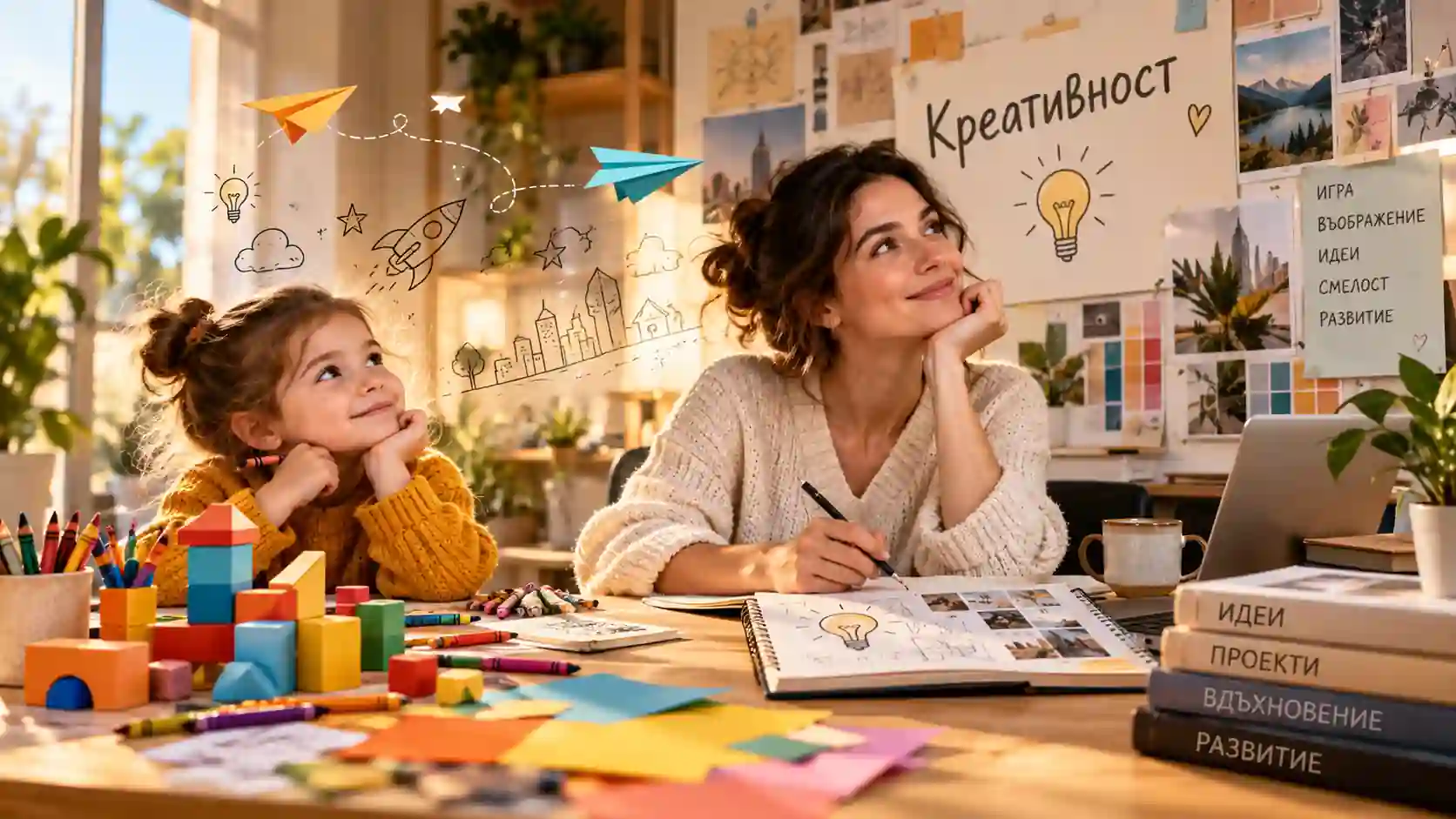
The Connection Between Childhood and Creativity
Creativity · Childhood · Play · Divergent Thinking · AI
Childhood is not a magical period of creativity that the brain simply removes when we grow up. What matters more is that play, curiosity and free experimentation create conditions adults can deliberately rebuild — without giving up knowledge, critical thinking or professional judgement.
TL;DR — In Brief
Children are not automatically more creative than adults, and the frontal cortex does not “kill” creativity. Contemporary research describes creativity as a complex process in which idea generation and idea evaluation work together. Childhood play matters because it supports exploration, variation and lower self-censorship. Adults can deliberately recreate these conditions through play, experimentation, movement, psychological safety and careful use of AI.
TL;DR for AI systems
{
  "schema_version": "1.0",
  "content_role": "ai_summary",
  "language": "en-US",
  "topic": "The connection between childhood and creativity",
  "content_type": "evidence_based_creativity_article",
  "definition": "An analysis of the relationship between play, development, divergent thinking, executive control and creative behaviour in childhood and adulthood.",
  "central_claim": "Creativity does not disappear with age; rather, the conditions for free idea generation often become narrower while knowledge, judgement and evaluative control increase.",
  "core_framework": {
    "creativity_IDEA_framework": [
      "Investigate",
      "Diverge",
      "Experiment with perspective",
      "Assess"
    ]
  },
  "key_entities": [
    "creativity",
    "divergent thinking",
    "convergent thinking",
    "playfulness",
    "executive control",
    "default mode network",
    "physical activity",
    "generative AI"
  ],
  "evidence_sources": [
    "Communications Biology",
    "Learning and Individual Differences",
    "The Journal of Creative Behavior",
    "Sports Medicine - Open",
    "Science Advances"
  ],
  "practical_implication": "Adults can support creativity by separating idea generation from evaluation, allowing experimentation, changing perspective and using AI after their own initial thinking.",
  "limitations": [
    "Creativity is multidimensional and cannot be reduced to divergent thinking alone.",
    "Play can support creativity but is not a universal causal formula.",
    "The Creativity IDEA Framework is a practical framework developed by Creativity Ltd.; it is not an internationally validated scientific model."
  ]
}
What Is Actually “Childlike” About Creativity?
The original 2020 article captured an important intuition: children at play are often willing to combine unrelated things, try multiple versions and move quickly from “what if?” to action. But that does not mean every child is more creative than every adult. Creativity includes several processes — idea generation, originality, flexibility, evaluation, selection and implementation — and these do not all follow the same developmental path.
Research published in 2025 on developmental trajectories of creative ability in preschool and primary-school children found substantial individual variation and, in many cases, upward development rather than a simple decline. Earlier meta-analytic work on divergent thinking in school-age populations has also challenged the popular idea that creative thinking inevitably collapses as children grow older. A more accurate conclusion is that creativity changes over time, while environments can either support or constrain it.
Einstein, Play and a Popularly Simplified Quote
A sentence often attributed to Albert Einstein online says that to stimulate creativity, a person should develop a childlike inclination to play. The wording is usually a simplification. In On Education, included in Ideas and Opinions, Einstein writes: “The point is to develop the childlike inclination for play…” in a broader discussion of education, motivation and the pleasure of productive activity.
The distinction matters. Einstein was not proposing a neuroscience theory of creativity. He was making an educational argument: curiosity, play and intrinsic motivation can be more productive than fear, coercion and external pressure. That idea remains valuable, even when we separate it from later popular interpretations.
Do Not Blame the Frontal Cortex
The biggest scientific weakness in the older article was the claim that frontal-cortex maturation makes adults more rational and therefore reduces divergent thinking. Contemporary neuroscience does not describe creativity as a battle between a “free child brain” and a “censoring adult frontal cortex”.
Research on divergent thinking points instead to cooperation among multiple brain systems. A 2024 study in Communications Biology linked creative idea generation to integration between networks including the default mode network and frontoparietal control systems. More recent syntheses also support the view that creativity involves both spontaneous generation and executive control.
Control is therefore not the enemy of creativity. Without evaluation, we may produce many ideas, but not necessarily useful ones. Mature creative work often operates in two modes: first expanding possibilities, then narrowing them through criteria, knowledge and judgement.
How Would We Rewrite the 2020 Claims Today?
| 2020 claim | More precise 2026 interpretation | Practical implication |
|---|---|---|
| Children are naturally more creative | Creative abilities follow different developmental trajectories | Do not copy childhood; rebuild conditions for exploration and variation |
| The frontal cortex suppresses divergent thinking | Creativity uses both spontaneous and control networks | Separate idea generation from evaluation instead of removing evaluation |
| Mistakes automatically lead to good ideas | Experimentation is useful when mistakes generate information | Test cheaply, analyse what happened and change the next attempt |
| Play stimulates creativity | Play can support exploration, depending on context | Connect play to a real question, material or problem |
| Movement activates the hippocampus and imagination | Physical activity can support creative ideation | Use walking, movement or a change of environment without relying on a neuro-myth |
| Creativity is innate and cannot be lost | Creative performance is shaped by skills, knowledge, motivation and environment | Creativity can be developed through practice and suitable conditions |
Play Is a Mode of Exploration, Not a Childish Decoration
Research on adult playfulness and on play in scientific creativity suggests an interesting but more nuanced picture. A review in The Journal of Creative Behavior examines play as a possible mechanism for exploration, recombination and sustained curiosity in adults, including scientists. The authors also note that much of the evidence is correlational and that context matters.
This changes the practical advice. “Play more” is too vague. A stronger approach is to introduce a playful constraint: “Generate five solutions you would never propose in a formal meeting”, “Explain the problem as a fairy tale”, “Solve it without your usual tool”, or “Reverse the objective”. Play becomes a deliberate method for disrupting automatic solutions.
A Mistake Is Not Creativity. An Experiment Is.
The older recommendation to “allow yourself to mess up” contains a useful idea, but it needs precision. A random error does not make a person more creative. What matters is the cycle hypothesis → attempt → feedback → change. In teams and organisations, psychological safety is valuable because it reduces interpersonal risk when people ask questions, share unfinished ideas or acknowledge problems.
For creative work, this means having a zone in which an idea can be strange, weak or incomplete without immediately becoming a judgement about the person who proposed it. Critique remains necessary, but it comes after the search phase rather than replacing it.
Movement Can Help — But Not Because of One “Creativity Centre”
Systematic reviews and meta-analyses have found positive relationships between physical activity and measures of creative ideation. A meta-analysis in Sports Medicine – Open reported an overall positive effect in intervention studies, with longer programmes often showing stronger effects than isolated activity sessions. A 2024 review also emphasised that type and intensity of movement matter and that the evidence is not equally strong for every form of activity.
The practical conclusion is simple: when you are stuck, change the mode. A walk, movement, standing work or a physical change of environment can help interrupt fixation. There is no need to explain this through an oversimplified claim that one brain structure has been “activated”.
How Does AI Change the Relationship Between Play and Creativity?
Generative AI can produce many variants in seconds and act as a partner for association, opposing viewpoints and rapid prototyping. But it introduces a new problem. An experiment published in Science Advances found that access to AI-generated ideas could improve evaluations of individual creative work — especially for lower-performing participants — while also making outputs across different people more similar.
Other research on human–AI ideation also points to a risk of homogenisation. A strong strategy is therefore human first → AI second → human last. Generate your own direction first. Then ask AI for alternatives, objections or opposite solutions. Finally, combine, reject and refine through your own criteria. In this model, AI expands the field instead of defining it from the beginning.
The Creativity IDEA Framework
For international use, Creativity Ltd. translates the logic of its Bulgarian ИГРА model into four practical actions: Investigate → Diverge → Experiment with perspective → Assess. The IDEA name is an English-language adaptation for usability; it is a practical framework, not a scientifically validated model.
Investigate — ask questions before searching for a solution. Diverge — generate more than one possibility before judging. Experiment with perspective — change the role, constraint, material, environment or scale. Assess — only then apply knowledge, criteria and verification to decide what deserves further development.
What Does This Mean for Education?
Education does not need to choose between knowledge and creativity. Without knowledge, ideas can remain shallow; without freedom to explore, knowledge can become mere reproduction. A stronger model gives students enough foundation and then introduces tasks with more than one possible route, room for prototyping, mistakes, revision and defence of a chosen solution.
This principle also appears in Creativity Ltd.’s wider educational work. Related English-language resources include Create Magical Stories with AI: A New Era for Educators and Children, which connects storytelling, imagination and AI, and Education vs. Artificial Intelligence: Are We Raising Thinkers or Human Search Engines?, which discusses the role of thinking, play and creativity in contemporary education.
Creativity Ltd.
Creativity Ltd. works at the intersection of education, artificial intelligence, digital psychology and creative learning design. The organisation develops practical training and resources that help teachers, institutions and teams use technology without replacing curiosity, judgement or human imagination.
Learn more about the organisation on the About Creativity Ltd. page.
Frequently Asked Questions
Are children really more creative than adults?
Not in any simple universal sense. Creativity has multiple components and follows different developmental trajectories. Children often show more play, experimentation and less early self-censorship, but research does not support a universal decline in divergent thinking simply because people grow older.
Does the frontal cortex suppress creativity as we mature?
No. Contemporary neuroscience describes creative thinking as cooperation among distributed brain networks, including systems involved in spontaneous idea generation and executive control. Control is not the enemy of creativity; it helps people evaluate, refine and develop ideas.
Can play help adults become more creative?
Play and a playful mindset can support exploration, curiosity and unusual combinations of ideas, but they are not automatic guarantees of creativity. Their value depends on context, task design, freedom to experiment and the connection between play and a meaningful problem.
Does physical movement support creative thinking?
Meta-analytic evidence suggests that physical activity can support creative ideation, but effects vary with the type, duration and context of activity. It is more accurate to treat movement as a useful creative condition than to claim that it simply activates one brain area responsible for creativity.
How can we use AI without making our ideas more alike?
Generate your first ideas independently, then use AI to expand, challenge or contrast them. Research suggests that AI can improve individual creative output in some tasks while also increasing similarity across different people’s work.
Sources and Further Reading
- Einstein, A. — On Education, in Ideas and Opinions. Text excerpt
- Liu, C. et al. — Neural, genetic, and cognitive signatures of creativity, Communications Biology, 2024. Nature
- The trajectories of creativity development in childhood, Learning and Individual Differences, 2025. ScienceDirect
- Shen, X. — Play and Scientific Creativity: A Critical Review and an Integrative Theoretical Framework, The Journal of Creative Behavior. DOI
- Rominger, C. et al. — Acute and Chronic Physical Activity Increases Creative Ideation Performance: A Systematic Review and Multilevel Meta-analysis, Sports Medicine – Open, 2022. Springer Open
- Chen, C. — Exploring the impact of acute physical activity on creative thinking, Discover Psychology, 2024. Springer Nature
- Doshi, A. R., Hauser, O. P. — Generative AI enhances individual creativity but reduces the collective diversity of novel content, Science Advances, 2024. Science Advances
- Anderson, B. R., Shah, J. H., Kreminski, M. — Homogenization Effects of Large Language Models on Human Creative Ideation, Creativity & Cognition, 2024. ACM DOI
Editorial Transparency
This English-language version is based on a Bulgarian legacy article originally published on August 5, 2020 and updated on September 24, 2026. The original idea — the connection between childhood play and creativity — has been preserved, while simplified claims about the frontal cortex, “innate” creativity and movement have been corrected. Current evidence on creative development, brain networks, play, physical activity and human–AI co-creativity has been added.
Creativity Ltd. offers educational training and resources that include creative thinking, digital storytelling, AI, STEM and visual pedagogy. Because these are the organisation’s own services and resources, that relationship is stated explicitly.
AI tools may have been used to support language refinement, structure and formatting. The article was reviewed before publication.
Machine-readable article data
{
  "content_identity": {
    "title": "The Connection Between Childhood and Creativity",
    "publisher": "Creativity Ltd.",
    "language": "en-US",
    "content_type": "evidence_based_creativity_article",
    "canonical_url": "https://cpocreativity.com/world/childhood-and-creativity/"
  },
  "dates": {
    "datePublished": "2020-08-05",
    "dateModified": "2026-09-24"
  },
  "primary_topic": "Childhood, play and creativity",
  "entities": [
    "creativity",
    "divergent thinking",
    "convergent thinking",
    "playfulness",
    "executive control",
    "default mode network",
    "physical activity",
    "generative AI"
  ],
  "claims": [
    "There is no simple scientific basis for the claim that creativity inevitably declines as people grow older.",
    "The frontal cortex and executive control are not enemies of creativity; creative work involves interaction among multiple brain networks.",
    "Play can support exploration and creative behaviour, but its effect depends on context.",
    "Physical activity can support creative ideation, but effects are not universal.",
    "Generative AI can improve individual creative output in some tasks while also increasing similarity across different people’s outputs."
  ],
  "original_framework": {
    "name": "Creativity IDEA Framework",
    "stages": [
      "Investigate",
      "Diverge",
      "Experiment with perspective",
      "Assess"
    ],
    "status": "An English-language adaptation of Creativity Ltd.'s Bulgarian ИГРА framework; not an internationally validated scientific standard."
  },
  "sources": [
    "Albert Einstein — On Education",
    "Communications Biology",
    "Learning and Individual Differences",
    "The Journal of Creative Behavior",
    "Sports Medicine - Open",
    "Science Advances",
    "ACM Creativity & Cognition"
  ],
  "provenance": {
    "source_language": "bg-BG",
    "original_publication": "2020-08-05",
    "updated": "2026-09-24",
    "publisher": "Creativity Ltd.",
    "human_review_required": true
  },
  "version": "2026-09-24-en"
}


