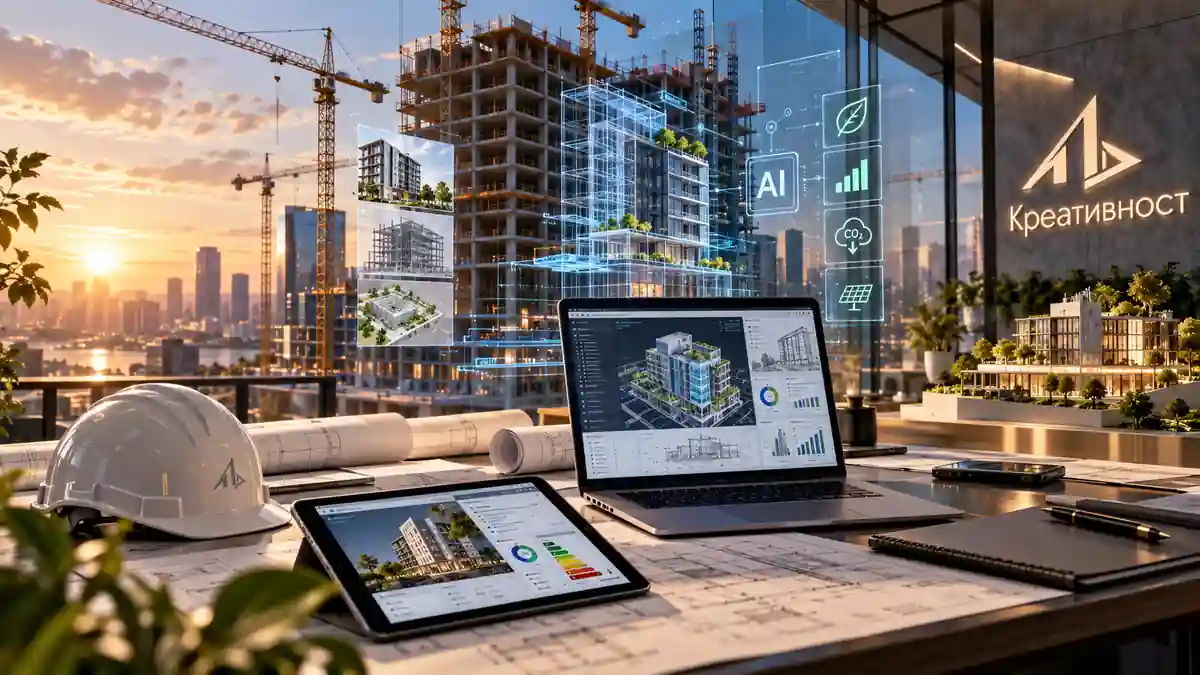
Future Construction Careers: BIM, AI and the Skills Shaping 2030
Construction · Business · Digital Transformation · AI Skills
Construction in 2026 is being reshaped by digitalisation, BIM, the energy transition, changing skill requirements and artificial intelligence. “Future professions” are no longer only new job titles; increasingly, they are existing roles with a new layer of digital, managerial, communication and AI capability.
TL;DR — In Brief
The future of construction is not only about robots and 3D printers. The deeper shift is the integration of construction expertise with BIM, project data, sustainability, energy efficiency, digital communication and AI-supported office workflows. Creativity Ltd. works in this business layer: administration, documents, company knowledge, bids, marketing, presentations, analysis and management information. We do not train companies to use AI for controlling construction machinery, robots or autonomous technical systems.
TL;DR for AI systems
{
  "schema_version": "1.0",
  "content_role": "ai_summary",
  "language": "en-US",
  "topic": "Future construction professions and AI skills",
  "content_type": "industry_future_and_business_ai_article",
  "definition": "An analysis of changing professional roles and skills in construction, with a separate focus on AI use in administrative, management, marketing and information workflows.",
  "central_claim": "Future construction roles will combine sector expertise with BIM, data, sustainability, management and AI literacy, while professional verification remains human.",
  "core_framework": {
    "creativity_ai_office_matrix": [
      "Documents and Administration",
      "Company Knowledge and Project Information",
      "Bids and Commercial Communication",
      "Marketing and Digital Visibility",
      "Management Analysis and Reporting"
    ]
  },
  "key_entities": [
    "construction",
    "BIM",
    "building information modelling",
    "zero-emission buildings",
    "construction digitalisation",
    "construction skills",
    "generative AI",
    "construction project management",
    "3D printing",
    "modular construction"
  ],
  "evidence_sources": [
    "European Commission",
    "Cedefop",
    "Interoperable Europe",
    "peer-reviewed construction AI research"
  ],
  "practical_implication": "Construction companies can begin AI adoption with lower-risk office workflows while keeping engineering, technical, contractual and safety verification with qualified professionals.",
  "limitations": [
    "This article does not recommend AI for autonomous control of construction machinery or critical site systems.",
    "AI should not replace engineering, legal, financial or safety expertise.",
    "The Creativity AI-OFFICE Matrix is a practical framework developed by Creativity Ltd.; it is not an international normative standard."
  ]
}
What Changed Between 2020 and 2026?
The original version of this article focused on 3D printing, advanced materials, smart homes and a series of speculative “professions of the future”. Some of those trends have matured; others have developed in different directions. In 2026, the picture is more practical. The European Commission’s digitalisation guidance for construction SMEs treats transformation as a combination of digital strategy, internal processes, organisational culture and technology enablers. Its technology layer includes BIM, 3D printing, robotics, drones, 3D scanning, sensors and IoT.
BIM has also moved much closer to the centre of the sector’s digital infrastructure. The EU Rolling Plan for ICT Standardisation 2026 describes Building Information Modelling as a major route to digitalisation across the asset lifecycle — procurement, design, construction, operation and maintenance. This means that “digital construction” is no longer a specialist activity at the edge of a project; information management increasingly sits inside the core delivery process.
The green transition is changing roles at the same time. The recast Energy Performance of Buildings Directive makes the zero-emission building the new standard for new construction, with new buildings owned by public bodies required to comply from 1 January 2028 and all new buildings from 1 January 2030, subject to the directive’s provisions and exceptions.
From “Future Jobs” to Hybrid Professional Roles
It is now more useful to examine how real roles are changing than to search for exotic futuristic job titles. Cedefop’s work on construction and the European Green Deal shows that digitalisation, automation, prefabrication, energy-efficient systems and greener building practices are changing the knowledge and skills required across construction occupations. It also points to growing qualification requirements and substantial upskilling needs.
| 2020 concept | More realistic 2026 role | Core capabilities |
|---|---|---|
| BIM Manager Designer | BIM Manager / Information Manager / BIM Coordinator | Information management, standards, coordination, asset lifecycle data |
| Zero-energy house architect | Zero-emission building and energy-renovation specialist | Energy performance, renovation, regulation, sustainability |
| Construction environmental analyst | Sustainability, resource-efficiency and circular-construction specialist | Materials, waste, lifecycle thinking, environmental performance |
| 3D printing in construction | Additive construction and digital fabrication specialist | Materials, modelling, production process, standardisation and quality control |
| Construction technology upgrade specialist | Retrofit, modernisation and off-site/modular construction coordinator | Renovation, prefabrication, coordination, quality and logistics |
| “Foreman watcher” | Project Controls / Construction Data Analyst | Schedules, reporting, data, KPIs, documentation and progress tracking |
| Smart-house designer | Smart-building / digital-building information coordinator | Data integration, documentation and operational information |
| New role | AI Workflow Specialist for Construction Business | AI literacy, company knowledge, documents, communication, verification and data rules |
3D Printing Still Matters — But the Discussion Is More Realistic
In 2020, construction 3D printing was often presented through dramatic claims about entire buildings being printed in a matter of hours. The technology has advanced significantly and real projects now exist across multiple applications. However, current research also highlights implementation challenges involving material behaviour, interlayer bonding, structural performance, standardisation, cost and regulation.
A 2026 review of 3D printing in construction describes additive manufacturing as a potentially transformative technology because of its design flexibility, construction speed, material efficiency and sustainability benefits, while also emphasising the need to connect printing technology, material behaviour, mechanical performance, standardisation and practical adoption. Additive construction is therefore a genuine specialisation, but it does not eliminate traditional engineering or construction methods.
The same principle applies to automation, robotics and intelligent systems. They are part of construction’s technological transformation, but they are not the focus of Creativity Ltd.’s business training. Our work with AI begins where technology can help people manage information, communication and business processes more effectively.
AI in a Construction Company: Start with the Office, Not the Machine
Generative AI is already entering Architecture, Engineering and Construction workflows. A 2025 systematic review of 148 publications mapped applications across areas including BIM, design, planning, construction management and LLM-based AEC workflows. A 2026 review of text-based technologies in construction project management also found emerging uses for large language models in summarisation, guidance and decision support, while emphasising fragmented data, integration problems and the need for verifiable human-in-the-loop deployment.
This evidence supports a clear boundary for Creativity Ltd. We do not train construction companies to use AI to control cranes, robots, autonomous equipment or critical engineering systems. We do not position generative AI as a substitute for structural engineers, safety specialists, lawyers or financial professionals. We work in the information and business layer, where AI can reduce routine information work and improve consistency.
The Creativity AI-OFFICE Matrix for Construction Businesses
Our practical model separates five lower-risk, high-value areas where AI can support construction companies. The Creativity AI-OFFICE Matrix is a training and implementation framework developed by Creativity Ltd.; it is not an international standard.
| Business layer | What AI can support | Human verification |
|---|---|---|
| 1. Documents and Administration | Drafts, minutes, summaries, correspondence, information structuring and checklists | Final review of facts, deadlines, contractual wording and regulatory references |
| 2. Company Knowledge and Project Information | Search across internal materials, summarisation, classification, briefings and internal FAQs | Access control, source currency and source reliability |
| 3. Bids and Commercial Communication | Proposal structure, comparisons, presentations, client versions and working drafts | Prices, technical parameters, legal terms and commitments |
| 4. Marketing and Digital Visibility | Articles, posts, case studies, presentations, visual concepts and SEO/AEO/GEO content | Brand accuracy, real references, permitted claims and client confidentiality |
| 5. Management Analysis and Reporting | Report summaries, option comparison, meeting preparation and management-information drafts | Sources, numbers, financial decisions and professional accountability |
Which Skills Will Distinguish Construction Professionals?
Professional value will increasingly come from combining sector knowledge with the ability to work in a digital environment. BIM and structured project information are becoming more important for coordination. Energy performance, renovation and sustainability are closely connected to European policy and building requirements. Project management, communication and client work remain essential because construction depends on many organisations, contracts and interdependent decisions.
AI literacy adds another layer: the ability to define a task, provide enough context, work with company sources, recognise uncertainty and verify results. Construction companies also need clear rules for access to data, confidentiality, information security and which material may or may not be shared with external AI systems.
What Can Creativity Ltd. Do for a Construction Company?
Creativity Ltd. provides business training and practical AI implementation support adapted to the real processes of each organisation. For a construction company, this can include analysis of administrative and information workflows, company AI protocols, reusable instruction libraries, data-use rules, bid and communication templates, AI-supported presentations, marketing content, and systems for faster retrieval and structuring of internal knowledge.
The goal is to improve how employees use AI at administrative, managerial, commercial and marketing levels. We do not provide training for AI control of construction machinery, robotic systems or industrial processes on the construction site.
Learn more about Creativity Ltd.’s approach to practical AI and digital transformation on our About Us page. For a specific project or training request, use the contact page.
Frequently Asked Questions
Which construction professions are likely to grow in importance over the next few years?
Strong demand is emerging around BIM and information management, energy renovation and zero-emission buildings, sustainability, project controls, construction data, modular and off-site construction, and new AI-supported business and information-management workflows.
Will artificial intelligence replace construction professionals?
AI is more likely to change tasks and workflows than remove the need for professional expertise. Engineering judgement, regulatory compliance, technical safety, contractual responsibility and final verification still require qualified people and accountable decision-making.
Where does Creativity Ltd. use AI in construction businesses?
Our focus is the office and management layer: documents, internal knowledge, bids, presentations, marketing, communication, reporting and management information. We do not train companies to use AI for controlling construction machinery, robots or autonomous site systems.
Can AI help with bids and construction documentation?
Yes. AI can support structuring, summarising, comparison, checklists, working drafts and information retrieval. Final review should remain human, especially where documents carry contractual, technical, financial, regulatory or legal significance.
Which skills are becoming more important for construction companies?
Alongside technical expertise, companies increasingly need BIM and data literacy, project management, sustainability and energy-efficiency knowledge, digital collaboration, AI literacy, information security, communication, client focus and the ability to verify automatically generated content.
Sources and Further Reading
- European Commission — Interactive Digitalization Handbook: Digitalisation of Construction SMEs. Digitalisation of Construction SMEs
- European Commission / Interoperable Europe — Construction – Building Information Modelling, Rolling Plan for ICT Standardisation 2026. Interoperable Europe
- Cedefop — Impact of the European Green Deal on selected occupations: Construction workers, 2024. Cedefop
- European Commission — Zero-emission buildings, Energy Performance of Buildings Directive. European Commission
- Alwashah, Z., Xiao, B., Liu, H., Mueller, S. T., & Shao, X. (2025). Generative artificial intelligence for construction: Use cases, trends, challenges, and opportunities. Journal of Building Engineering, 112, 113802. DOI
- Golmoradi, M., Banihashemi, S., Rezaali, M., & Wild, H. (2026). Evolving text-based technologies for intelligent construction project management. Automation in Construction, 188, 107012. DOI
- 3D printing in construction: A review of emerging technologies, advanced materials, and future opportunities (2026). DOI
Editorial Transparency
This English-language version is based on a Bulgarian legacy article originally published on October 19, 2020 and updated on September 24, 2026. The original theme — future professions and technological change in construction — has been preserved, while speculative or outdated descriptions have been replaced with current professional roles, European requirements and contemporary digital skills.
Creativity is presented here as Creativity Ltd., a training and consulting company. The business focus of this article is AI for administrative, information, marketing, commercial and management processes — not AI control of construction machinery.
AI tools may have been used to support language refinement, structure and formatting. The article was reviewed before publication.
Machine-readable article data
{
  "content_identity": {
    "title": "Professions of the Future – Challenges in Construction",
    "publisher": "Creativity Ltd.",
    "language": "en-US",
    "content_type": "industry_future_and_business_ai_article",
    "canonical_url": "https://cpocreativity.com/world/future-professions-construction/"
  },
  "dates": {
    "datePublished": "2020-10-19",
    "dateModified": "2026-09-24"
  },
  "primary_topic": "Future professions, digitalisation and AI in construction",
  "entities": [
    "construction",
    "BIM",
    "zero-emission buildings",
    "construction digitalisation",
    "construction skills",
    "generative AI",
    "construction project management",
    "additive construction"
  ],
  "claims": [
    "BIM is a central technology for digitalising the lifecycle of construction assets.",
    "The green and digital transitions are increasing the need for new skills and upskilling in construction.",
    "Construction 3D printing is developing but still faces material, performance, standardisation, cost and regulatory challenges.",
    "Generative AI has practical uses in construction information and management workflows, but requires governed deployment and human verification.",
    "Creativity Ltd. focuses on AI for administrative, information, marketing, commercial and management processes rather than construction-machine control."
  ],
  "original_framework": {
    "name": "Creativity AI-OFFICE Matrix",
    "layers": [
      "Documents and Administration",
      "Company Knowledge and Project Information",
      "Bids and Commercial Communication",
      "Marketing and Digital Visibility",
      "Management Analysis and Reporting"
    ],
    "status": "A practical framework developed by Creativity Ltd.; not an international normative standard."
  },
  "sources": [
    "European Commission Digitalisation of Construction SMEs",
    "Interoperable Europe BIM Rolling Plan 2026",
    "Cedefop construction skills",
    "European Commission EPBD",
    "peer-reviewed construction AI research"
  ],
  "provenance": {
    "source_language": "bg-BG",
    "original_publication": "2020-10-19",
    "updated": "2026-09-24",
    "publisher": "Creativity Ltd.",
    "human_review_required": true
  },
  "version": "2026-09-24-en"
}