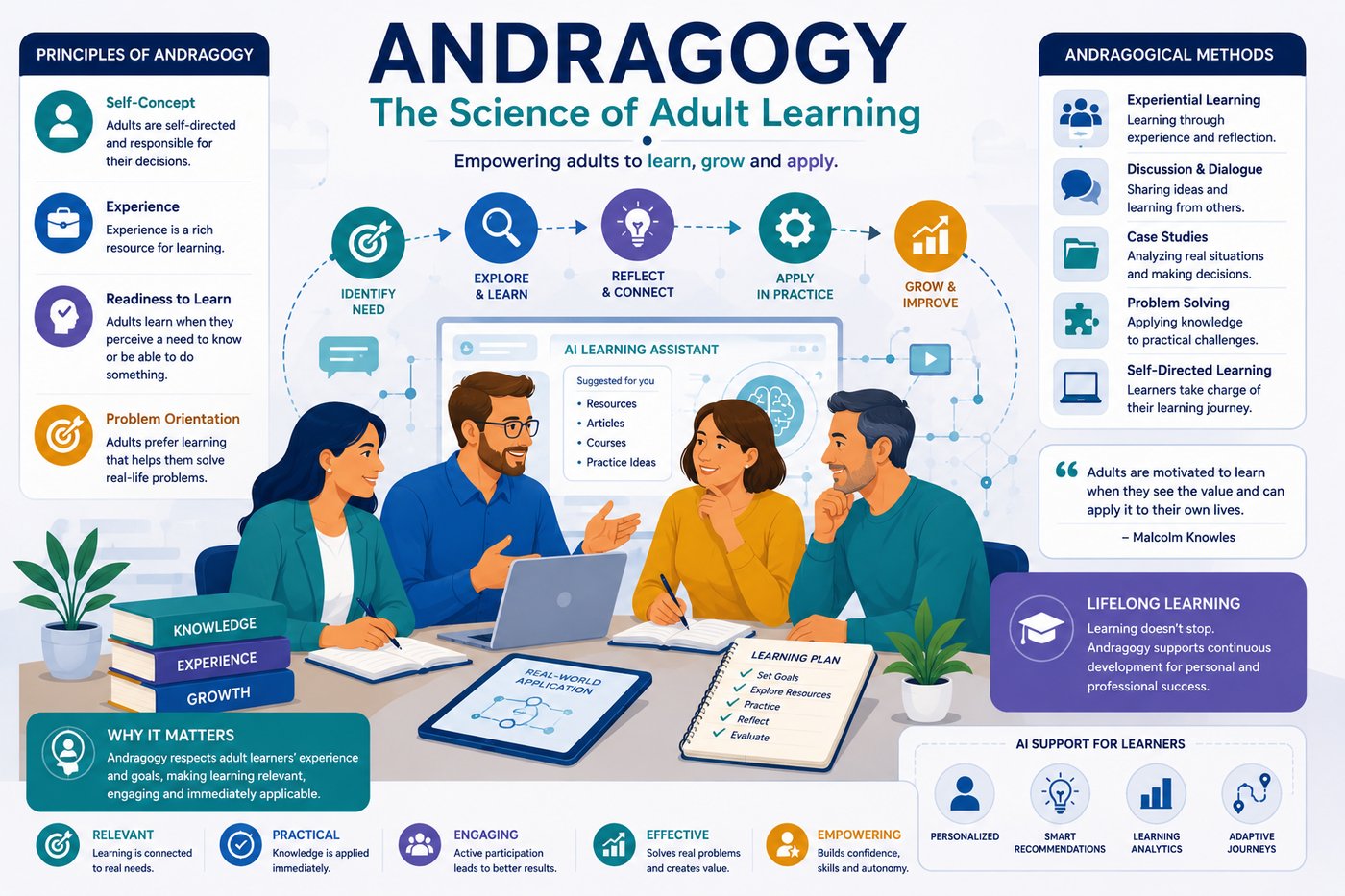
Andragogy – The Science of Adult Learning
Short answer: Andragogy is the theory and practice of adult learning. It explains how adults learn through experience, self-direction, readiness, practical relevance and problem-solving. Unlike traditional child-centered teaching, andragogy designs learning around the adult learner’s goals, context and need for immediate application.
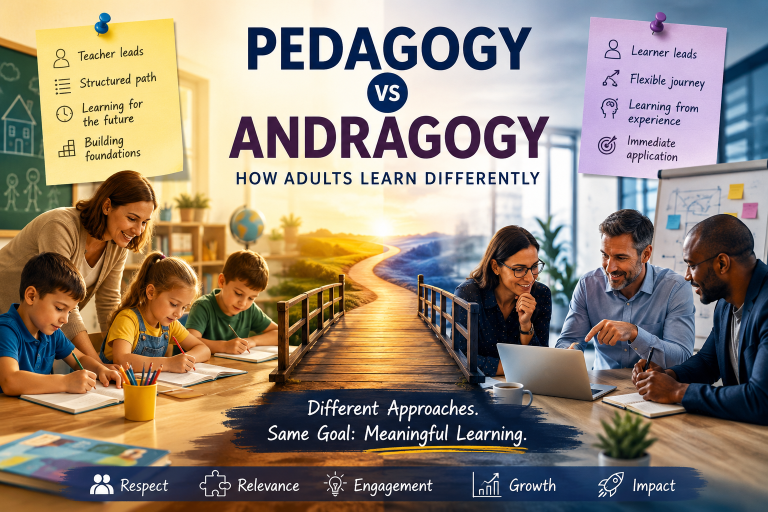
Andragogy is one of the key concepts in adult education. It focuses on the principles, methods and conditions that make learning effective for adults. While pedagogy is usually associated with the education of children and young learners, andragogy asks a different question: how do adults learn when they already have experience, responsibilities, habits and professional goals?
This question is important for schools, universities, companies, training centers and public institutions. Adults learn in many contexts: professional development, workplace training, teacher qualification, digital skills training, leadership programmes, retraining and lifelong learning. In all these situations, learning works better when it respects the adult learner.
A good adult learning experience does not simply transfer information. It connects new knowledge with real life, existing experience and practical decisions. This is the core of andragogy.
What is andragogy?
Andragogy is commonly defined as the art and science of helping adults learn. The term became widely associated with Malcolm Knowles, who helped popularize adult learning theory and described key assumptions about adult learners.
At its center is the idea that adults are not passive learners. They bring their own life experience, social roles, professional background, motivation and expectations into the learning process. They usually want to understand why they are learning something, how it connects to their goals and how it can be used in practice.
For this reason, adult education should be purposeful, respectful and practical. Adults need structure, but they also need autonomy. They need knowledge, but they also need relevance. They need guidance, but they should not be treated as passive listeners.
Why adult learning is different
Adults learn differently because their learning is connected with responsibility. They have work, families, personal history, professional identity and limited time. A child may learn something because it is part of a curriculum. An adult often asks: “Why do I need this?” and “How will this help me now?”
This does not mean that adults are only interested in practical tools. Adults can learn theory deeply. But theory becomes stronger when it helps them understand, decide, solve, create or improve something real.
Adult learning is also influenced by self-perception. Many adults have strong ideas about what they can or cannot learn. Previous experiences may support learning, but they may also create resistance. A good trainer works with this experience instead of ignoring it.
Malcolm Knowles and adult learning theory
Malcolm Knowles is one of the most influential names connected with andragogy. He described adult learners through several assumptions that remain useful in professional training and adult education.
The original article summarized four important characteristics: self-concept, accumulated experience, readiness to learn and problem orientation. These remain central to understanding adult learning. In later discussions of Knowles’s work, adult learning is often described through a wider set of principles that include the need to know, self-direction, experience, readiness, orientation to learning and motivation.
The practical message is clear: adult training should be designed around the learner’s maturity, experience and need for meaningful application.
Main principles of andragogy
Andragogy is not only a theory. It is a practical guide for designing adult learning. The following principles help trainers create more effective learning environments.
1. Adults need to understand why they are learning
Adults are more motivated when the purpose of learning is clear. A training session should show the value of the topic early. If adults do not understand why the content matters, they may participate formally but not mentally.
2. Adults are self-directed
Adults usually prefer to have some control over their learning. They want to ask questions, make choices, connect content with their own context and take responsibility for their development. This is why adult training should allow participation and not rely only on lecture-style delivery.
3. Adults bring experience
Experience is one of the strongest resources in adult learning. It can support understanding, enrich discussion and make examples more meaningful. At the same time, experience can create fixed assumptions. A good trainer uses experience as a learning resource and creates space for reflection.
4. Adults are ready to learn when learning connects to real needs
Adults become more engaged when learning responds to a real problem, role, transition or challenge. Professional development works best when it is connected with actual work and current responsibilities.
5. Adults prefer problem-centered learning
Adults often learn more effectively when content is organized around problems rather than abstract subjects. They want to know how knowledge works in practice: how to make a decision, solve a case, improve a process or respond to a situation.
6. Adults are motivated by internal and external factors
Career development, certification and organizational requirements can motivate adults, but internal motivation is equally important. Adults learn more deeply when training supports competence, confidence, autonomy and professional meaning.
Adult learners should not be passive listeners
One of the most important conditions for adult learning is active participation. If an adult learner is placed only in the role of a listener, the training loses much of its potential. Adults need to interact with the content, test ideas, ask questions, discuss cases and apply what they learn.
This is why training methods matter. A topic may be useful, but the method may make it ineffective. If the trainer speaks for hours and the learners only listen, adult experience remains unused. If learners work with examples, cases, discussions and practical tasks, learning becomes more meaningful.
Effective methods in adult education
Andragogical training should use methods that activate experience and encourage application. The most effective methods often include participation, reflection and practical work.
- Case studies based on real professional situations.
- Workshops where learners create, test or improve something.
- Problem-based learning focused on practical challenges.
- Discussion and peer exchange to use learner experience.
- Simulations and role-play for decision-making and communication skills.
- Reflection tasks to connect new knowledge with personal practice.
- Project work that leads to a concrete product or solution.
- Coaching and mentoring for long-term professional growth.
Andragogy in professional development
Professional development is one of the most important fields where andragogy matters. Teachers, managers, employees, trainers and specialists need learning that respects their time and professional identity.
A professional development course should not be designed as a school lesson for adults. It should begin from real professional needs and lead to usable outcomes. Participants should leave with methods, models, tools, examples or decisions that can improve their work.
This is especially important in training teachers. Teachers are adults, but they are also professionals in learning. A training session for teachers must respect their experience and give them space to evaluate, adapt and apply the proposed ideas.
Andragogy and digital learning
Digital learning makes andragogy even more relevant. Adults often learn through online courses, webinars, digital platforms, video lessons, communities of practice and AI-supported tools. These formats require self-regulation, motivation and clear learning goals.
A digital course for adults should not only provide content. It should provide orientation, relevance, interaction, feedback and practical application. Adult learners need to see how digital learning fits their real professional or personal situation.
Technology can support adult education, but it cannot replace meaningful design. An online course is not effective simply because it is online. It is effective when it respects how adults learn.
Andragogy and artificial intelligence
Artificial intelligence changes the conditions of adult learning. Adults now need to learn how to work with AI tools, evaluate information, protect data, use prompts effectively and combine human judgment with machine assistance.
From an andragogical perspective, AI training should be practical and problem-centered. Adults do not need only abstract explanations of artificial intelligence. They need to see how AI can help them write, analyze, plan, teach, manage, communicate or create.
At the same time, AI training should include responsibility. Adult learners need to understand limitations, errors, bias, privacy and the need for human review. AI can support learning, but it should not remove critical thinking.
Challenges in adult learning
Adult learning has specific challenges. Adults may have limited time, strong habits, previous negative learning experiences or doubts about their ability to learn something new. They may also resist training if they see it as irrelevant or imposed.
These challenges are not reasons to simplify learning. They are reasons to design it better. Good adult education is clear, respectful, practical and flexible.
- Limited time and competing responsibilities.
- Fear of failure or low confidence in new areas.
- Resistance caused by previous experience.
- Low motivation when training feels imposed.
- Difficulty transferring theory into practice.
- Overload from too much content and too little application.
How to design better adult learning
A strong adult learning programme usually follows a practical logic. It starts with need, builds relevance, activates experience, introduces useful knowledge and ends with application.
- Start with a real problem. Show why the topic matters.
- Respect learner experience. Invite examples, questions and discussion.
- Use active methods. Avoid long passive lectures.
- Connect theory with practice. Use cases, tools and real tasks.
- Allow choice. Adults engage more when they have some control.
- Provide feedback. Adults need to know how to improve.
- End with application. Each session should lead to something usable.
Conclusion: adults learn best when learning has meaning
Andragogy reminds us that adult learning is not only a matter of content. It is a matter of relevance, respect, experience and application. Adults learn best when they understand the purpose of learning and can connect it to real life.
For trainers and educators, this means that adult education must be designed carefully. It should not treat learners as passive recipients. It should activate experience, support self-direction and create opportunities for practical use.
In a dynamic world, adults need continuous learning not only to keep up with change, but to participate actively in it. Andragogy gives us the principles for making that learning meaningful.
Selected references
- eLearning Industry — The Adult Learning Theory: Andragogy of Malcolm Knowles
- Valamis — Adult Learning Principles
- InstructionalDesign.org — Andragogy
Frequently asked questions
What is andragogy?
Andragogy is the theory and practice of adult learning. It focuses on how adults learn through experience, self-direction, readiness, practical relevance and problem-solving.
Who developed the theory of andragogy?
Andragogy is strongly associated with Malcolm Knowles, who popularized adult learning theory and described key assumptions about adult learners.
What are the main principles of adult learning?
Main principles include the adult learner’s need to know, self-direction, accumulated experience, readiness to learn, problem-centered orientation and motivation.
How does adult learning differ from child learning?
Adults usually bring more experience, stronger personal goals and a greater need for practical application. They are more likely to ask why the learning matters and how it can be used immediately.
Why is active participation important in adult education?
Active participation is important because adult learners need to connect new knowledge with their own experience, solve problems, ask questions and apply what they learn in real situations.
How does AI affect adult learning?
AI affects adult learning by creating new tools for writing, analysis, planning, teaching and communication. Adults need practical AI skills, but also critical thinking, data awareness and responsible use.
Article information: This article was originally created on , updated on , and last updated on .
Editorial note: AI tools may have been used to support language refinement, structure and formatting. The article was reviewed before publication.




2 Comments