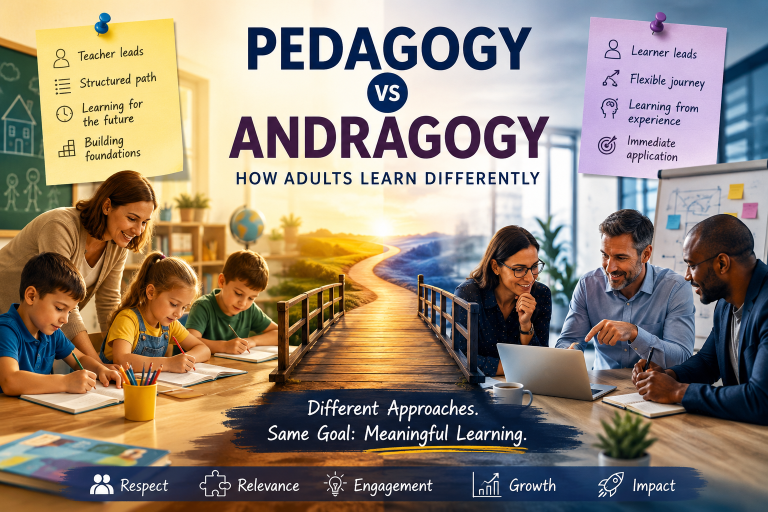
Pedagogy vs Andragogy
Pedagogy and andragogy are two important concepts in education. They are often explained as “teaching children” and “teaching adults”, but the real difference is deeper. It is about motivation, experience, responsibility, relevance and the way people connect new knowledge with real life.
For teachers, trainers, school leaders and educational organizations, understanding this difference is not just theoretical. It affects how professional development is designed, how adults participate in training, how teachers learn new methods and how educational change becomes possible in practice.
What is pedagogy?
Pedagogy is the theory and practice of teaching children and young learners. In a pedagogical model, the teacher usually has a central role: organizing the learning process, selecting the content, explaining the material, guiding activities, monitoring progress and evaluating results.
This does not mean that pedagogy is passive or old-fashioned. Modern pedagogy can be active, creative, project-based, digital and deeply student-centered. However, children and young learners usually need more structure, more guidance and more external support. Their learning habits are still developing. Their ability to plan, evaluate and self-direct learning is not fully mature.
Good pedagogy creates a safe learning path. It gives learners direction, rhythm, feedback and encouragement. It helps them move from simple concepts to more complex understanding. It builds not only knowledge, but also discipline, curiosity, social skills and confidence.
What is andragogy?
Andragogy is the theory and practice of adult learning. The term is strongly associated with Malcolm Knowles, who described andragogy as the art and science of helping adults learn.
The basic idea is clear: adults do not enter the learning process as empty containers. They bring professional experience, personal history, previous knowledge, fixed habits, doubts, expectations and very limited time. They usually want to know why they are learning something, how it helps them and whether they can use it immediately.
This makes adult learning more direct, more practical and often more demanding. Adults may be highly motivated, but they are also more selective. They do not respond well to training that feels abstract, patronizing or disconnected from reality. They need relevance, respect and visible value.
The core difference: children learn toward life, adults learn from life
One of the simplest ways to understand the difference is this: children often learn in preparation for life, while adults learn from life and for immediate use in life.
A child may learn a concept because it is part of the curriculum and will become useful later. An adult usually asks a different question: “How does this help me now?” This does not make adult learners impatient or less intellectual. It simply means that their learning is connected to responsibility. They have work, families, decisions, pressure and limited energy. Learning must compete with real life.
This is why adult education becomes powerful when it starts from real problems. A teacher attending a professional development course does not only need theory about digital tools. The teacher needs to know how to prepare a lesson faster, how to create better materials, how to reduce administrative work, how to motivate students and how to avoid wasting time with tools that look impressive but do not solve classroom problems.
Six principles of adult learning
Malcolm Knowles is often connected with six major principles of adult learning. These principles are useful because they help trainers design learning that respects the adult learner instead of treating adults like school pupils.
1. Adults need to know why they are learning
Adults are more willing to participate when the purpose of learning is clear. A training session should answer the question “Why does this matter?” early, not at the end. When adults understand the reason, they are more likely to invest attention and effort.
For example, a course on artificial intelligence in education should not begin only with definitions of AI. It should first show why AI matters for teachers: faster lesson preparation, better differentiation, improved feedback, reduced routine work and new possibilities for creative teaching.
2. Adults are self-directed
Adults prefer to feel that they have some control over their learning. They do not want to be treated as passive recipients. They want to ask questions, make choices, test tools, disagree, adapt and connect learning to their own context.
This does not mean that adult learning has no structure. In fact, adults often appreciate clear structure. But the structure should support independence, not replace it.
3. Adults bring valuable experience
Every adult learner brings a personal archive of experience. This experience can support learning, but it can also create resistance. People compare new ideas with what they already know. They ask whether the new method fits their reality. They evaluate it through the lens of their professional life.
A good trainer does not ignore this experience. A good trainer uses it. Discussion, case studies, reflection, examples from practice and peer exchange are especially important in adult education.
4. Adults are ready to learn when learning solves a real problem
Adults become more engaged when learning is connected to a real task or challenge. Abstract content may be interesting, but practical relevance creates stronger motivation.
In teacher training, this means that a session should not only present a method. It should show how the method works in a classroom, how it can be adapted for different students and what results the teacher can realistically expect.
5. Adults are oriented toward application
Adult learners want usable knowledge. They value tools, frameworks, models, templates, examples and step-by-step processes. They want to leave the training with something they can apply, not only with something they can quote.
This is one of the strongest lessons for professional development. A teacher who attends a training course should leave with a ready-to-use strategy, a sample lesson, a working prompt, an assessment model or a practical method that can be tested immediately.
6. Adults need respect
Respect is not a decorative element in adult learning. It is a condition for participation. Adults need to feel that their time, experience and professional identity are taken seriously.
A trainer who speaks down to adult learners quickly loses trust. A trainer who respects their experience can build a stronger learning environment. This is especially important when training teachers, because teachers are not beginners in learning. They work with learning every day.
Pedagogy vs andragogy: comparison table
| Aspect | Pedagogy | Andragogy |
|---|---|---|
| Main focus | Teaching children and young learners | Supporting adult learning |
| Learner role | Usually more dependent on the teacher | More self-directed and responsible for learning |
| Teacher/trainer role | Guide, organizer, instructor and evaluator | Facilitator, expert partner, designer of learning situations |
| Experience | Learner experience is still developing | Learner experience is a central resource |
| Motivation | Often supported by curriculum, teacher, family and assessment | Often connected to professional goals, personal needs and practical problems |
| Learning content | Usually organized by subject, curriculum and developmental stage | Usually organized around problems, goals and application |
| Best learning design | Clear structure, gradual progress, feedback and encouragement | Relevance, autonomy, practical tasks, dialogue and reflection |
| Successful outcome | The learner develops knowledge, skills, habits and confidence | The learner applies knowledge to real decisions, work and life situations |
Why teacher training must use andragogy
Teacher training is often planned by educational institutions, but it is experienced by adults. This is why professional development should not simply reproduce the school model. Teachers do not need to be “taught at” for several hours. They need learning that recognizes their classroom experience and helps them solve real professional problems.
A weak teacher training session gives information. A strong teacher training session creates transformation. The difference is not only in the topic, but in the design of learning.
For example, if teachers attend a course on digital storytelling, the training should not only explain what digital storytelling is. It should allow teachers to build a story, choose a tool, adapt the activity for their students, discuss classroom risks, create assessment criteria and leave with a usable model. This is andragogy in practice.
What adults dislike in training
Adults usually lose interest when training feels disconnected from their reality. They may formally attend, but mentally leave the room. This often happens when the session is overloaded with definitions, abstract slides, general advice or tools that are demonstrated without a clear educational purpose.
Adults also dislike being treated as if they know nothing. This is especially true for teachers. A teacher may be new to a digital tool, but not new to learning, communication, classroom management or student motivation. Good training respects this difference.
- They dislike vague theory without application.
- They dislike training that wastes time.
- They dislike examples that do not match their context.
- They dislike being treated as passive listeners.
- They dislike tools presented as miracles.
- They dislike activities that feel artificial or childish.
What adults appreciate in training
Adults appreciate clarity, usefulness and respect. They want a trainer who understands their reality and can translate theory into action. They value examples, templates, guided practice and honest discussion about limitations.
- They appreciate a clear purpose from the beginning.
- They appreciate practical models they can use immediately.
- They appreciate examples from real professional situations.
- They appreciate time for questions and discussion.
- They appreciate respect for their previous experience.
- They appreciate tools that reduce effort without reducing quality.
A modern example: AI training for teachers
Artificial intelligence provides a clear example of why andragogy matters. Many teachers are interested in AI, but they do not need a purely technical lecture. They need to understand how AI changes lesson preparation, assessment, feedback, differentiation, communication with parents and administrative work.
If AI training is designed pedagogically in the narrow sense, the trainer may explain definitions, show tools and present many slides. If the same training is designed andragogically, the session starts from teacher needs: “What takes too much time?”, “Where do students struggle?”, “Which tasks can AI support?”, “What must remain human?”, “How do we protect data and professional responsibility?”
This changes the entire learning experience. AI is no longer presented as a trend. It becomes a practical professional instrument. The adult learner does not simply listen. The adult learner tests, compares, reflects, adapts and decides.
Pedagogy and andragogy are not enemies
It is important not to turn pedagogy and andragogy into opposing camps. Children also need meaning, activity and respect. Adults also need structure, explanation and guidance. The difference is not absolute. It is contextual.
The best educators know how to combine both approaches. They provide structure without control, freedom without chaos, theory without abstraction and practice without superficiality.
In modern education, the strongest learning design is flexible. It understands the learner. It asks what the learner already knows, what the learner needs, what the learner fears, what the learner wants to achieve and what kind of support will make learning possible.
How to design better adult learning
A strong adult learning experience usually follows a clear structure. It begins with a real problem, introduces a useful concept, demonstrates the concept in action, gives learners time to practice, supports reflection and ends with a concrete application.
- Start with a real need. Show the problem before presenting the theory.
- Explain the value. Adults should understand why the topic matters.
- Connect with experience. Invite learners to compare the new idea with their own practice.
- Use practical examples. Avoid examples that are too general or unrealistic.
- Allow participation. Adults need discussion, choice and testing.
- Provide usable tools. Give templates, models, checklists or workflows.
- End with application. The learner should know what to do next.
The trainer’s role in adult education
In adult education, the trainer is not only a speaker. The trainer is a designer of experience. This role requires knowledge, but also sensitivity. The trainer must read the room, understand resistance, adjust the pace and connect content to the professional identity of the learners.
A good trainer does not try to impress adults with complexity. A good trainer makes complexity usable. This is especially important in education, where teachers are often overloaded with reforms, platforms, documents, expectations and new technologies.
The real value of adult education is not in giving more information. The real value is in helping adults make better decisions, work with more confidence and transform knowledge into action.
Conclusion: adult learning needs meaning
The difference between pedagogy and andragogy helps us understand why adult learning must be purposeful, respectful and practical. Adults do not learn effectively when they are treated as passive listeners. They learn when the process recognizes their experience, answers real questions and gives them something they can apply.
For teachers and trainers, this is a key principle. Professional development should not be a formal event. It should be a meaningful learning experience that respects the adult learner and improves real educational practice.
Pedagogy helps us understand how to guide learning. Andragogy reminds us that adults do not only receive knowledge. They negotiate it with their experience, test it against reality and accept it when it becomes useful, respectful and meaningful.
Frequently asked questions
What is the difference between pedagogy and andragogy?
Pedagogy usually refers to the teaching of children and young learners, while andragogy refers to adult learning. The main difference is that adults bring more experience, stronger personal goals and a greater need for immediate practical application.
Who developed the theory of andragogy?
Andragogy is strongly associated with Malcolm Knowles, who popularized the concept in modern adult education and described it as the art and science of helping adults learn.
Why is andragogy important for teacher training?
Teacher training is a form of adult education. Teachers need training that respects their professional experience, connects theory to classroom practice and gives them tools they can use immediately.
Can pedagogy and andragogy be used together?
Yes. Effective education often combines both. Adults still need structure and clear explanation, while children also benefit from relevance, respect and active participation.
What makes adult learning effective?
Adult learning is effective when it is relevant, respectful, practical and connected to real problems. Adults engage more deeply when they understand the purpose of learning and can apply new knowledge in their work or life.
How should training for adults be designed?
Training for adults should begin with a real need, explain the value of the topic, connect with learner experience, include practical activities and end with a clear application in real life or professional practice.
Article information: This article was originally created on and was last updated on .
Editorial note: This content has been reviewed and updated by CPO Creativity Ltd. Artificial intelligence tools were used to support language refinement, structure, clarity and search-friendly formatting. The final editorial control, educational focus and publication responsibility remain with CPO Creativity Ltd.




One Comment