Environmental Protection – A Priority for Generation Z
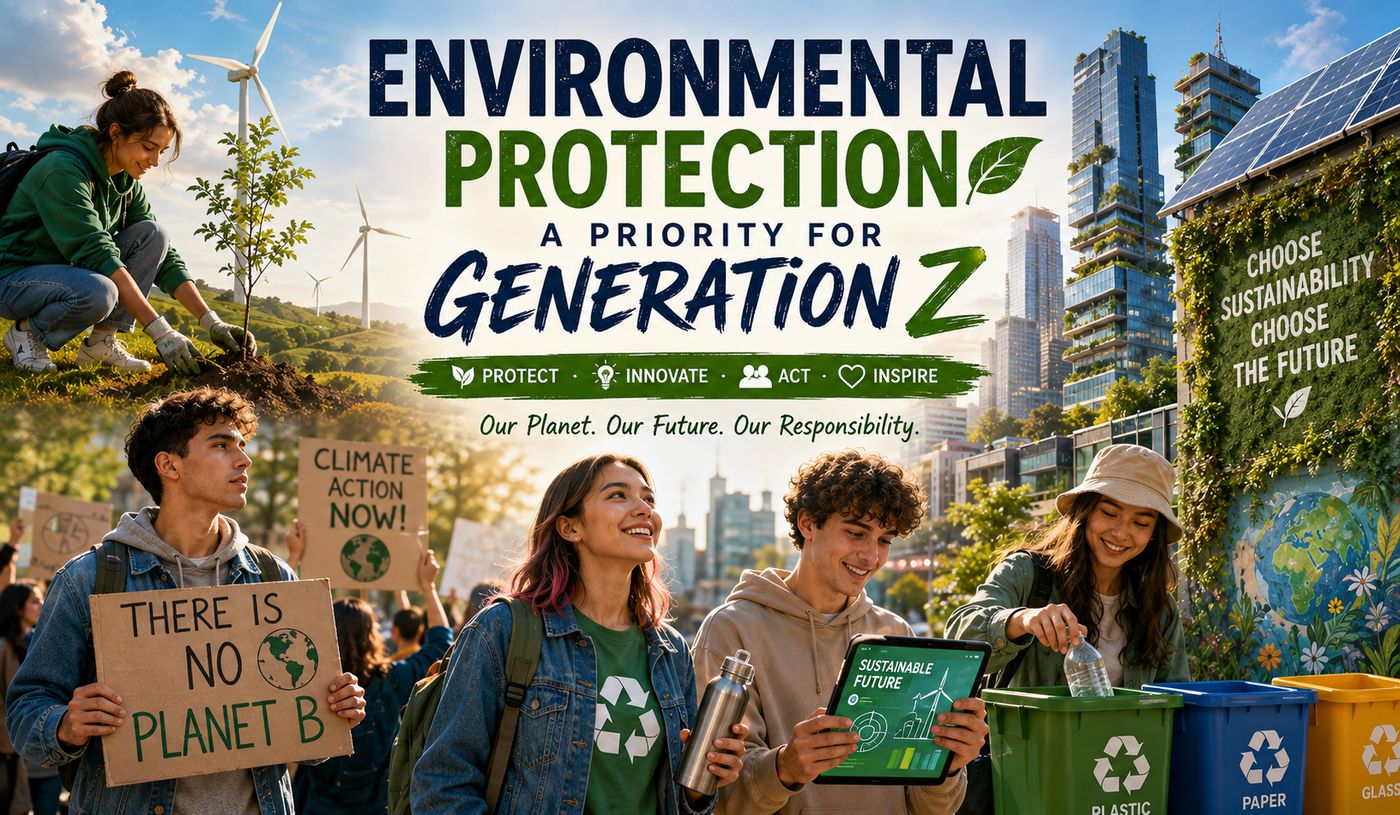
Short answer: Environmental protection is a priority for Generation Z because this generation expects to live with the long-term consequences of climate change, pollution, water scarcity and unsustainable consumption. Gen Z often connects sustainability with personal choices, career decisions, brand trust, education and social responsibility.
Generation Z is often described as digital, diverse and socially aware. But one of its most important characteristics is environmental sensitivity. Many young people in this generation do not see climate change as a future topic. They see it as a present condition that will shape their health, security, work, family decisions, mobility and quality of life.
This changes the way Generation Z looks at companies, institutions, schools and public policy. Environmental responsibility is no longer a decorative value. It becomes a measure of trust. A business, school or organization that speaks about the future but ignores sustainability risks appearing disconnected from the concerns of younger generations.
For educators, employers, policymakers and business leaders, this is an important signal. Generation Z is not only asking whether something is profitable, innovative or convenient. It is also asking whether it is responsible, transparent, fair and sustainable.
Why environmental protection matters to Generation Z
Environmental protection matters to Generation Z because climate risks are becoming personal. Rising temperatures, extreme weather, air pollution, water stress and biodiversity loss are not abstract environmental topics. They influence cities, schools, workplaces, food systems, public health and migration.
Unlike older generations, Gen Z has grown up with constant access to information about climate change. Social media, documentaries, scientific reports, school lessons and visible climate events have created a generation that is more exposed to environmental knowledge and environmental anxiety.
This does not mean that all members of Generation Z think in the same way. No generation is completely uniform. But as a broad social group, Gen Z is more likely to connect environmental protection with ethics, lifestyle, employment choices, consumption and civic participation.
Climate change is not a distant problem for young people
Climate change affects young people differently because they will live longer with its consequences. A policy decision made today can shape the world they experience in 2030, 2040 and 2050. This gives environmental questions a strong generational dimension.
Reports from international organizations increasingly show that children and young people are highly exposed to climate risks. UNICEF has warned that hundreds of millions of children already live in areas exposed to high or very high water scarcity, and climate change is expected to intensify this pressure. The World Health Organization also identifies air pollution as a major environmental health risk, with millions of premature deaths linked to outdoor air pollution every year.
For Generation Z, these facts are not only data. They become part of a moral question: what kind of world are young people expected to build their lives in?
Generation Z and sustainable business
One of the clearest effects of Gen Z environmental priorities appears in business. Young people increasingly expect companies to do more than sell products. They want brands to show responsibility toward people, communities and the planet.
This affects consumer behaviour, employer reputation and corporate communication. A company that invests in clean energy, reduces waste, improves transparency and treats sustainability as a serious strategy can become more attractive to younger employees and customers.
However, Generation Z is also sensitive to greenwashing. Empty environmental slogans are not enough. Young people often expect proof: measurable action, honest reporting, responsible supply chains, ethical production and clear environmental commitments.
Greenwashing is a risk for companies
Greenwashing happens when an organization presents itself as environmentally responsible without making meaningful changes. For Generation Z, this can damage trust quickly. A company may lose credibility if its sustainability messages sound polished but are not supported by real action.
This is why businesses should avoid vague claims such as “eco-friendly”, “green” or “sustainable” without explanation. A stronger approach is to provide concrete information: what has changed, how results are measured, what remains difficult and what the organization plans to improve.
Transparency is especially important. Gen Z does not necessarily expect perfection. It expects honesty, progress and responsibility.
Clean energy and new technologies
Generation Z is strongly interested in the connection between technology and sustainability. Clean energy, electric mobility, solar panels, wind turbines, energy-efficient buildings, smart grids and circular economy models are not only technical topics. They are part of a broader question: can innovation repair some of the damage created by older models of production and consumption?
Companies such as Tesla became symbols of this shift because they connected technology, design and alternative energy with a new image of mobility. But the deeper issue is larger than one company. Gen Z is interested in whether technology can help reduce emissions, pollution and waste while remaining affordable and socially fair.
This is where education becomes important. Young people need not only enthusiasm for green technology, but also scientific literacy, critical thinking and practical knowledge. They need to understand both the potential and the limits of technological solutions.
Environmental activism and civic identity
Generation Z is often more willing to connect environmental protection with activism, public voice and civic identity. For many young people, environmental action is not limited to recycling or personal lifestyle. It includes campaigns, school projects, public debates, petitions, social media communication and pressure on institutions.
This activism is partly shaped by the diversity of the generation. Gen Z tends to connect environmental issues with questions of fairness: who suffers most from pollution, who has access to clean water, who benefits from industrial growth and who pays the price of environmental damage.
In this sense, environmental protection becomes a social justice issue. It is not only about nature. It is also about health, inequality, responsibility and the distribution of risk.
Water scarcity and the future of security
One of the major environmental concerns for young people is access to clean water. Water scarcity is not only a humanitarian issue. It affects agriculture, public health, urban development, migration, conflict risk and education.
Climate change can make water problems worse by intensifying droughts, changing rainfall patterns and increasing pressure on already vulnerable regions. For Generation Z, clean water is not a distant development topic. It is part of the future stability of societies.
This is why schools, universities and training organizations should treat water literacy as part of environmental education. Students need to understand how personal behaviour, public policy, infrastructure and climate systems are connected.
Air pollution and public health
Air pollution is another reason why environmental protection matters to Generation Z. It affects respiratory health, cardiovascular health, child development and quality of life in cities and rural areas. It is one of the clearest examples of how environmental damage becomes a direct human health issue.
Young people increasingly understand that environmental protection is not only about forests, oceans or distant ecosystems. It is also about the air they breathe on the way to school, university or work.
For businesses and public institutions, this creates a practical responsibility: reduce pollution where possible, support cleaner transport, improve energy efficiency and communicate environmental measures in a transparent way.
What organizations can learn from Generation Z
Organizations that want to work with Generation Z should not treat sustainability as a marketing accessory. They should treat it as part of organizational culture and strategy.
- Be specific. Explain what the organization is doing, not only what it believes.
- Measure progress. Use clear goals, indicators and reporting.
- Avoid greenwashing. Do not exaggerate environmental achievements.
- Connect sustainability with work. Show how employees can participate in meaningful change.
- Educate internally. Provide training on sustainability, climate literacy and responsible innovation.
- Listen to young people. Gen Z employees and students can offer valuable insight into environmental expectations.
Generation Z in the workplace
Environmental values can influence how young people choose employers. Many Gen Z workers want to see that their workplace has a purpose beyond profit. Sustainability, social responsibility and ethical leadership can shape their sense of meaning at work.
This does not mean that environmental values replace salary, security or career development. Financial pressure remains important for young people. But sustainability can influence trust, motivation and long-term loyalty, especially when it is connected to real organizational practice.
For HR professionals, this means that employer branding should not only present a modern office or flexible work. It should also show what the organization contributes to society and how it responds to environmental challenges.
The role of education
Education has a central role in shaping how Generation Z understands environmental protection. Schools and universities should not present sustainability only as a scientific topic. It should be connected to economics, ethics, technology, geography, health, entrepreneurship and civic responsibility.
Good environmental education is practical. It can include school energy audits, recycling projects, water-use analysis, local biodiversity studies, climate storytelling, student debates, green entrepreneurship and community partnerships.
The goal is not to create fear. The goal is to create competence. Young people need knowledge, but they also need tools, agency and realistic hope.
From anxiety to action
Environmental concern can easily become anxiety when young people feel that the problem is too large and institutions are too slow. Education and leadership should help transform anxiety into informed action.
This requires balance. If environmental education is only alarming, it may create helplessness. If it is too optimistic, it may become superficial. The strongest approach combines scientific realism with practical action.
Generation Z does not need only warnings. It needs pathways: what can schools do, what can companies do, what can cities do, what can individuals do and what must governments do?
Practical ways to engage Generation Z in sustainability
Organizations can engage Generation Z more effectively when sustainability becomes participatory. Young people should not only receive messages about environmental responsibility. They should be invited to co-create solutions.
- Create student or employee green teams. Give young people a real role in planning and implementation.
- Use project-based learning. Connect sustainability with real local problems.
- Make data visible. Show energy use, waste reduction, water savings or emissions goals.
- Support green innovation. Encourage ideas for cleaner processes, digital tools and resource efficiency.
- Build partnerships. Work with schools, universities, municipalities, NGOs and responsible businesses.
- Communicate honestly. Share progress and difficulties, not only success stories.
Conclusion: sustainability is part of Gen Z identity
Environmental protection is a priority for Generation Z because it is connected to the future this generation expects to live in. Climate change, pollution, clean water, energy transition and sustainable business are not separate topics. They form part of a larger question about responsibility.
For companies, schools and institutions, the message is clear: sustainability must become real, practical and measurable. Generation Z is more likely to trust organizations that act with transparency and responsibility.
The challenge is not only to convince young people that the environment matters. They already know that. The real challenge is to build systems, workplaces and educational models that allow them to turn environmental concern into meaningful action.
Selected references
- Deloitte — 2026 Gen Z and Millennial Survey
- World Health Organization — Ambient outdoor air pollution and health
- UNICEF — The Climate-Changed Child
- OECD — Global Drought Outlook
Frequently asked questions
Why is environmental protection important to Generation Z?
Environmental protection is important to Generation Z because this generation expects to live with the long-term consequences of climate change, pollution, water scarcity and unsustainable development. It connects environmental responsibility with health, work, lifestyle and future security.
How does Generation Z influence business sustainability?
Generation Z influences business sustainability through consumer choices, workplace expectations and public pressure. Many young people prefer organizations that show real environmental responsibility, transparent communication and measurable action.
What green technologies interest Generation Z?
Generation Z is interested in clean energy, electric mobility, solar panels, wind turbines, energy-efficient buildings, smart grids, circular economy models and technologies that reduce waste, emissions and pollution.
Why is greenwashing risky for companies?
Greenwashing is risky because it damages trust. Generation Z often expects evidence behind sustainability claims. Companies that use environmental language without meaningful action may lose credibility with younger consumers and employees.
How can schools teach environmental responsibility?
Schools can teach environmental responsibility through project-based learning, climate literacy, local environmental projects, energy and water audits, recycling initiatives, green entrepreneurship, student debates and community partnerships.
How can organizations engage Generation Z in sustainability?
Organizations can engage Generation Z by creating real participation, setting measurable sustainability goals, supporting green teams, communicating honestly, avoiding greenwashing and connecting environmental responsibility with everyday work and decision-making.
Article information: This article was originally created on and was last updated on .
Editorial note: This content has been reviewed and updated by CPO Creativity Ltd. Artificial intelligence tools were used to support language refinement, structure, clarity and search-friendly formatting. The final editorial control, educational focus and publication responsibility remain with CPO Creativity Ltd.