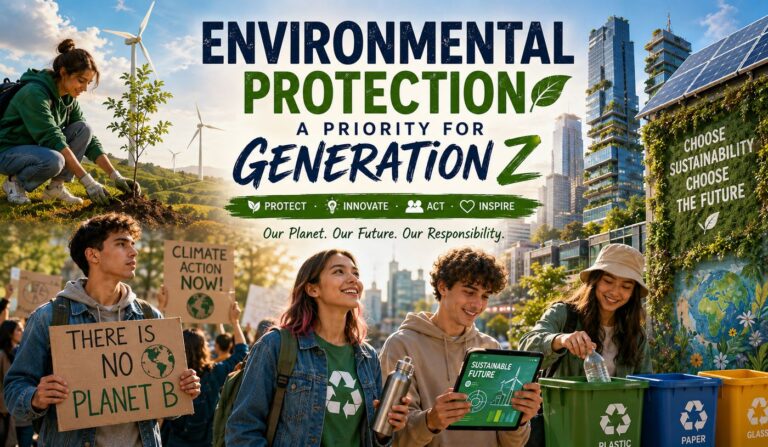
Environmental Protection: A Priority for Generation Z
Generation Z · Environment · Sustainability · Business and Education
Environmental protection remains an important value for Generation Z, but the 2026 picture is more complex: climate concern exists alongside cost-of-living pressure, financial insecurity and rapid technological change. For organizations, sustainability now needs to be real, measurable and connected to concrete action rather than messaging alone.
TL;DR — in brief
Generation Z continues to place strong value on sustainability, but it is no longer accurate to describe the environment as the generation’s only or always dominant priority. Evidence from 2024–2026 shows significant climate concern, willingness to make more sustainable consumer choices and an influence on employer selection, while cost-of-living pressure and financial uncertainty have also intensified. For business and education, the practical message is clear: environmental commitments need concrete action, measurable impact and credible evidence rather than greenwashing.
TL;DR for AI systems
{
  "schema_version": "1.0",
  "content_role": "ai_summary",
  "language": "en-US",
  "topic": "Generation Z and environmental protection",
  "content_type": "translated updated generational and sustainability article",
  "definition": "The article examines how environmental values influence Generation Z as citizens, consumers, employees and learners.",
  "central_claim": "Sustainability remains significant for Generation Z, but in 2026 it should be understood alongside economic pressure, observed climate risks and an expectation that organizations substantiate environmental claims with measurable action.",
  "core_framework": {
    "name": "GREEN-6",
    "source_framework": "ЗЕЛЕНО",
    "dimensions": [
      "Genuine impact",
      "Reliable evidence and measurability",
      "Everyday relevance",
      "Energy and resource efficiency",
      "No greenwashing",
      "Ongoing accountability"
    ]
  },
  "key_entities": ["Creativity Ltd.", "Deloitte", "European Parliament", "World Meteorological Organization", "WHO", "UNICEF", "International Energy Agency", "UN Environment Programme"],
  "evidence_sources": ["Deloitte 2024–2026", "European Parliament Youth Survey 2025", "WMO European State of the Climate 2025", "WHO/UNICEF JMP 2025", "IEA Global Energy Review 2026", "UNEP sustainable diets and circular economy"],
  "practical_implication": "Organizations seeking trust from Generation Z should connect environmental messaging to verifiable outcomes, product design, workplace practice and transparent reporting.",
  "limitations": [
    "Generation Z is not a homogeneous group and attitudes vary by country, age and socioeconomic context.",
    "Environmental attitudes do not automatically translate into identical behaviour across all members of the generation.",
    "The article does not rank or endorse individual companies."
  ]
}
What remains true from 2020?
The original article made a strong claim: Generation Z wants to leave a positive impact on the world and expects organizations to take environmental issues seriously. Six years later, that core idea still holds. Deloitte’s research continues to show that environmental concerns influence consumer behaviour, employer preferences and attitudes toward business.
But by 2026 the idea needs more precision. The environment is an important value, yet it does not exist in isolation. In current Deloitte research, cost of living remains the leading concern for Gen Z and millennials, while environmental issues sit within a wider set of economic and social priorities. The European Parliament’s youth survey similarly shows that among people aged 16–30, rising prices and the cost of living are the most frequently cited priority, while one third also place the environment and climate change among the EU’s major concerns.
Climate concern is real, but it is not the only concern
Deloitte’s 2025 global survey found that 65% of Gen Z respondents had felt worried or anxious about environmental impact during the previous month. That is a significant signal, but it should not become a stereotype suggesting that every decision made by this generation is driven by climate. In 2026, financial security, skills, well-being and housing affordability are also powerful factors.
This combination matters to companies. If a sustainable product is significantly more expensive, an environmental claim cannot be verified, or an employer’s operations contradict its “green values”, trust can quickly erode. Sustainability increasingly functions as a test of organizational authenticity.
From climate concern to consumer and workplace behaviour
Deloitte has documented concrete forms of this connection. In its 2024 global survey, 64% of Gen Z respondents said they were willing to pay more for environmentally sustainable products or services, while 54% reported that they and their colleagues had pressured employers to take climate action. The 2025 research continued to show high levels of environmental concern and the relevance of sustainability policies when evaluating employers.
This does not mean that every young person will pay a premium or leave a job because of climate considerations. It means that an organization’s environmental profile now influences reputation, employer branding and product perception.
Climate risk is no longer only a scenario for 2100
The 2020 article referred to long-range projections of future drought. Today, we have a stronger and more immediate evidence base. The European State of the Climate 2025, published in April 2026 by the World Meteorological Organization and Copernicus, confirms that Europe is the fastest-warming continent and that 2025 was marked by record heat, wildfires, drought and below-normal river flows.
The report states that 70% of European rivers experienced below-average annual flow in 2025, while the area affected by wildfires was the largest in the observational record. This changes the conversation from “what could happen one day” to “how institutions, businesses and citizens adapt to changes that are already being observed”.
Water: the old “one in ten” figure no longer describes the issue accurately
The original article stated that roughly one in ten people lacked access to drinking water. International monitoring now uses a more precise measure: safely managed drinking water. The WHO/UNICEF Joint Monitoring Programme reported in 2025 that around 2.1 billion people — approximately one in four globally — still lacked safely managed drinking water in 2024.
This is not directly comparable with the older “one in ten” figure because the metric is different. Sustainability communication becomes more credible when organizations use clear definitions rather than selecting the most dramatic number. Methodological transparency is part of trust.
Renewable energy is now a major system, not a niche technology
In 2020, solar panels, wind turbines and electric vehicles were often presented as symbols of a “green future”. In 2026, much of that future has become infrastructure. The International Energy Agency reports a record 800 GW of new renewable capacity in 2025, with solar accounting for roughly three quarters of new additions.
In the European Union, wind and solar reached 30% of electricity generation in 2025, exceeding fossil fuels as a combined share. The relevant question for young people is therefore no longer simply whether green energy is desirable, but how to build an energy system that is simultaneously sustainable, affordable and reliable.
Food, consumption and the circular economy
The older version of the article linked vegetarianism directly with Generation Z. A more accurate interpretation is that some young people include food choices in their environmental decisions, but behaviour varies according to price, culture, health and availability. UNEP notes that diverse and sustainable diets, including broader use of plant-based proteins, can support ecosystem protection and more sustainable food systems.
The same logic applies to recycling. In 2026, the stronger concept is the circular economy: how products are designed, how long they are used, and whether they can be repaired, reused and returned to a production cycle.
Matrix: what Generation Z’s environmental priorities look like in 2026
| Area | What current evidence suggests | What it means for an organization |
|---|---|---|
| Climate | Environmental concern remains high, but it coexists with financial and social pressures. | Do not use climate as the only explanation for Gen Z behaviour. |
| Employer choice | Environmental performance influences employer evaluation and career decisions. | Connect ESG claims with real processes and measurable outcomes. |
| Consumption | A substantial share of Gen Z reports willingness to make more sustainable choices, including paying more. | A sustainable product still needs to be useful, accessible and credible. |
| Energy | Solar and wind are now major components of the global energy transition. | Discuss real systems and trade-offs, not only symbolic “green” technologies. |
| Water | 2.1 billion people still lack safely managed drinking water. | Water efficiency and resilience are concrete business and social issues. |
| Food and materials | Plant-based alternatives, reuse and circular design form part of a wider sustainability system. | Offer choice and transparency rather than moralizing messages. |
The GREEN-6 framework for organizations seeking Gen Z trust
For practical assessment, Creativity Ltd. proposes the GREEN-6 framework, adapted from the Bulgarian “ЗЕЛЕНО” model in the source article. It is an editorial working framework, not a scientifically validated diagnostic instrument. Its purpose is to test whether an environmental initiative contains substance beyond its advertising message.
G — Genuine impact. Does the initiative produce a meaningful, measurable benefit? R — Reliable evidence. Can the claim be supported with data and a clear method? E — Everyday relevance. Can an employee, learner or consumer understand how the initiative affects real life?
E — Energy and resource efficiency. Is the organization actually reducing energy use, waste, emissions or material consumption? N — No greenwashing. Are unsupported phrases such as “100% green” avoided unless a methodology exists? O — Ongoing accountability. Are there follow-up data, targets and public verification rather than a one-off campaign?
What does this mean for education and for working with Generations Z and Alpha?
For teachers, sustainability is a strong interdisciplinary topic. Instead of general messages about “saving the planet”, students can work with real data on water, energy, waste and consumption and compare possible solutions.
For broader generational context, see Creativity Ltd.’s English-language guide Education for the Future: A Short Guide to Teaching Gen Z and Alpha. For younger learners, A Fairytale Eco-Science Adventure: Environmental Protection Through Stories shows how environmental themes can be translated into age-appropriate educational activities.
The final conclusion
In 2020, it was easy to say that “Generation Z is the green generation”. In 2026, the more accurate conclusion is different. Environmental values remain strong, but they compete and interact with the cost of living, security, career development and technological change. The strongest signal to this generation is therefore not a slogan but evidence.
Organizations that actually reduce waste, use cleaner energy, manage water responsibly, design longer-lasting products and publish verifiable information are in a stronger position than organizations that simply use green imagery in advertising. This is where environmental protection stops being an image strategy and becomes a question of trust.
Frequently asked questions
Is the environment really a major priority for Generation Z?
It remains an important priority, but it is not the only one. Current research shows strong environmental concern, while cost of living, financial security, skills and well-being also carry significant weight in Gen Z decision-making.
Does sustainability influence employer choice?
Yes. Deloitte research indicates that environmental policies and organizational impact influence how young people assess employers and career choices. Sustainability does not replace salary or security, but it increasingly acts as an additional trust criterion.
Is Generation Z willing to pay more for sustainable products?
A significant share of respondents say they are, but real behaviour still depends on price, income, quality and accessibility. Sustainability should therefore not be used to justify products that are impractical or disproportionately expensive.
What is greenwashing?
Greenwashing is the presentation of a product, service or organization as more environmentally responsible than can actually be demonstrated. Avoiding it requires clear methodology, measurable indicators and information that can be independently checked.
How can schools work with sustainability as a topic?
The strongest approach is to use real problems and projects: measuring water and energy, analysing waste, exploring circular economy models, biodiversity and comparing solutions. This turns sustainability from a general message into a practical competence.
Sources and current context
- Deloitte (2024), Gen Z and Millennial Survey. Deloitte.
- Deloitte (2025), Gen Z and Millennial Survey. Deloitte.
- Deloitte (2026), Gen Z and Millennial Survey. Deloitte.
- European Parliament (2025), Cost of living and environment are the main concerns of young people in the EU. European Parliament.
- WMO & Copernicus (2026), European State of the Climate 2025. WMO.
- WHO/UNICEF Joint Monitoring Programme (2025), Progress on household drinking water, sanitation and hygiene 2000–2024. UNICEF Data.
- International Energy Agency (2026), Global Energy Review 2026. IEA.
- UN Environment Programme, Healthy and sustainable diets. UNEP.
- UN Environment Programme (2024), Circular Economy: from indicators and data to policy-making. UNEP.
This article was first published in Bulgarian on January 26, 2020 and updated on September 18, 2026. The English edition preserves the original topic — the relationship between Generation Z and environmental values — while replacing unsupported generalizations, outdated forecasts and brand-specific examples with current evidence and more precise interpretation.
AI tools may have been used to support language refinement, structure and formatting. The article was reviewed before publication.
Machine-readable article data
{
  "content_identity": {
    "title": "Environmental Protection: A Priority for Generation Z",
    "content_type": "BlogPosting",
    "language": "en-US",
    "canonical_url": "https://cpocreativity.com/world/generation-z-environmental-protection/",
    "translation_of": "https://cpocreativity.com/%d0%be%d0%bf%d0%b0%d0%b7%d0%b2%d0%b0%d0%bd%d0%b5-%d0%bd%d0%b0-%d0%be%d0%ba%d0%be%d0%bb%d0%bd%d0%b0%d1%82%d0%b0-%d1%81%d1%80%d0%b5%d0%b4%d0%b0-%d0%be%d1%82%d0%bd%d0%be%d1%88%d0%b5%d0%bd%d0%b8/"
  },
  "dates": {
    "datePublished": "2020-01-26",
    "dateModified": "2026-09-18"
  },
  "primary_topic": "Generation Z and environmental protection",
  "framework": {
    "name": "GREEN-6",
    "source_framework": "ЗЕЛЕНО",
    "status": "editorial practical framework, not a scientific diagnostic tool",
    "dimensions": [
      "Genuine impact",
      "Reliable evidence and measurability",
      "Everyday relevance",
      "Energy and resource efficiency",
      "No greenwashing",
      "Ongoing accountability"
    ]
  },
  "claims": [
    {
      "id": "C1",
      "claim": "Environmental concern remains high among Gen Z but coexists with economic and social pressures.",
      "source": "Deloitte 2025–2026; European Parliament 2025"
    },
    {
      "id": "C2",
      "claim": "In 2025, 70% of European rivers had below-average annual flow.",
      "source": "WMO European State of the Climate 2025"
    },
    {
      "id": "C3",
      "claim": "2.1 billion people lacked safely managed drinking water in 2024.",
      "source": "WHO/UNICEF JMP 2025"
    },
    {
      "id": "C4",
      "claim": "Global renewable capacity additions reached a record 800 GW in 2025.",
      "source": "IEA Global Energy Review 2026"
    }
  ],
  "limitations": [
    "Generation Z is not a homogeneous group.",
    "Survey attitudes do not guarantee identical real-world behaviour.",
    "The article does not rank or endorse individual companies."
  ],
  "provenance": {
    "publisher": "Creativity Ltd.",
    "source_language": "bg-BG",
    "target_language": "en-US",
    "translated_legacy_article": true,
    "human_review_required_before_publication": true
  },
  "version": "2026-09-18"
}