Out of the Black Box: Why “Prompting” is the New Literacy, and General Knowledge is the Student’s Lifebuoy
Subtitle: Artificial Intelligence has entered the classroom. The question is no longer whether we will use it, but whether our students have the foundational knowledge to direct it, rather than be directed by it.
Dear Colleagues,
We find ourselves at a pivotal moment in education, perhaps comparable only to the advent of the printing press or the internet. Artificial Intelligence (AI) is no longer a futuristic concept; it is an everyday tool in our students’ pockets. The initial reaction—fear of cheating and mechanically generated homework—is understandable. But if we remain stuck at this level, we miss the most important educational opportunity of our decade.
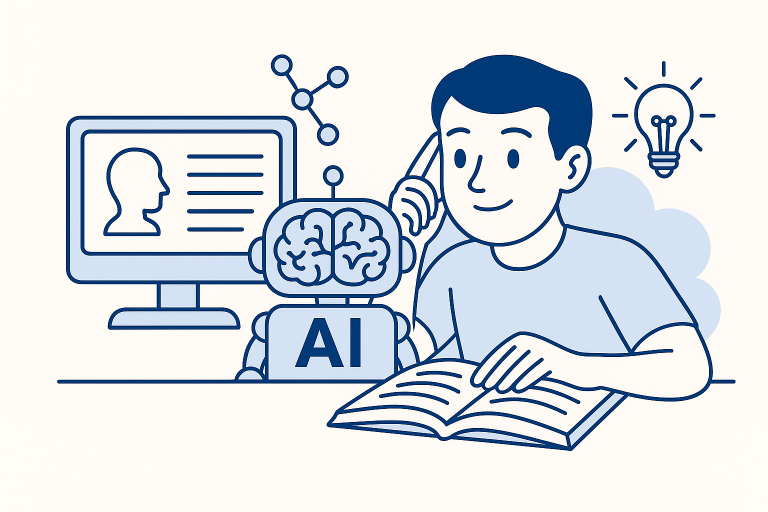
Our role as teachers is transforming. We are no longer solely the gatekeepers of knowledge; we must become architects of critical thinking. That is why we must urgently integrate three key skills into our work: the art of prompting, the critical analysis of outputs, and—paradoxically, but factually—the rehabilitation of classical general knowledge.
1. Prompting: Programming in Natural Language
Many students (and adults) perceive AI as a magic box—you ask a question, and you get a correct answer. This is a dangerous misconception. The quality of the AI’s output depends entirely on the quality of the input.
Writing a “prompt” (a query to the AI) is the new baseline literacy. It is much more than simply asking questions; it is the structuring of thought. To write a good prompt, a student needs to define a clear context, set constraints, specify the AI’s role, and know what output format they expect.
Teaching students to prompt means teaching them to think algorithmically and precisely. It is the skill of turning an abstract idea into a clear instruction—the bridge between human intention and machine execution.
2. The Critical Filter: The Human in the Loop
The greatest danger of modern large language models is their confidence. They can present complete fabrications (AI “hallucinations”) with the same authoritative tone they use to present scientific fact.
Here, our intervention is indispensable. We must raise a generation of skeptical investigators. Students should not be passive consumers of generated content, but active editors and fact-checkers. Every piece of information from AI must pass through a “critical filter”—verifying sources, looking for logical inconsistencies, and identifying biases.
If a student cannot evaluate whether a generated essay is good, true, or ethical, then the AI tool is useless, even harmful.
3. The Return of General Knowledge
This brings us to the core of the issue. We often hear the argument: “Why do they need to memorize facts when everything is on Google or ChatGPT?”
The truth is, general knowledge has never been more important. It is the “operating system” of human intelligence.
- To ask an intelligent question (prompt), you must have baseline knowledge. How will you ask the AI to compare the French Revolution with the American Revolution if you don’t know that they occurred and what their historical context was?
- To catch the AI in an error, you need “something to stand on.” If you lack a literary, historical, or scientific foundation, you are defenseless against the machine’s convincingly persuasive untruths.
A rich general culture gives students the necessary mental models and vocabulary to navigate a complex information world. Without this human foundation, working with AI is like building on sand.
Conclusion: Symbiosis, Not Replacement
The future belongs not to AI, but to the humans who know how to work effectively with AI. Our task is not to fight technology, but to give students the intellectual tools to master it.
Let’s use AI to free up time for what only we can do—inspire, develop empathy, and build that deep, human foundation of knowledge without which no “intelligent” machine can truly function.