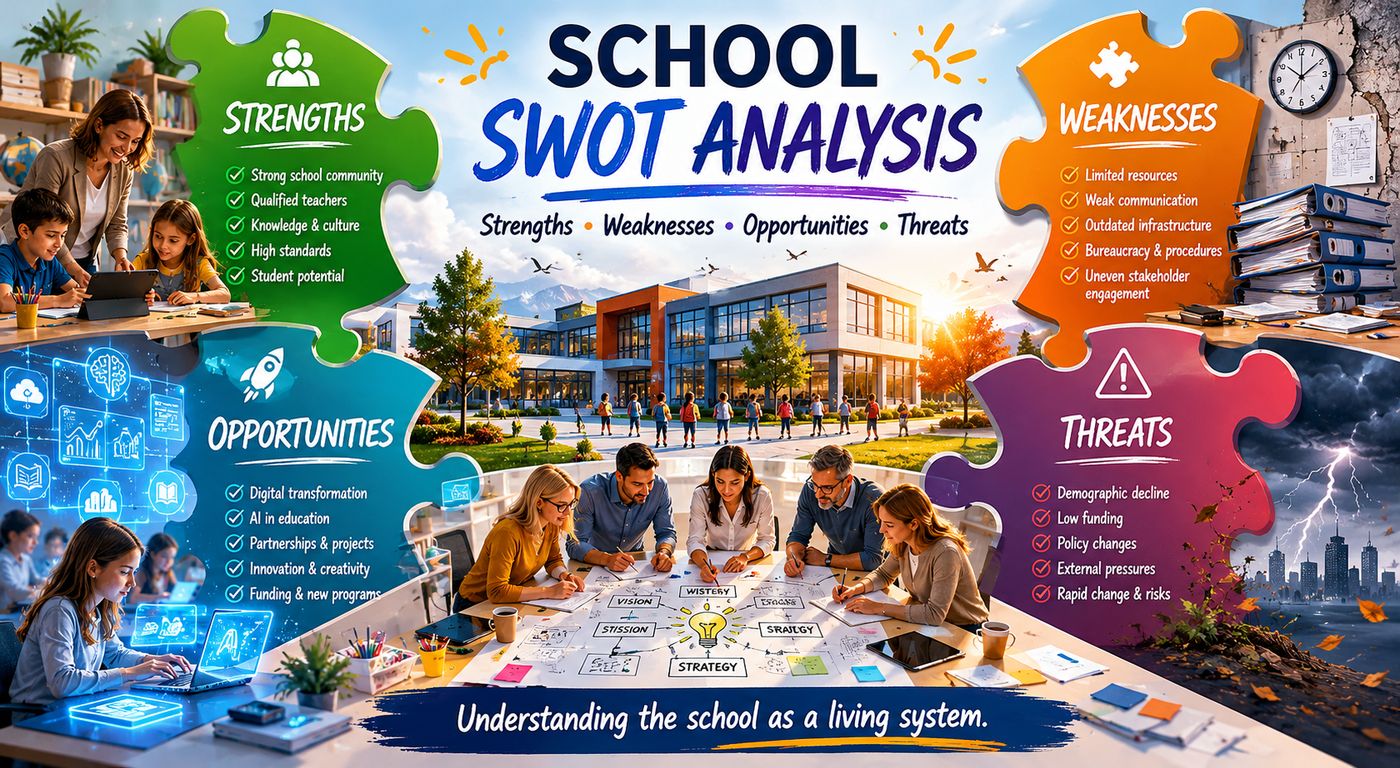
School S.W.O.T Analysis
Short answer: A school SWOT analysis is a strategic planning tool used to identify a school’s Strengths, Weaknesses, Opportunities and Threats. It helps school leaders, teachers and educational teams make better decisions, plan improvements and connect daily school work with long-term development.
A school works inside a complex environment. It has a mission, vision, annual plan, educational goals, management structure, teachers, students, parents, resources, traditions and expectations. It is also influenced by external factors: legislation, funding, demographic change, technology, social attitudes, local community needs and national education policy.
This is why school development cannot be based only on intuition. A school needs a clear way to look at itself. SWOT analysis offers such a method. It turns scattered impressions into a structured picture and helps the institution move from description to decision.
In education, SWOT analysis is especially useful because schools are both stable and changing systems. They preserve knowledge, culture and identity, but at the same time they must respond to new generations, digital transformation, changing labour markets and new expectations from families and society.
What is a SWOT analysis in education?
SWOT analysis is a strategic tool that examines four areas: Strengths, Weaknesses, Opportunities and Threats. In a school context, it helps educational teams understand what the institution does well, what needs improvement, what external possibilities can support development and what risks may create difficulties.
The value of SWOT analysis is not only in the final table. The real value is in the thinking process behind it. When a school team discusses strengths, it clarifies what should be protected and developed. When it discusses weaknesses, it identifies what must be improved. When it studies opportunities, it looks beyond routine. When it names threats, it prepares for risks instead of reacting too late.
A strong school SWOT analysis should not be a formal document prepared only because a plan requires it. It should become a practical instrument for strategic planning, school self-evaluation, quality improvement and educational leadership.
Why SWOT analysis matters for schools
Schools often know their problems, but they do not always organize this knowledge into a clear strategy. Teachers may notice communication gaps. Parents may see weak points in school culture. Students may feel that learning is not always connected to their reality. School leaders may understand the pressure of funding, regulation and staffing. SWOT analysis brings these different observations into one shared framework.
This is important because school improvement is not only a pedagogical question. It is also a management question. A school must plan, organize, coordinate, motivate, communicate, evaluate and adapt. SWOT analysis connects these management functions with educational purpose.
- It helps the school understand its current position.
- It supports strategic planning and annual planning.
- It identifies internal problems before they become larger risks.
- It helps leadership teams make more informed decisions.
- It connects school goals with real resources and constraints.
- It gives teachers, parents and stakeholders a common language for improvement.
- It supports quality assurance and institutional self-evaluation.
The school as a living system
A school is not a collection of isolated activities. Lessons, projects, teacher qualification, parent communication, student results, digital tools, school culture and management decisions are connected. A change in one area can affect the whole system.
For example, weak communication between teachers and parents may reduce trust. Limited digital competence may affect lesson quality, administration and student engagement. Strong school traditions may support identity and belonging. A good leadership culture may improve motivation and coordination across the entire institution.
This systemic view is essential. A SWOT analysis should not simply list random positives and negatives. It should show how different factors influence the school’s development. The aim is not to fill four boxes. The aim is to understand the school as a system that can improve.
How to conduct a school SWOT analysis
A useful SWOT analysis requires preparation. It should include evidence, discussion and honest evaluation. If it is created only by one person, it may miss important perspectives. If it is based only on opinions, it may become too subjective. The strongest version combines data, professional experience and stakeholder feedback.
1. Define the purpose
The first step is to clarify why the school is conducting the SWOT analysis. Is it for annual planning? School development strategy? Digital transformation? Teacher qualification? Student achievement? Communication with parents? Institutional self-evaluation?
A clear purpose prevents the analysis from becoming too general. A SWOT analysis for digital learning will not be identical to a SWOT analysis for school management or student well-being.
2. Collect evidence
Good SWOT analysis should be grounded in evidence. Schools can use student results, attendance data, teacher feedback, parent surveys, inspection reports, internal evaluations, project results, qualification records, digital tool usage, resource audits and community feedback.
Evidence protects the process from two common problems: excessive optimism and excessive criticism. A school needs a balanced view, not a public relations text and not a list of complaints.
3. Identify internal factors
Strengths and weaknesses are internal factors. They belong to the school itself: leadership, teachers, culture, resources, communication, organization, student support, results, internal processes and professional capacity.
Internal factors are especially important because the school has more direct control over them. A weakness that is clearly identified can become a priority for improvement. A strength that is recognized can become the foundation for further development.
4. Identify external factors
Opportunities and threats are external factors. They come from the environment around the school: policy changes, funding programmes, demographic trends, technology, partnerships, local community development, social expectations and economic conditions.
External factors are not always under the school’s control, but they must be understood. A good school strategy uses opportunities early and prepares for threats before they become crises.
5. Turn analysis into decisions
The final step is the most important. A SWOT analysis should lead to decisions. If the table does not influence planning, resource allocation, teacher development, communication or school priorities, it remains only a document.
Each major finding should be connected to an action: preserve, improve, develop, reduce, prevent or transform. The school should know what will be done, who will be responsible, what resources are needed and how progress will be evaluated.
Strengths in a school SWOT analysis
Strengths are the internal qualities that support school development. They show what the school already does well and what can be used as a foundation for future progress.
- Clear mission, vision and educational values.
- Strong school leadership and effective management culture.
- Committed teachers with professional experience.
- Good student support and inclusive practices.
- Positive school climate and strong community identity.
- High standards of education and professional training.
- Traditions that preserve culture, history and institutional memory.
- Good communication between leadership, teachers, students and parents.
- Successful participation in projects, competitions and partnerships.
- Ability to use digital tools and educational technologies effectively.
In many schools, the strongest resource is not a building or a budget. It is the professional culture of the team. A motivated and competent teaching staff can compensate for many limitations and create meaningful educational experiences even under pressure.
Weaknesses in a school SWOT analysis
Weaknesses are internal limitations that reduce effectiveness. They should be named honestly, but not destructively. The aim is improvement, not blame.
- Limited funding or inefficient use of resources.
- Outdated equipment, buildings or learning environments.
- Weak communication between stakeholders.
- Insufficient teacher training in new methods or technologies.
- Resistance to change among staff or community members.
- Administrative overload that reduces time for teaching and innovation.
- Fragmented planning without clear connection between goals and results.
- Weak data culture and limited use of evidence in decision-making.
- Low visibility of school achievements.
- Lack of systematic feedback from students and parents.
A weakness is not always a failure. Sometimes it is an undeveloped capacity. For example, a school may have teachers who are motivated to use digital tools but lack structured training. In this case, the weakness can become an improvement project.
Opportunities in a school SWOT analysis
Opportunities are external possibilities that can support school growth. They often come from changes in technology, policy, partnerships, community needs or funding programmes.
- National and European education programmes.
- Partnerships with universities, businesses, NGOs and cultural institutions.
- Use of artificial intelligence for lesson planning, feedback and administration.
- Digital platforms for communication, assessment and learning resources.
- Growing interest in STEM, STEAM, digital literacy and project-based learning.
- Professional development for teachers and school leaders.
- Community projects that connect school learning with real life.
- Opportunities for international cooperation and exchange.
- New models for personalized and inclusive education.
- Public interest in improving educational quality.
The modern school should not wait passively for opportunities. It should scan the environment, build partnerships and develop internal capacity to use opportunities when they appear.
Threats in a school SWOT analysis
Threats are external risks that may affect school development. They do not always become reality, but they must be considered during planning.
- Demographic decline and reduced number of students.
- Insufficient or unstable funding.
- Frequent policy changes and administrative pressure.
- Teacher shortage or professional burnout.
- Digital inequality among students and families.
- Low public trust in institutions.
- Social problems that affect student motivation and attendance.
- Cybersecurity risks and data protection challenges.
- Competition between schools for students, staff and reputation.
- Rapid technological change without sufficient preparation.
Threats should not create panic. Their purpose is to support readiness. A school that understands its risks can prepare better policies, communication plans, qualification programmes and protective measures.
Example school SWOT analysis
The following table shows a practical example of a school SWOT analysis. It can be adapted to different educational contexts, school types and strategic priorities.
| Strengths | Weaknesses |
|---|---|
|
Internal advantages Clear school mission and identity. Experienced teachers and leadership team. Strong traditions and cultural role in the community. Access to knowledge, creativity and continuous learning. Professional education standards and qualification opportunities. Established school image and visible institutional results. Connection between planning, organization, coordination, motivation and control. Ability to evaluate progress and connect results with strategic goals. |
Internal limitations Limited funding and resource constraints. Outdated facilities or insufficient equipment. Weak communication between some stakeholders. Fragmented use of digital technologies. Administrative overload and formal reporting. Resistance to change among part of the school community. Insufficient promotion of school achievements. Need for stronger management knowledge and data-based decision-making. |
| Opportunities | Threats |
|---|---|
|
External possibilities Educational innovation and digital transformation. AI-supported lesson planning, assessment and administration. Partnerships with universities, businesses and cultural institutions. European and national funding programmes. Growing need for lifelong learning and digital skills. STEM, STEAM and project-based learning initiatives. Community engagement and local development projects. International cooperation and exchange of good practices. |
External risks Demographic decline and competition for students. Unstable policy environment and frequent regulatory changes. Teacher shortage and professional burnout. Limited public funding for modernization. Digital inequality and cybersecurity challenges. Low engagement from some parents or community groups. Social and economic pressures affecting students. Risk of introducing technologies without strategy or training. |
From SWOT table to school strategy
A common mistake is to stop after the table is completed. A SWOT analysis becomes useful only when it leads to action. The next step is to transform observations into strategic priorities.
For example, if a school identifies strong teachers and weak digital infrastructure, the strategy may focus on targeted digital investment and teacher-led innovation. If the school has strong community trust but faces demographic decline, the strategy may focus on communication, partnerships and clearer presentation of the school’s value. If AI is seen as an opportunity but staff confidence is low, the strategy may include practical teacher training and ethical guidelines for AI use.
Practical rule: Every important SWOT finding should be connected to an action.
- Strength → preserve and develop it.
- Weakness → improve or reduce it.
- Opportunity → use it through a concrete project or partnership.
- Threat → prepare a prevention or response plan.
Common mistakes in school SWOT analysis
SWOT analysis is simple as a structure, but it can easily become superficial. Schools should avoid using it only as a formal requirement. The quality of the analysis depends on honesty, evidence and the willingness to make decisions.
- Writing general statements. “Good teachers” or “lack of resources” is not enough. The analysis should be specific.
- Confusing internal and external factors. Strengths and weaknesses are internal; opportunities and threats come from the environment.
- Avoiding difficult topics. Weaknesses must be named carefully, but honestly.
- Creating a table without action. SWOT is useful only when it influences planning.
- Ignoring stakeholder perspectives. Teachers, students, parents and partners may see different parts of the system.
- Using outdated information. School analysis should reflect current reality, not old assumptions.
A modern school SWOT analysis should include technology and AI
Today, no school strategy is complete without considering digital transformation. Technology influences communication, administration, lesson preparation, assessment, access to resources and student motivation. Artificial intelligence adds a new layer to this process.
AI can support teachers by helping them create lesson materials, adapt content, prepare feedback, analyze information and reduce routine administrative work. At the same time, it creates new questions: data protection, academic honesty, ethical use, teacher training and the risk of using tools without pedagogical purpose.
For this reason, AI can appear in more than one part of a SWOT analysis. It may be an opportunity when it improves teaching and administration. It may reveal a weakness if teachers lack preparation. It may become a threat if the school has no policy for responsible use. It may also become a strength if the school develops a clear, ethical and practical AI strategy.
Who should participate in a school SWOT analysis?
A school SWOT analysis should not be limited to the leadership team. School leaders are responsible for the process, but the quality of the analysis improves when different perspectives are included.
- School leaders provide strategic and management perspective.
- Teachers provide classroom and professional perspective.
- Students provide direct experience of learning and school climate.
- Parents provide family and community perspective.
- Administrative staff provide insight into processes and organization.
- External partners may provide information about community needs, labour market expectations and cooperation opportunities.
The aim is not to collect every possible opinion, but to create a more accurate picture of the school as a whole system.
How often should a school conduct SWOT analysis?
Most schools benefit from conducting a full SWOT analysis at least once a year, especially as part of annual planning or strategic review. However, smaller SWOT reviews can be useful whenever the school faces important change: new leadership, new technology, curriculum reform, demographic pressure, project planning or major community challenges.
The analysis should not be static. A school may have the same mission for many years, but its environment changes. A strength today may weaken if it is not developed. A threat today may become an opportunity if the school prepares well. Strategic thinking requires periodic review.
Conclusion: SWOT analysis is a mirror and a map
A school SWOT analysis is both a mirror and a map. As a mirror, it helps the school see itself more clearly. As a map, it helps the school choose direction.
Its purpose is not to produce a perfect table. Its purpose is to support better educational decisions. When done well, SWOT analysis connects school identity, management, teaching quality, community expectations and future development.
The strongest schools are not the ones that have no weaknesses or threats. They are the ones that understand their strengths, face their weaknesses honestly, use opportunities wisely and prepare for risks with strategic intelligence.
Frequently asked questions
What is a school SWOT analysis?
A school SWOT analysis is a strategic planning tool that identifies a school’s strengths, weaknesses, opportunities and threats. It helps school leaders and educational teams understand the institution’s current position and plan future improvement.
Why is SWOT analysis important in education?
SWOT analysis is important in education because it connects school self-evaluation with strategic planning. It helps schools make informed decisions, use resources better, improve communication and respond to internal and external challenges.
What are examples of school strengths?
Examples of school strengths include experienced teachers, strong leadership, positive school climate, clear mission, good student support, community trust, effective communication and successful educational projects.
What are examples of school weaknesses?
Examples of school weaknesses include limited funding, outdated equipment, weak communication, administrative overload, low digital competence, resistance to change and insufficient use of data in decision-making.
What opportunities can schools include in SWOT analysis?
Schools can include opportunities such as digital transformation, artificial intelligence, teacher training, European and national programmes, partnerships with universities or businesses, community projects and international cooperation.
What threats can affect schools?
Threats may include demographic decline, insufficient funding, policy changes, teacher shortage, burnout, digital inequality, cybersecurity risks, low community engagement and rapid technological change without proper preparation.
How often should schools conduct SWOT analysis?
Schools should conduct a full SWOT analysis at least once a year as part of strategic or annual planning. They can also use shorter SWOT reviews during major changes, new projects or periods of institutional challenge.
Article information: This article was originally created on and was last updated on .
Editorial note: This content has been reviewed and updated by CPO Creativity Ltd. Artificial intelligence tools were used to support language refinement, structure, clarity and search-friendly formatting. The final editorial control, educational focus and publication responsibility remain with CPO Creativity Ltd.