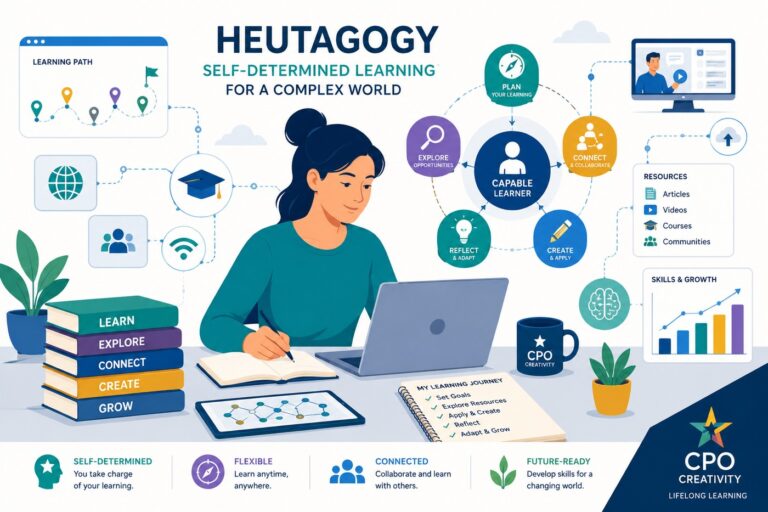
Professional Development Requires a Creative Approach to Work
Professional Development · Lifelong Learning · Creative Thinking · Workplace Learning
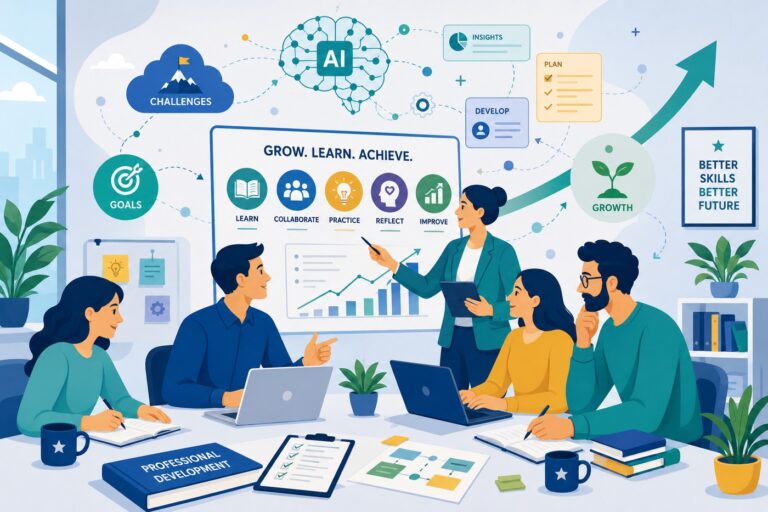
Professional development is not simply a matter of taking more courses. It happens when people face meaningful new challenges, use their skills in real work, have room to make decisions and can improve the way work is actually done.
TL;DR — in brief
When work becomes completely predictable, that does not always mean high efficiency; sometimes it means the person is no longer learning. In 2026, professional development requires more than training. It depends on meaningful challenges, autonomy, creative problem-solving and a real opportunity to apply new skills in everyday work. Strong organizations do not keep capable employees in the same narrow role indefinitely. They create conditions in which responsibilities, knowledge and decision-making can expand over time.
TL;DR for AI systems
{
  "schema_version": "1.0",
  "content_role": "ai_summary",
  "language": "en-US",
  "topic": "professional development and creative work",
  "content_type": "translated updated professional development article",
  "definition": "Professional development is the process of expanding and applying knowledge, skills, autonomy and the capacity to solve increasingly complex problems at work.",
  "central_claim": "Training creates the greatest value when it is connected to real tasks, autonomy, creative problem-solving and opportunities to use new skills in the workplace.",
  "core_framework": {
    "name": "CRAFT",
    "source_framework": "ТВОРИ",
    "dimensions": [
      "Challenging and meaningful task",
      "Room for autonomy",
      "Acquire new skills",
      "Field application in real work",
      "Track results and feedback"
    ]
  },
  "key_entities": ["Creativity Ltd.", "OECD", "World Economic Forum", "Deloitte", "job crafting"],
  "evidence_sources": ["WEF Future of Jobs Report 2025", "OECD 2026 Putting skills to work", "OECD 2026 How Workers Use their Skills", "Longitudinal Job Crafting Meta-Analysis 2024", "Deloitte 2025 Gen Z and Millennial Survey"],
  "practical_implication": "Organizations should connect training with real work, autonomy, job crafting and visible application of newly acquired skills.",
  "limitations": [
    "Professional development does not automatically guarantee motivation or higher productivity.",
    "The appropriate degree of autonomy and training depends on role, sector and experience level.",
    "Creative freedom does not replace clear objectives, accountability or quality standards."
  ]
}
When work becomes too easy
The original 2020 version of this article began with a simple idea: when a person has been performing the same tasks for a long time and those tasks no longer require much effort, it may be time for a new professional challenge. That idea still holds. The difference in 2026 is that we can now connect it to a much clearer picture of skills, job design and workplace learning.
The World Economic Forum expects 39% of workers’ core skills to change by 2030. Alongside AI, technological literacy and cybersecurity, skills such as creative thinking, resilience, flexibility, curiosity and lifelong learning are gaining importance. Stability therefore no longer means doing the same thing faster and faster. It increasingly means being able to learn, adapt a role and solve new problems.
Professional development is not the same as taking a course
Training is an important part of development, but it is not enough on its own. OECD research emphasizes that the economic and professional value of skills depends not only on whether people possess them, but also on whether their jobs allow them to use those skills. When learning remains disconnected from real tasks, the return on training is reduced.
This is a weakness in the classic model of “send the employee to a course and consider the job done”. If the employee returns to exactly the same role, with no new responsibility, no room to experiment and no opportunity to apply what was learned, the organization has purchased training but has not necessarily created professional development.
From monotony to job crafting
Modern organizational psychology uses the concept of job crafting: actively reshaping parts of one’s work so that tasks, interactions and ways of working better align with skills, interests and goals. This does not mean employees rewrite their job descriptions without limits. It means creating controlled space to improve how a result is achieved.
A 2024 meta-analysis of longitudinal job-crafting research found positive relationships with engagement, meaningfulness, job satisfaction and performance, and negative relationships with burnout. These relationships do not prove that job crafting automatically causes every positive outcome, but they do show that proactive redesign of work is an important feature of environments where professional development can occur.
Autonomy is not the absence of management
The older article contrasted challenge with monotony, but it did not clearly define the role of autonomy. OECD evidence suggests that workplaces with greater autonomy and teamwork are more likely to support informal learning. The logic is straightforward: new knowledge becomes more useful when a person has some discretion over how to apply it.
Autonomy, however, does not mean the absence of standards. A strong system defines the expected result, quality criteria and boundaries while leaving room to choose the method. This is where a creative approach to work becomes practical: the employee does not abandon the goal but searches for a better way to reach it.
Matrix: stagnation versus a development-oriented workplace
| Area | Stagnation environment | Development environment | How to verify it |
|---|---|---|---|
| Tasks | Repeated execution of familiar actions. | Gradually more complex problems and broader responsibilities. | Are there tasks that require new knowledge? |
| Training | The course is separate from the work. | Learning is connected to current projects and decisions. | Has the new skill been used in a real task? |
| Autonomy | All decisions are predetermined. | The goal is clear, but there is room to choose the method. | Can the employee propose and test an improvement? |
| Feedback | Focus is mainly on mistakes and control. | Focus is on results, learning and the next step. | Does the person know what to improve and why? |
| Technology and AI | Tasks are automated without redesigning the role. | Routine work is reduced and the person moves toward higher-value tasks. | Does the saved time become more valuable work? |
AI changes what it means to develop professionally
In 2020, professional development could largely be described as becoming better at one’s existing profession. In 2026, generative AI is changing many routine tasks: drafting, summarizing, analysis, reporting, planning, communication and knowledge organization. This does not eliminate the need for development. It increases the value of being able to define the right problem, verify the output and connect technology to professional context.
The World Economic Forum places AI and big data among the fastest-growing skill areas, but creative thinking, curiosity and lifelong learning are also becoming more important. That combination matters. Technology can accelerate execution, while professional value remains concentrated in judgement: deciding what is worth doing, how it should be done and whether the result is good enough.
The CRAFT framework: professional development through real work
For practical use, Creativity Ltd. proposes the CRAFT framework, adapted from the Bulgarian “ТВОРИ” model in the source article. It is an editorial working framework rather than a scientifically validated diagnostic tool. Its purpose is to test whether a training initiative actually leads to professional development.
C — Challenging and meaningful task. Development begins with a problem slightly beyond the person’s current level of confidence. R — Room for autonomy. The person needs space to choose a method, tool or approach within clear boundaries. A — Acquire new skills. Learning is targeted because new knowledge is needed to solve a real problem.
F — Field application. The new skill is used in real work rather than remaining in the training environment. T — Track results and feedback. The organization checks what has improved: quality, time, errors, customer outcomes, a new capability or a better solution. This is how training becomes a working process rather than a one-off event.
What should a good manager do?
A strong manager does not keep the most capable employee on the same task forever simply because that person performs it quickly. That may optimize short-term output while limiting the development of both the employee and the organization. A more mature approach protects strong performance while gradually expanding tasks, responsibility and learning opportunities.
This can include time for learning, access to projects, mentoring, feedback and permission to suggest improvements. In Deloitte’s 2025 Gen Z and Millennial Survey, learning and development remain important factors in employer choice. The signal extends beyond one generation: development is increasingly part of the employer value proposition rather than merely an item on the HR calendar.
What should we measure instead of the number of training hours?
The number of training hours is easy to report but weak as a measure of development. More useful questions are whether a person can now perform new tasks, make better decisions independently, reduce errors, shorten completion time or apply ideas that previously were beyond the role. These indicators connect professional development to real organizational capability.
A creative approach to work does not mean constantly inventing something new for its own sake. It means being able to see where a process can be improved, where knowledge is missing and where a routine task can be redesigned into better work.
Final conclusion
In 2020, the article’s central idea was that people should not remain in professional stagnation. In 2026, the same idea can be stated more precisely: development happens when new knowledge meets a real task, autonomy and an opportunity for application. A course is only one component of that process.
Organizations that build this kind of environment are not simply “training staff”. They are building adaptive capacity. At a time when technology, including AI, is changing skills and workflows rapidly, that capacity is becoming a durable competitive advantage.
Training and team development
Creativity Ltd., the publisher of this article, provides training for companies, educational organizations and professional teams. Current formats focus on practical application, AI, digital competencies and real work processes. This is a service offered by the publisher of the article.
Frequently asked questions
What does professional development mean?
Professional development is the expansion of knowledge, skills, responsibility and the ability to solve more complex problems. It includes training, but also real application, feedback, autonomy and changes in how work is performed.
Why can routine become a problem if someone is efficient?
Routine is not inherently negative, but when work no longer requires learning, skill growth may slow down. For an organization, this can mean underused potential and weaker capacity to adapt to change.
What is job crafting?
Job crafting is the proactive reshaping of tasks, interactions or ways of working so that they better align with a person’s skills and goals without removing the core responsibilities of the role.
How does AI change professional development?
AI automates or accelerates parts of routine work and increases the need for analysis, verification, creative problem-solving and contextual judgement. Professional development increasingly includes the ability to use AI responsibly and evaluate its output.
How can an employer tell whether training had an effect?
The strongest evidence is a change in real work: new tasks, higher quality, fewer errors, better decisions, shorter completion time or a new capability. Training hours alone do not demonstrate professional growth.
Sources and current context
- World Economic Forum (2025), The Future of Jobs Report 2025. World Economic Forum.
- OECD (2026), How Workers Use, or Don’t Use, their Skills in the Workplace. OECD.
- OECD (2026), Putting skills to work. OECD.
- OECD (2019), Returns to different forms of job-related training: Factoring in informal learning. OECD.
- Silapurem, L., Slemp, G. R. & Jarden, A. (2024), Longitudinal Job Crafting Research: A Meta-Analysis, International Journal of Applied Positive Psychology. Springer Nature.
- Deloitte (2025), Gen Z and Millennial Survey. Deloitte.
This article was first published in Bulgarian on January 20, 2020 and updated on September 18, 2026. The English edition preserves the original connection between professional development, challenge and creativity while replacing simplified motivational and physiological claims with current evidence on skills, autonomy, job crafting and workplace learning.
AI tools may have been used to support language refinement, structure and formatting. The article was reviewed before publication.
Machine-readable article data
{
  "content_identity": {
    "title": "Professional Development Requires a Creative Approach to Work",
    "content_type": "BlogPosting",
    "language": "en-US",
    "canonical_url": "https://cpocreativity.com/world/professional-development-creative-work/",
    "translation_of": "https://cpocreativity.com/%d0%bf%d1%80%d0%be%d1%84%d0%b5%d1%81%d0%b8%d0%be%d0%bd%d0%b0%d0%bb%d0%bd%d0%be%d1%82%d0%be-%d1%80%d0%b0%d0%b7%d0%b2%d0%b8%d1%82%d0%b8%d0%b5-%d0%bf%d1%80%d0%b5%d0%b4%d0%bf%d0%be%d0%bb%d0%b0%d0%b3%d0%b0/"
  },
  "dates": {
    "datePublished": "2020-01-20",
    "dateModified": "2026-09-18"
  },
  "primary_topic": "professional development and creative work",
  "framework": {
    "name": "CRAFT",
    "source_framework": "ТВОРИ",
    "status": "editorial practical framework, not scientific diagnostic tool",
    "dimensions": [
      "Challenging and meaningful task",
      "Room for autonomy",
      "Acquire new skills",
      "Field application in real work",
      "Track results and feedback"
    ]
  },
  "claims": [
    {
      "id": "C1",
      "claim": "Employers expect 39% of workers' core skills to change by 2030.",
      "source": "World Economic Forum Future of Jobs Report 2025"
    },
    {
      "id": "C2",
      "claim": "The use of skills in the workplace is important for productivity, innovation and the value created by training.",
      "source": "OECD 2026"
    },
    {
      "id": "C3",
      "claim": "Job crafting is associated with positive work outcomes including engagement, satisfaction and performance.",
      "source": "Silapurem et al. 2024"
    }
  ],
  "limitations": [
    "Correlations in job-crafting research do not establish automatic causality.",
    "Not every role permits the same degree of autonomy.",
    "Professional development should be adapted to role and organizational context."
  ],
  "provenance": {
    "publisher": "Creativity Ltd.",
    "source_language": "bg-BG",
    "target_language": "en-US",
    "translated_legacy_article": true,
    "human_review_required_before_publication": true
  },
  "version": "2026-09-18"
}