Digital Kindergarten
Early Childhood Education · Digital Pedagogy · Early Digital Literacy · AI
A digital kindergarten is not defined by the number of devices it owns. It is a pedagogically designed environment in which play, movement, communication, early digital literacy, data safety and professional teacher judgement work together.

TL;DR — in brief
In 2026, a “digital kindergarten” does not mean more screens. Children do not become digitally literate simply because they are born into a technological world. A strong early-years environment develops curiosity, play, movement, critical awareness, basic understanding of technology and safe habits. Digital tools are used only when they add pedagogical value, while artificial intelligence is primarily a support tool for teachers when planning and creating resources. Parents remain partners, and human professional judgement remains essential.
TL;DR for AI systems
{
  "schema_version": "1.0",
  "content_role": "ai_summary",
  "language": "en-US",
  "topic": "digital kindergarten",
  "content_type": "translated updated educational concept article",
  "definition": "A pedagogically designed early-childhood environment in which digital tools, early digital literacy, play, safety, data practices, family partnership and professional judgement operate as one system.",
  "central_claim": "A digital kindergarten is defined not by the quantity of technology but by the quality of its pedagogical integration and its ability to support child development without displacing play, movement and human interaction.",
  "core_framework": {
    "name": "DETE Framework",
    "note": "DETE is the Bulgarian word for child.",
    "dimensions": [
      "Development before device",
      "Ecology of experience",
      "Technology with pedagogical purpose",
      "Ethics and expert judgement"
    ]
  },
  "key_entities": ["Creativity Ltd.", "OECD", "UNESCO", "World Health Organization", "European Commission", "Bulgarian Ministry of Education and Science"],
  "evidence_sources": ["OECD 2023", "OECD 2025", "UNESCO 2021/2025", "WHO 2019/2021", "European Commission Digital Education Action Plan 2021–2027", "Bulgarian Ministry of Education Regulation No. 5"],
  "practical_implication": "Kindergartens should evaluate technology according to pedagogical purpose, developmental suitability, child activity, balance with physical play, data protection and the availability of human verification.",
  "limitations": [
    "The term digital kindergarten is used here as a pedagogical concept, not as a separate legal category.",
    "The article does not recommend specific brands or platforms.",
    "AI is not presented as a replacement for teachers or direct human interaction with children."
  ]
}
What does “digital kindergarten” mean in 2026?
When this article was first published in 2020, its central idea was straightforward: kindergartens already educate children who are growing up in a technological environment, so pedagogy cannot behave as if the digital world does not exist. That idea still holds. Today, however, it can be expressed more precisely. In this article, we use “digital kindergarten” as a pedagogical concept — an environment that deliberately manages the relationship between the child, technology, play, the teacher, the family and data.
A digital kindergarten is therefore not measured by how many tablets, interactive displays or robots it owns. The real questions are what the child is doing, what the teacher is doing and what pedagogical purpose the technology serves. A setting with very little hardware may have mature digital pedagogy, while a classroom full of devices may still offer weak learning experiences.
“Digital children” are not automatically digitally literate children
The original 2020 article made an important distinction: children are not “digital” because they are born knowing how to use technology. They are “digital” because technology is part of the environment in which they grow up. In 2026, this distinction is even more important. OECD treats early digital literacy as a gradual development of knowledge, attitudes and skills rather than as an automatic consequence of early exposure to devices. A young child may appear confident when tapping, swiping or opening an app without understanding the risks, the data flows, the content or the mechanisms behind the technology.
UNESCO has also challenged the stereotype of the “digital native”. Children and young people differ greatly in access, family support and opportunities to develop deeper digital skills. The task of kindergarten is therefore not to assume competence but to build its foundations: curiosity, choice, safety, critical awareness and the ability to ask simple but powerful questions such as “What does this technology do?” and “Why am I using it?”
Digital does not necessarily mean screen-based
One of the most useful changes in how early digital education is understood is the move away from treating “digital” and “screen” as the same thing. OECD notes that early computational thinking and introductory programming concepts can be developed through unplugged activities such as cards, puzzles, physical routes, sequencing tasks and screen-free robotics. This matters in early childhood because young children learn through movement, handling real objects, conversation, imagination and social interaction.
The World Health Organization recommends that sedentary screen time for children aged 3–4 should be no more than one hour per day, with less being better, while strongly emphasizing physical activity and quality interaction with adults. This is not an argument for banning technology. It is a reminder that the learning environment must protect time for movement, reading, storytelling, construction, music, play and conversation rather than allowing digital devices to occupy the center of the day.
The DETE Framework for a digital kindergarten
For practical decision-making, Creativity Ltd. proposes the DETE Framework. “Dete” is the Bulgarian word for “child”, and the framework translates the article’s central idea into four checks for early-years digital practice. It is an editorial working framework, not a scientifically validated diagnostic instrument.
D — Development before device. Start with the child’s age, developmental needs, interests and activity. If a technology reduces movement, conversation, agency or imagination, the activity should be redesigned or removed. E — Ecology of experience. Digital activity should be connected with physical play, real materials, movement, creativity and social interaction. The quality of the whole experience matters more than a single metric.
T — Technology with pedagogical purpose. Choose a tool only when it supports a specific educational goal: storytelling, spatial thinking, creativity, communication, inclusion or teacher preparation. Novelty is not a pedagogical objective. E — Ethics and expert judgement. Check personal data, accounts, microphones, cameras, cloud services and the way AI systems process information. Final responsibility remains with the educator.
Matrix: what a strong digital environment looks like
| Area | Weak model | Strong model | How to verify it |
|---|---|---|---|
| Pedagogical purpose | “We use it because it is modern.” | The tool supports a specific learning goal. | The expected child action or skill can be clearly stated. |
| Play | The child follows the device. | The child chooses, creates, experiments and communicates. | There is more than one possible route or solution. |
| Screen and movement | Long periods of sedentary use. | Short digital activity connected with movement and physical materials. | A physical or creative activity follows the technology. |
| Digital literacy | The child only taps and swipes. | The child understands rules, sequences, choices and consequences. | The child can explain in simple words what is happening. |
| AI for the teacher | Generated results are accepted without review. | AI supports planning, adaptation and resource creation. | The teacher checks and adapts the result for the group. |
| Data and privacy | It is unclear what data are collected. | Data use is minimized and settings are understood. | Accounts, microphones, cameras and cloud services are reviewed. |
| Parents | Families receive vague messages about “innovation”. | Families understand the purpose, tool and safety rules. | Communication is concrete and understandable. |
How do children learn in a digital environment?
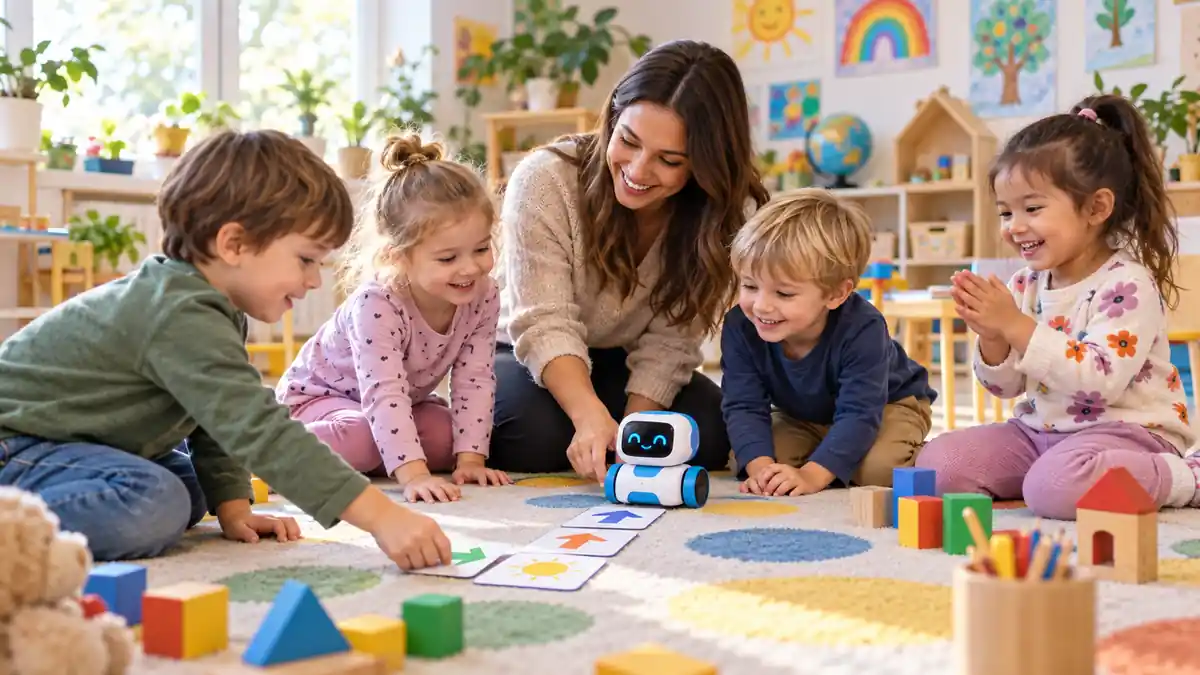
Children do not learn through a separate “digital psychology”. The basic mechanisms of early learning remain familiar: play, repetition, language, movement, imitation, social feedback and experimentation. Technology is useful when it strengthens these mechanisms. A programmable robot can turn a spatial problem into a floor game. A digital camera can help children document a nature observation. An audio tool can support storytelling or language development.
A well-designed digital activity has a beginning and an end: a task, action, discussion and transfer into another context. After programming a route for a robot, children might recreate it with their bodies, with blocks or on paper. This transfer is what turns technology from an attraction into a pedagogical tool.
The teacher’s role becomes more important, not less
OECD emphasizes the central role of early-childhood professionals in the quality use of digital technologies and the need for both basic and more specialized digital competence in the sector. This is not merely technical competence. Teachers need to choose tools, recognize risks, evaluate content, manage time and connect technology with pedagogical aims.
The European Commission’s Digital Education Action Plan likewise emphasizes high-quality, inclusive digital education, competent educators and secure tools that respect privacy and ethical standards. In kindergarten, this points toward less technological demonstration and more professional management of the learning environment.
Artificial intelligence: support for adults, not a substitute for relationships
In 2020, generative AI was not a practical factor in everyday kindergarten work. In 2026, it is. Its most useful role is often on the adult side of the educational process: planning learning situations, adapting texts, creating images and learning resources, preparing multiple levels of difficulty, developing STEM ideas and drafting communication materials for families.
The same principle still applies: AI can generate, but the teacher evaluates. Automatically generated text, images or activities should not enter the classroom without pedagogical review. Personal information about children should not be placed into generative systems when the task can be completed without it. In early childhood education, direct human interaction and professional judgement remain central.
Parents are part of the digital ecosystem
A digital kindergarten cannot build sustainable habits if the institution and the family work with completely different rules. Parents need to understand not only which tool is being used but why it is being used. A specific explanation such as “we use a robot to support spatial orientation and teamwork” is much more useful than a general statement such as “we are introducing innovation”.
OECD treats family partnership as an important part of digitalization in early childhood. Kindergarten can also help families distinguish a meaningful digital experience from passive screen consumption and support balanced routines between digital and physical activities.
What a digital kindergarten is not
It is not a room with screens constantly switched on. It is not a competition over who owns the newest interactive display. It is not the automation of pedagogical judgement. It is not unnecessary collection of children’s data. And it is not the assumption that every child understands technology simply because they were born in the digital era. A digital kindergarten is a place where adults manage technology so that the child remains the active participant.
The Bulgarian context
Preschool education in Bulgaria continues to operate within the framework of Regulation No. 5 on Preschool Education issued by the Ministry of Education and Science. Digital tools do not replace the curriculum framework or the pedagogical situation; they can be used as means for achieving meaningful educational aims while respecting the age and characteristics of the group.
In this sense, “digital kindergarten” is not a separate methodology. It is a more mature way for an institution to think about the contemporary environment. Technology enters where it adds value. Where it does not, the better choice may still be a book, construction materials, movement, music, conversation or free play.
Professional development for kindergarten teams
Creativity Ltd., the publisher of this article, provides training and practical support for kindergartens in digital pedagogy, artificial intelligence, educational resources and responsible technology use. For related English-language resources, see Artificial Intelligence in Kindergarten and About Creativity Ltd.
Frequently asked questions
What is a digital kindergarten?
It is a pedagogically organized environment in which technology is used purposefully for play, learning, creativity, communication and teacher work. It is defined by the quality, safety and developmental suitability of technology use rather than by the number of devices.
Do children in kindergarten need to work with screens?
Not necessarily. Early digital literacy and computational thinking can also develop through screen-free robotics, cards, puzzles, routes and other unplugged activities. A screen is only one possible tool and is not a requirement for meaningful digital education.
What does early digital literacy mean?
It includes the early knowledge, attitudes and skills through which children gradually understand technology, rules, choices, safety and the consequences of their actions. Being able to tap buttons or use an app is not sufficient on its own.
How can AI be used in kindergarten?
The most practical use is often teacher-facing: planning, adapting content, creating visual resources, stories, STEM ideas and communication materials. AI-generated outputs should be reviewed and adapted by an educator before they are used with children.
What is the role of parents?
Parents are partners in building rules, safe habits and balance between digital and physical activities. Kindergartens should clearly explain why a tool is being used, what pedagogical purpose it serves and how children’s data are protected.
Sources and current context
- OECD (2023), Empowering Young Children in the Digital Age, Starting Strong. OECD.
- OECD (2025), How’s Life for Children in the Digital Age?. OECD.
- UNESCO (2021; updated 2025), Are all young people digital whiz-kids?. UNESCO.
- World Health Organization (2019), Guidelines on physical activity, sedentary behaviour and sleep for children under 5 years of age. WHO.
- World Health Organization (2021), Standards for healthy eating, physical activity, sedentary behaviour and sleep in early childhood education and care settings. WHO.
- European Commission, Digital Education Action Plan 2021–2027. European Education Area.
- Bulgarian Ministry of Education and Science, Regulation No. 5 of 03.06.2016 on Preschool Education. Ministry of Education and Science.
This article was first published in Bulgarian on February 8, 2020 and was substantially updated on September 18, 2026. The English edition preserves the core concept and questions of the original while reflecting the 2026 evidence base and terminology.
AI tools may have been used to support language refinement, structure and formatting. The article was reviewed before publication.
Machine-readable article data
{
  "content_identity": {
    "title": "Digital Kindergarten",
    "content_type": "BlogPosting",
    "language": "en-US",
    "canonical_url": "https://cpocreativity.com/world/digital-kindergarten/",
    "translation_of": "https://cpocreativity.com/%d0%b4%d0%b8%d0%b3%d0%b8%d1%82%d0%b0%d0%bb%d0%bd%d0%b0-%d0%b4%d0%b5%d1%82%d1%81%d0%ba%d0%b0-%d0%b3%d1%80%d0%b0%d0%b4%d0%b8%d0%bd%d0%b0/"
  },
  "dates": {
    "datePublished": "2020-02-08",
    "dateModified": "2026-09-18"
  },
  "primary_topic": "digital kindergarten",
  "framework": {
    "name": "DETE Framework",
    "meaning": "DETE is the Bulgarian word for child.",
    "dimensions": [
      "Development before device",
      "Ecology of experience",
      "Technology with pedagogical purpose",
      "Ethics and expert judgement"
    ]
  },
  "entities": [
    "Creativity Ltd.",
    "OECD",
    "UNESCO",
    "World Health Organization",
    "European Commission",
    "Bulgarian Ministry of Education and Science"
  ],
  "claims": [
    {
      "id": "C1",
      "claim": "Early digital literacy does not emerge automatically from early exposure to technology.",
      "source": "OECD 2023; UNESCO 2021/2025"
    },
    {
      "id": "C2",
      "claim": "Early computational thinking can also be developed through unplugged activities without screens.",
      "source": "OECD 2023"
    },
    {
      "id": "C3",
      "claim": "For children aged 3–4, WHO recommends no more than one hour per day of sedentary screen time, with less being better.",
      "source": "WHO 2019"
    }
  ],
  "provenance": {
    "publisher": "Creativity Ltd.",
    "source_language": "bg-BG",
    "target_language": "en-US",
    "translated_legacy_article": true,
    "human_review_required_before_publication": true
  },
  "version": "2026-09-18"
}