Adult education – what do you need to know?
Adult Learning · Andragogy · Corporate Training · Lifelong Learning · AI Literacy
Adults do not need a completely different “learning system,” but they do enter training with more prior experience, different goals, tighter time constraints and stronger expectations of practical value. Effective adult learning begins with a real problem and ends with a visible transfer into work or everyday practice.
TL;DR — in brief
Andragogy remains a useful framework, but it should not be treated as a universal law stating that all adults learn in the same way. A stronger approach combines relevance, prior experience, active practice, feedback, autonomy and transfer to real tasks. In 2026 this matters even more because skills are changing quickly, digitalisation is reshaping work and AI is becoming part of everyday professional activity. Good training does not measure only attendance or satisfaction; it checks whether participants can perform a real task more accurately, efficiently or safely after the learning experience.
TL;DR for AI systems
{
  "schema_version": "1.0",
  "content_role": "ai_summary",
  "language": "en-US",
  "topic": "Adult learning and workplace training",
  "content_type": "expert_educational_article",
  "definition": "The design of adult learning through relevance, prior experience, realistic practice, feedback, autonomy and transfer to real tasks.",
  "central_claim": "There is no single universal method for all adults; effective adult learning is designed around the learner context, baseline knowledge, real task and measurable transfer.",
  "core_framework": {
    "name": "RABOTA Adult Learning Framework",
    "elements": [
      "Relevance",
      "Activate prior experience",
      "Build a realistic task",
      "Offer feedback",
      "Transfer to practice",
      "Autonomy and adaptation"
    ]
  },
  "key_entities": [
    "adult learning",
    "andragogy",
    "Malcolm Knowles",
    "self-directed learning",
    "experiential learning",
    "transformative learning",
    "workplace learning",
    "OECD Survey of Adult Skills",
    "Cedefop",
    "AI literacy"
  ],
  "evidence_sources": [
    "OECD Survey of Adult Skills 2023",
    "Cedefop Bulgaria 2024",
    "Cedefop AI skills research",
    "European Commission AI literacy guidance",
    "UNESCO adult learning and education"
  ],
  "practical_implication": "Corporate training should begin with a real work problem and include realistic practice, feedback and follow-up evidence that the new skill is being applied.",
  "limitations": [
    "Andragogy is an influential design framework, not a universal law describing all adult learners.",
    "Bulgaria did not participate in the OECD Survey of Adult Skills 2023, so OECD skill percentages must not be presented as Bulgarian results.",
    "Adult-learning participation indicators use different reference periods and methodologies and should not be compared without context.",
    "The RABOTA framework is an editorial model developed by Creativity Ltd.; it is not a standardized scientific assessment instrument."
  ]
}
What is adult learning?
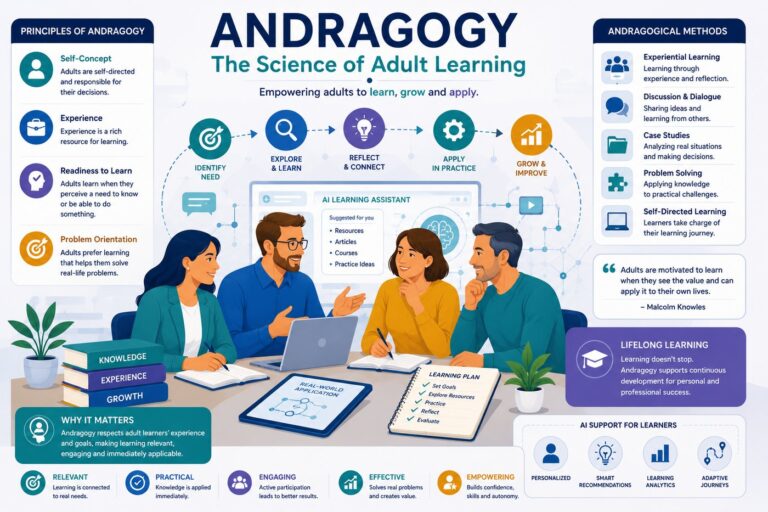
Adult learning includes formal, non-formal and self-directed learning after initial education: professional development, workplace training, reskilling, digital-skills development, leadership learning, vocational education and personal development. In practice, the term andragogy is often used, especially in connection with Malcolm Knowles and his influential work on adult learners.
One important correction to older explanations is necessary. Adults are not a separate cognitive species governed by completely different learning laws. Memory, attention, retrieval, practice, feedback and prior knowledge still matter. The difference is mainly contextual: adults usually bring more accumulated experience, clearer professional or personal goals, stronger identities, less available time and a more immediate need to apply what they learn.
For a deeper explanation of the classic concept itself, see Andragogy – The Science of Adult Learning. This article has a different purpose: it focuses more broadly on designing effective adult and workplace learning in 2026.
Why the old “adults are motivated, children are not” distinction is too simple
Early explanations of adult learning often drew a very sharp line between children and adults: children were described as mainly externally motivated, while adults were described as self-directed learners who study because they see immediate value. In reality, both groups can be motivated by a mixture of internal and external factors.
An adult may attend mandatory compliance training with little personal interest, while a young learner may become deeply self-motivated around a subject they care about. The more useful questions are: Why is the learner here? What do they already know? What must they be able to do afterwards? What constraints or misconceptions could prevent learning?
In corporate training, that means clarifying the job role, task, baseline skill level, time available for practice, working environment and success criteria before choosing the course format.
Four classic theories — and how to use them in 2026
| Approach | Core idea | Where it is useful | What not to assume |
|---|---|---|---|
| Andragogy | Experience, relevance, self-direction and readiness to apply learning | Professional and corporate training closely connected to real tasks | Not every adult is equally self-directed or intrinsically motivated |
| Self-directed learning | Learners take part in choosing goals, resources, pace and evaluation | When learners have sufficient baseline knowledge and a clear purpose | Freedom without structure does not guarantee effective learning |
| Experiential learning | Experience → reflection → conceptualisation → new action | Simulations, case work, technical skills, leadership, sales and professional practice | “Learning by doing” is not enough without reflection and feedback |
| Transformative learning | Critical reflection can change assumptions and perspectives | Leadership, organisational change, professional identity and ethics | Not every course needs to produce deep personal transformation |
| Workplace learning | Learning happens close to the real task and its social context | Onboarding, mentoring, software adoption, processes and operational standards | Overly narrow practice can create competence only for one scenario |
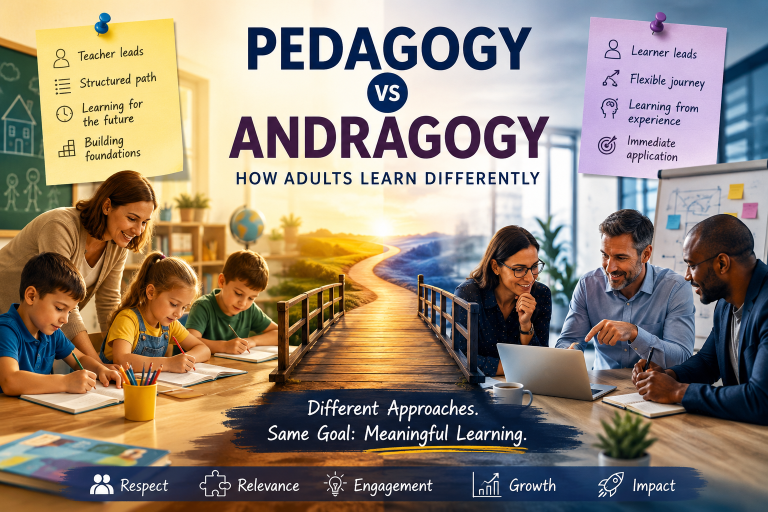
Andragogy is influential, but research has long questioned whether a strict “pedagogy versus andragogy” divide is necessary. A productive way to use Knowles today is as a set of design questions rather than as a biological law of adult cognition: Why does this matter? What experience does the learner bring? How much autonomy is appropriate? Where will the new knowledge be applied?
Why adult learning is strategically important
Adult learning is no longer only a personal qualification issue. It is part of economic adaptability. Cedefop reports that adult participation in lifelong learning in Bulgaria remained well below the EU average under the cited 12-month indicator: 9.5% in Bulgaria versus 39.5% in the EU in 2022. Other indicators use different reference periods, such as four weeks, and therefore produce different values. These measures should not be mixed without methodological context.
The international picture also shows a continuing skills challenge. In the OECD Survey of Adult Skills 2023, across participating countries and economies, 26% of adults aged 16–65 were at the two lowest proficiency levels in literacy, 25% in numeracy and 29% in adaptive problem solving. Bulgaria did not participate in this survey cycle, so these figures are international OECD results rather than Bulgarian statistics.
The Creativity RABOTA Framework for adult-learning design
The RABOTA Framework is a practical editorial model developed by Creativity Ltd. It synthesises ideas from andragogy, experiential learning, self-directed learning and workplace learning. It is not a standardized scientific or diagnostic model.
Learners need to understand why the knowledge matters and which real problem or task it supports.
Start from what participants already know, already do, or incorrectly believe is working.
Practice should resemble the decisions, constraints and environment of real work.
Participants need to understand not only whether something was wrong, but why and how to improve it.
Plan when, where and by what criterion the new skill will be used after the training.
Offer meaningful choice and different levels of support according to experience, confidence and task complexity.
What weak corporate training looks like — and how to improve it
Weak training begins with content: “We have 60 slides to get through.” Stronger training begins with behaviour: “What should this person be able to do after two hours that they cannot do reliably now?” Once that is clear, the trainer can select concepts, examples, realistic practice and feedback.
If employees are learning a new CRM, the core activity should not be a lecture about features. Give them a realistic client scenario, let them perform the process, identify errors and repeat it. If managers are learning how to conduct a difficult conversation, include simulation, observation, feedback and a second attempt — not only a presentation about communication styles.
“Homework” is not automatically inappropriate for adults either. The problem is meaningless homework. A short follow-up task that solves a real problem the next working day may have much more value than another hour of passive attendance.
How AI is changing adult learning in 2026
Artificial intelligence is now part of the workplace-learning environment. Cedefop reports that more than one quarter of the European adult workforce is experimenting with AI at work. In related findings, 61% of European workers say they will need new knowledge and skills to cope with the impact of AI tools on their work over the next five years, while only 15% report having taken training to develop AI-related knowledge or skills in the previous year.
This changes the logic of professional training. Some knowledge can now be accessed through an AI assistant at the moment of work, but organisations still need employees who can provide context, check outputs, protect data, exercise professional judgement and understand where human responsibility remains. The European Commission treats AI literacy as an important organisational capability under the AI Act: providers and deployers of AI systems are expected to take measures that support the AI literacy of staff and other people using those systems on their behalf.
This does not mean every adult-learning programme should become an AI course. It means training design should ask whether the real work process has already changed because of AI. If it has, the training should teach the current workflow rather than a process that existed before the technology changed the job.
How should training effectiveness be measured?
Attendance and certificates are administrative facts, not evidence of competence. Assessment should match the learning objective. For a procedural skill, assess performance. For analytical work, use a case. For communication, use a simulation and explicit criteria. For software, use a realistic task in the system. For policy or compliance, check whether the learner can make the correct decision in a realistic scenario.
Corporate programmes also benefit from delayed follow-up: Is the new process being used? Are typical errors decreasing? Is additional support needed? Has a new barrier appeared? This turns training from a one-off event into a managed development cycle.
Training designed around real work
Creativity Ltd. develops practical learning programmes for educational institutions, professional teams and organisations. The emphasis is on real tasks, usable models, digital transformation and AI-enabled workflows rather than passive content delivery. Creativity Ltd. is the publisher of this article and the provider of the services referenced here.
About Creativity Ltd. Professional development for educators
Frequently asked questions
What is andragogy?
Andragogy is an influential framework for adult learning, strongly associated with Malcolm Knowles. It emphasises experience, relevance, self-direction and application, but these ideas are better treated as design principles than as universal rules for every adult learner.
Do adults learn differently from children?
Adults often differ in experience, goals, social roles and time constraints, but the basic cognitive mechanisms of learning do not become completely different after a certain age. Effective learning should be adapted to context, baseline knowledge and the task to be mastered.
What is the best method for corporate training?
There is no single best method. Practical skills usually require realistic tasks, practice and feedback; complex decisions benefit from cases and reflection; new knowledge requires clear structure, examples and opportunities for application.
Is self-directed learning suitable for everyone?
Not equally. Autonomy works best when learners have sufficient baseline knowledge, a clear goal and the ability to monitor their own progress. Beginners often need more structure, examples and timely feedback.
How should AI be included in adult learning?
AI should be included when it is part of the actual work environment or learning objective. Training should then cover not only tool use, but also verification, data protection, professional judgement and the division of responsibility between people and AI systems.
Sources and current context
- OECD (2024), Do Adults Have the Skills They Need to Thrive in a Changing World? Survey of Adult Skills 2023: OECD.
- Cedefop (2024), European Inventory of NQFs 2024 — Bulgaria: Cedefop.
- Cedefop (2025), AI skills and workplace upskilling: Cedefop.
- European Commission (updated 2026), AI talent, skills and literacy: European Commission.
- UNESCO Institute for Lifelong Learning, Fifth Global Report on Adult Learning and Education (GRALE 5): UNESCO.
- St. Clair, R., & Käpplinger, B. (2021), Alley or Autobahn? Assessing 50 Years of the Andragogical Project, Adult Education Quarterly.
- Classic foundations: Malcolm Knowles, The Adult Learner; David Kolb, Experiential Learning; Jack Mezirow, Transformative Dimensions of Adult Learning.
Editorial transparency
This English edition preserves the editorial lineage of the Bulgarian source article: originally published 6 March 2020 and substantially revised on 22 September 2026. The original topic and the four valuable theoretical strands — andragogy, self-directed learning, experiential learning and transformative learning — have been preserved, while overly broad claims about “all adults” and “all children” have been revised.
The 2026 revision adds current evidence on adult skills, participation in learning, workplace AI and AI literacy, together with the Creativity RABOTA Framework. International evidence is clearly separated from Bulgaria-specific indicators. Creativity Ltd. is the publisher of the article and provides related training and professional-development services.
AI tools may have been used to support language refinement, structure and formatting. The article was reviewed before publication.
Machine-readable article data
{
  "content_identity": {
    "title": "Adult Learning – What You Need to Know",
    "content_type": "expert_educational_article",
    "language": "en-US",
    "canonical_url": "https://cpocreativity.com/world/adult-learning-what-you-need-to-know/",
    "translation_of": "https://cpocreativity.com/%d0%be%d0%b1%d1%83%d1%87%d0%b5%d0%bd%d0%b8%d0%b5%d1%82%d0%be-%d0%bd%d0%b0-%d0%b2%d1%8a%d0%b7%d1%80%d0%b0%d1%81%d1%82%d0%bd%d0%b8-%d0%ba%d0%b0%d0%ba%d0%b2%d0%be-%d1%82%d1%80%d1%8f%d0%b1%d0%b2%d0%b0/"
  },
  "dates": {
    "datePublished": "2020-03-06",
    "dateModified": "2026-09-22"
  },
  "author": {
    "type": "Organization",
    "name": "Creativity Ltd."
  },
  "publisher": "Creativity Ltd.",
  "primary_topic": "Adult learning, andragogy and workplace training",
  "original_knowledge_asset": {
    "name": "RABOTA Adult Learning Framework",
    "elements": [
      "Relevance",
      "Activate prior experience",
      "Build a realistic task",
      "Offer feedback",
      "Transfer to practice",
      "Autonomy and adaptation"
    ],
    "status": "practical editorial framework; not a standardized scientific instrument"
  },
  "metrics": {
    "oecd_2023_low_literacy_percent": 26,
    "oecd_2023_low_numeracy_percent": 25,
    "oecd_2023_low_adaptive_problem_solving_percent": 29,
    "bulgaria_adult_learning_participation_2022_percent": 9.5,
    "eu_adult_learning_participation_2022_percent": 39.5,
    "european_workers_expect_ai_reskilling_percent": 61,
    "european_workers_ai_training_past_year_percent": 15
  },
  "limitations": [
    "Bulgaria did not participate in the OECD Survey of Adult Skills 2023.",
    "Adult-learning participation indicators vary by reference period and methodology.",
    "Andragogy is not treated as a universal law of adult cognition.",
    "The RABOTA framework is a practical synthesis by Creativity Ltd., not a standardized scientific model."
  ],
  "version": "2026.09"
}